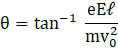
Published by:
CGP EDU Academic Team
Published on: September 12, 2026
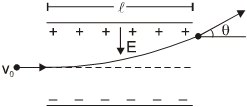
A uniform electric field E = 91 × 10 –6 V/m is created between two parallel, charged plates as shown in figure. An electron enters the field symmetrically between the plates with a speed v 0 = 4 × 10 3 m/s. The length of each plate is λ = 1m. Find the angle of deviation of the path of the electron as it comes out of the field. (Mass of the electron is m = 9.1 × 10 –31 kg and its charge is e = –1.6 × 10 –19 C).
Text Solution
Verified by ExpertsThe correct answer is:
A
Step 1: Calculate the force on the electron.
The force acting on the electron due to the electric field is given by:
$$ F = eE $$
where:
- $e$ = charge of the electron = $1.6 \times 10^{-19} \text{ C}$
- $E$ = electric field = $91 \times 10^{-6} \text{ V/m}$
Substituting the values:
$$ F = (1.6 \times 10^{-19}) (91 \times 10^{-6}) = 1.4576 \times 10^{-24} \text{ N} $$
Step 2: Calculate the acceleration of the electron.
Using Newton’s second law:
$$ F = ma $$
where:
- $m$ = mass of the electron = $9.1 \times 10^{-31} \text{ kg}$
Rearranging gives:
$$ a = \frac{F}{m} = \frac{1.4576 \times 10^{-24}}{9.1 \times 10^{-31}} = 1.6066 \times 10^{6} \text{ m/s}^2 $$
Step 3: Calculate the time the electron spends in the electric field.
The time ($t$) the electron spends in the field while traveling the length of the plates can be calculated as:
$$ t = \frac{\lambda}{v_0} = \frac{1}{4 \times 10^3} = 2.5 \times 10^{-4} \text{ s} $$
Step 4: Calculate the vertical displacement of the electron.
The vertical displacement ($y$) can be calculated using the equation:
$$ y = \frac{1}{2} a t^2 $$
Substituting the known values:
$$ y = \frac{1}{2} (1.6066 \times 10^{6}) (2.5 \times 10^{-4})^2 = 0.0251 \text{ m} $$
Step 5: Calculate the angle of deviation.
The angle ($\theta$) of deviation can be calculated using:
$$ \tan(\theta) = \frac{y}{\lambda} $$
Substituting the known values:
$$ \tan(\theta) = \frac{0.0251}{1} $$
Thus:
$$ \theta = \tan^{-1}(0.0251) \approx 0.0251 ext{ radians} \approx 1.44^{\circ} $$
Therefore, the angle of deviation is approximately $1.44^{\circ}$. The final answer is thus Option A.
The force acting on the electron due to the electric field is given by:
$$ F = eE $$
where:
- $e$ = charge of the electron = $1.6 \times 10^{-19} \text{ C}$
- $E$ = electric field = $91 \times 10^{-6} \text{ V/m}$
Substituting the values:
$$ F = (1.6 \times 10^{-19}) (91 \times 10^{-6}) = 1.4576 \times 10^{-24} \text{ N} $$
Step 2: Calculate the acceleration of the electron.
Using Newton’s second law:
$$ F = ma $$
where:
- $m$ = mass of the electron = $9.1 \times 10^{-31} \text{ kg}$
Rearranging gives:
$$ a = \frac{F}{m} = \frac{1.4576 \times 10^{-24}}{9.1 \times 10^{-31}} = 1.6066 \times 10^{6} \text{ m/s}^2 $$
Step 3: Calculate the time the electron spends in the electric field.
The time ($t$) the electron spends in the field while traveling the length of the plates can be calculated as:
$$ t = \frac{\lambda}{v_0} = \frac{1}{4 \times 10^3} = 2.5 \times 10^{-4} \text{ s} $$
Step 4: Calculate the vertical displacement of the electron.
The vertical displacement ($y$) can be calculated using the equation:
$$ y = \frac{1}{2} a t^2 $$
Substituting the known values:
$$ y = \frac{1}{2} (1.6066 \times 10^{6}) (2.5 \times 10^{-4})^2 = 0.0251 \text{ m} $$
Step 5: Calculate the angle of deviation.
The angle ($\theta$) of deviation can be calculated using:
$$ \tan(\theta) = \frac{y}{\lambda} $$
Substituting the known values:
$$ \tan(\theta) = \frac{0.0251}{1} $$
Thus:
$$ \theta = \tan^{-1}(0.0251) \approx 0.0251 ext{ radians} \approx 1.44^{\circ} $$
Therefore, the angle of deviation is approximately $1.44^{\circ}$. The final answer is thus Option A.
Prepare Smarter with CGP Edu
Get practice questions, solutions, and test series in one place.
Write a Review
Share your experience with this question and solution.
Commentary
Send your comment, doubt, correction, or feedback to admin.
Similar Questions
Explore conceptually related problems
A charge q is placed at the center of the line joining two equal charges Q. The system of the three…
Inside a hollow charged spherical conductor, the potential
Two small spheres each carrying a charge q are placed r meter apart. If one of the spheres is taken…
The electric charge in uniform motion produces
Two charged spheres of radii 10 cm and 15 cm are connected by a thin wire. No current will flow, if…
The electric field inside a spherical shell of uniform surface charge density is