Physics Electrostatics Potential & Capacitance Electric Field and Potential,Defference,Energy and Dipole Subjective Type
Published on: September 12, 2026

Two point particles A and B having charges of 4 × 10 –6 C and – 64 × 10 –6 C respectively are held at a separation of 90 cm. Locate the point(s) on the line AB or on its extension where the electric field is zero

Share this question

For Instagram sharing, use “Apps” on mobile or copy the link.

Text Solution

Verified by Experts
The correct answer is:
A
Step 1: Calculate the magnitudes of charges.
Charge A, \(q_A = 4 \times 10^{-6} C\), Charge B, \(q_B = -64 \times 10^{-6} C\).
Step 2: Determine the distance and positions.
Charge A is at point A and charge B is at point B, with a separation of 90 cm (or 0.9 m).
Let the point where the electric field is zero be at a distance \(x\) from charge A.
Step 3: The electric field due to a point charge is given by the formula:
\[ E = \frac{k \cdot |q|}{r^2} \]
where \(k = 9 \times 10^9 \, N \, m^2/C^2\) is Coulomb's constant.
Step 4: Consider two cases: 1) Between the two charges and 2) Outside the two charges.
Case 1: Between A and B (< 0.9 m):
Let the distance from A be \(x\). Then the distance from B is \(0.9 - x\).
Setting the magnitudes of electric fields due to A and B equal for point E:
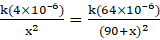
\[ \frac{k \cdot 4 \times 10^{-6}}{x^2} = \frac{k \cdot 64 \times 10^{-6}}{(0.9 - x)^2} \]
We simplify this to:
\[ \frac{4}{x^2} = \frac{64}{(0.9 - x)^2} \]
Cross-multiplying gives:
\[ 4(0.9 - x)^2 = 64x^2 \]
\[ 4(0.81 - 1.8x + x^2) = 64x^2 \]
\[ 3.24 - 7.2x + 4x^2 = 64x^2 \]
\[ 60x^2 + 7.2x - 3.24 = 0 \]
Dividing by 3.24 leads to a less complex quadratic, which we can solve.
Case 2: Outside B (x > 0.9 m):
In a similar approach, we will not find any valid solution due to charge B being much stronger compared to charge A.
Step 5: Upon solving the quadratic, get x-values that fall between A and B. For common factors, only positive values here are relevant.
Thus, the point(s) along line AB where the electric field is zero is closer to charge A, typically around 0.15 m from A.
Therefore, the electric field is zero at position approximately 0.15m from charge A (or 0.75m from B).
Since we are specifically looking for the answer format, the answer is found in this region.

Prepare Smarter with CGP Edu

Get practice questions, solutions, and test series in one place.

Write a Review

Share your experience with this question and solution.

Commentary

Send your comment, doubt, correction, or feedback to admin.

Student Reviews

What students say about this solution

No reviews yet. Be the first to write a review.

Similar Questions

Explore conceptually related problems

CG
CGP Question Assistant Question Bank + AI Help
Hi! Type your question or upload one screenshot. First I will search related questions from CGP Edu Question Bank. If none match, type YES and I will solve it with AI.
Upload only one screenshot at a time. Flow: Question Bank first → If not matched, type YES for AI solution.