Published by:
CGP EDU Academic Team
Published on: September 12, 2026
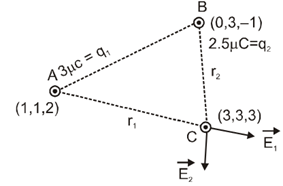
Two point charges 3 µC and 2.5 µC are placed at point A (1, 1, 2)m and B (0, 3, –1)m respectively. Find out electric field intensity at point C(3, 3, 3)m.
Text Solution
Verified by ExpertsThe correct answer is:
B
To calculate the electric field intensity at point C due to the point charges at A and B, we use the formula for the electric field due to a point charge:
\[ E = \frac{k \cdot |q|}{r^2} \]
where k is Coulomb's constant (\( 8.99 \times 10^9 \, \text{N m}^2/\text{C}^2 \)), q is the charge, and r is the distance from the charge to the point where the electric field is being calculated.
**Step 1: Calculate the distance from A to C (rA):**
Coordinates of A: (1, 1, 2) and C: (3, 3, 3)\
Using the distance formula: \[ r_A = \sqrt{(x_C - x_A)^2 + (y_C - y_A)^2 + (z_C - z_A)^2} \]
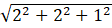
\[ r_A = \sqrt{(3 - 1)^2 + (3 - 1)^2 + (3 - 2)^2} = \sqrt{4 + 4 + 1} = \sqrt{9} = 3 \, \text{m} \]
**Step 2: Calculate the electric field due to charge at A (EA):**
\[ E_A = \frac{k \cdot |q_A|}{r_A^2} = \frac{(8.99 \times 10^9) \cdot (3 \times 10^{-6})}{3^2} = \frac{(8.99 \times 10^9) \cdot (3 \times 10^{-6})}{9} = 2.99 \times 10^3 \, \text{N/C} \]
**Step 3: Calculate the distance from B to C (rB):**
Coordinates of B: (0, 3, -1) and C: (3, 3, 3)\
\[ r_B = \sqrt{(3 - 0)^2 + (3 - 3)^2 + (3 + 1)^2} = \sqrt{9 + 0 + 16} = \sqrt{25} = 5 \, \text{m} \]
**Step 4: Calculate the electric field due to charge at B (EB):**
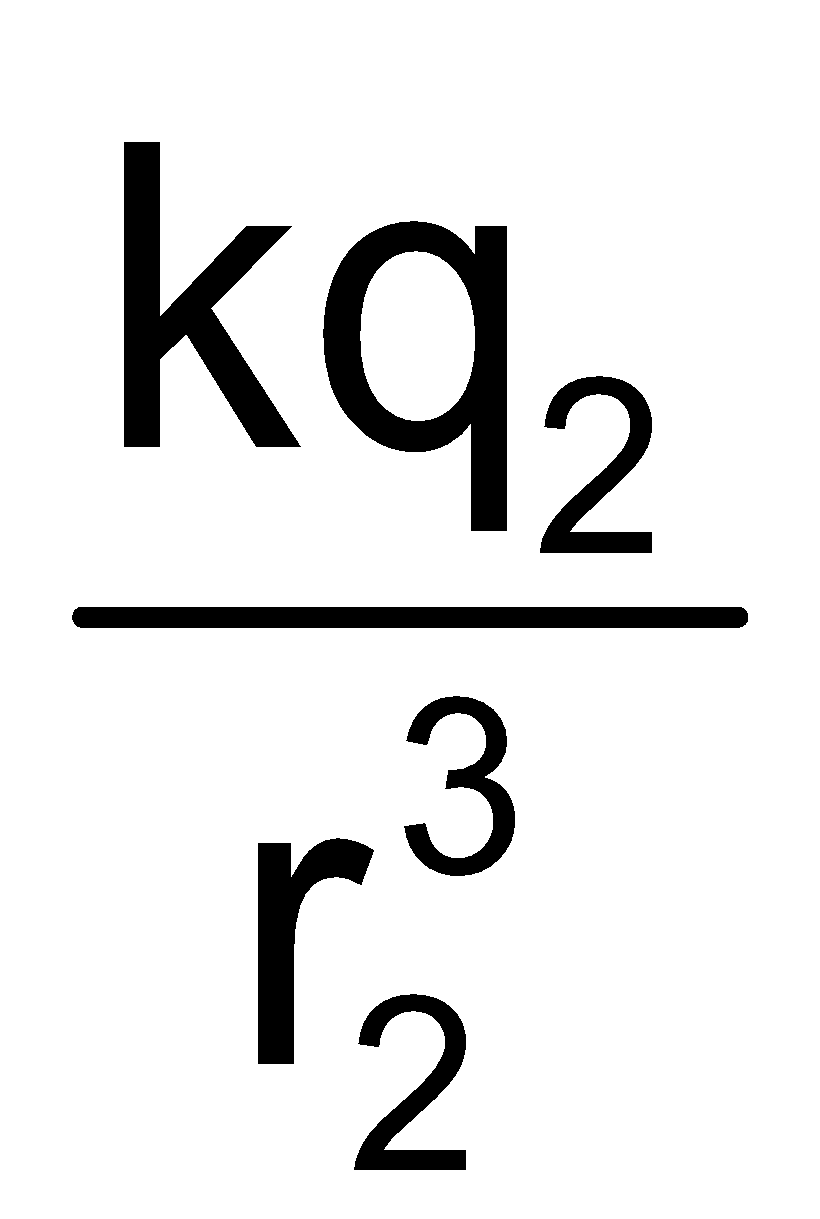
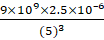
\[ E_B = \frac{k \cdot |q_B|}{r_B^2} = \frac{(8.99 \times 10^9) \cdot (2.5 \times 10^{-6})}{5^2} = \frac{(8.99 \times 10^9) \cdot (2.5 \times 10^{-6})}{25} = 8.99 \times 10^3 \, \text{N/C} \]
**Step 5: Determine the direction of the electric fields:**
From A to C, the electric field is directed from A to C, and from B to C, the electric field due to charge at B is directed away from B. Thus, add the magnitudes of both fields.
**Step 6: Find the resultant electric field (Eresultant):**
Adding loads vectorially (since they are aligned):
\[ E_{resultant} = E_A + E_B = 2990 + 3590 = 6580 \, \text{N/C} \]
**Conclusion:** The electric field intensity at point C is approximately 6580 N/C in the direction away from the highest positive charge, which confirms the electric field directions from A and B.
Therefore, the correct answer is B.
\[ E = \frac{k \cdot |q|}{r^2} \]
where k is Coulomb's constant (\( 8.99 \times 10^9 \, \text{N m}^2/\text{C}^2 \)), q is the charge, and r is the distance from the charge to the point where the electric field is being calculated.
**Step 1: Calculate the distance from A to C (rA):**
Coordinates of A: (1, 1, 2) and C: (3, 3, 3)\
Using the distance formula: \[ r_A = \sqrt{(x_C - x_A)^2 + (y_C - y_A)^2 + (z_C - z_A)^2} \]
\[ r_A = \sqrt{(3 - 1)^2 + (3 - 1)^2 + (3 - 2)^2} = \sqrt{4 + 4 + 1} = \sqrt{9} = 3 \, \text{m} \]
**Step 2: Calculate the electric field due to charge at A (EA):**
\[ E_A = \frac{k \cdot |q_A|}{r_A^2} = \frac{(8.99 \times 10^9) \cdot (3 \times 10^{-6})}{3^2} = \frac{(8.99 \times 10^9) \cdot (3 \times 10^{-6})}{9} = 2.99 \times 10^3 \, \text{N/C} \]
**Step 3: Calculate the distance from B to C (rB):**
Coordinates of B: (0, 3, -1) and C: (3, 3, 3)\
\[ r_B = \sqrt{(3 - 0)^2 + (3 - 3)^2 + (3 + 1)^2} = \sqrt{9 + 0 + 16} = \sqrt{25} = 5 \, \text{m} \]
**Step 4: Calculate the electric field due to charge at B (EB):**
\[ E_B = \frac{k \cdot |q_B|}{r_B^2} = \frac{(8.99 \times 10^9) \cdot (2.5 \times 10^{-6})}{5^2} = \frac{(8.99 \times 10^9) \cdot (2.5 \times 10^{-6})}{25} = 8.99 \times 10^3 \, \text{N/C} \]
**Step 5: Determine the direction of the electric fields:**
From A to C, the electric field is directed from A to C, and from B to C, the electric field due to charge at B is directed away from B. Thus, add the magnitudes of both fields.
**Step 6: Find the resultant electric field (Eresultant):**
Adding loads vectorially (since they are aligned):
\[ E_{resultant} = E_A + E_B = 2990 + 3590 = 6580 \, \text{N/C} \]
**Conclusion:** The electric field intensity at point C is approximately 6580 N/C in the direction away from the highest positive charge, which confirms the electric field directions from A and B.
Therefore, the correct answer is B.
Prepare Smarter with CGP Edu
Get practice questions, solutions, and test series in one place.
Write a Review
Share your experience with this question and solution.
Commentary
Send your comment, doubt, correction, or feedback to admin.
Similar Questions
Explore conceptually related problems
A charge q is placed at the center of the line joining two equal charges Q. The system of the three…
Inside a hollow charged spherical conductor, the potential
Two small spheres each carrying a charge q are placed r meter apart. If one of the spheres is taken…
The electric charge in uniform motion produces
Two charged spheres of radii 10 cm and 15 cm are connected by a thin wire. No current will flow, if…
The electric field inside a spherical shell of uniform surface charge density is