Published by:
CGP EDU Academic Team
Published on: September 12, 2026
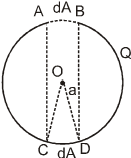
A hollow sphere of radius a carries a total charge Q distributed uniformly over its surface. A small area dA of the sphere is cut off. Find the electric field at the center due to the remaining sphere.
Text Solution
Verified by ExpertsThe correct answer is:
A
Step 1: Understand the problem scenario. We have a hollow sphere of radius 'a' with a uniform charge 'Q' distributed on its surface. When a small area 'dA' is cut off, we need to find the electric field at the center of the remaining part of the sphere.
Step 2: Consider the properties of electric fields for symmetrical charge distributions. A hollow sphere with uniformly distributed charge creates an electric field outside the sphere but has zero electric field inside it, due to symmetry, at any point inside.
Step 3: Analyze the change in electric field after cutting off a small area 'dA'. When we remove a small piece of charge, the symmetry is disturbed but the remaining charge still has a similar symmetrical nature since 'dA' is very small. We focus on the small charge area removed and the remaining charge.
Step 4: The removed charge will produce a field that we need to consider. Let the charge density on the sphere be \( \sigma = \frac{Q}{4\pi a^2} \). The charge on the small area 'dA' is \( dq = \sigma dA = \frac{Q}{4\pi a^2} dA \).
Step 5: The electric field due to the small area 'dA' at the center is a vector pointing away from the area. However, due to symmetry of the remaining surface charge, the contribution of the electric field from the remaining surface at the center is still zero as there is no net charge inside the remaining hollow sphere.
Conclusion: Thus, even after removing a small surface area 'dA', the electric field at the center of the remaining sphere continues to be zero because the contributions from the remaining parts of the sphere effectively cancel out the field due to the removed part.
Therefore, the electric field at the center is zero. Hence, the correct conclusion is:
The electric field at the center of the remaining hollow sphere is \( 0 \).
Step 2: Consider the properties of electric fields for symmetrical charge distributions. A hollow sphere with uniformly distributed charge creates an electric field outside the sphere but has zero electric field inside it, due to symmetry, at any point inside.
Step 3: Analyze the change in electric field after cutting off a small area 'dA'. When we remove a small piece of charge, the symmetry is disturbed but the remaining charge still has a similar symmetrical nature since 'dA' is very small. We focus on the small charge area removed and the remaining charge.
Step 4: The removed charge will produce a field that we need to consider. Let the charge density on the sphere be \( \sigma = \frac{Q}{4\pi a^2} \). The charge on the small area 'dA' is \( dq = \sigma dA = \frac{Q}{4\pi a^2} dA \).
Step 5: The electric field due to the small area 'dA' at the center is a vector pointing away from the area. However, due to symmetry of the remaining surface charge, the contribution of the electric field from the remaining surface at the center is still zero as there is no net charge inside the remaining hollow sphere.
Conclusion: Thus, even after removing a small surface area 'dA', the electric field at the center of the remaining sphere continues to be zero because the contributions from the remaining parts of the sphere effectively cancel out the field due to the removed part.
Therefore, the electric field at the center is zero. Hence, the correct conclusion is:
The electric field at the center of the remaining hollow sphere is \( 0 \).
Prepare Smarter with CGP Edu
Get practice questions, solutions, and test series in one place.
Write a Review
Share your experience with this question and solution.
Commentary
Send your comment, doubt, correction, or feedback to admin.
Similar Questions
Explore conceptually related problems
A charge q is placed at the center of the line joining two equal charges Q. The system of the three…
Inside a hollow charged spherical conductor, the potential
Two small spheres each carrying a charge q are placed r meter apart. If one of the spheres is taken…
The electric charge in uniform motion produces
Two charged spheres of radii 10 cm and 15 cm are connected by a thin wire. No current will flow, if…
The electric field inside a spherical shell of uniform surface charge density is