Published by:
CGP EDU Academic Team
Published on: September 12, 2026
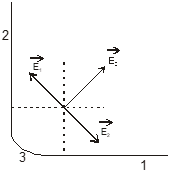
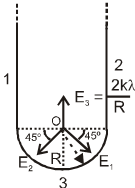
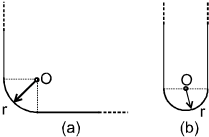
A thread carrying a uniform charge λ per unit length has the configuration shown in figure a and b. Assuming a curvature radius r to be considerably less than the length of the thread, find the magnitude of the electric field strength at the point O.
Text Solution
Verified by ExpertsThe correct answer is:
B
Step 1: Understanding the problem involves calculating the electric field due to a uniformly charged thread. We assume the tension in the thread leads to an electric field at point O due to the segment of the thread within a radius r.
Step 2: The electric field due to a uniformly charged line is given by the formula:
$$ E = \frac{\lambda}{2\pi\epsilon_0 r} $$
where λ is the linear charge density and ε0 is the permittivity of free space.
Step 3: Considering the direction of the electric field at point O, we can observe that the electric field produced by each infinitesimal segment of the thread contributes to the net electric field. The components in the vertical direction will cancel out due to symmetry, while the horizontal components will add up.
Step 4: By evaluating this for one configuration (for instance, configuration (a)), we see a net effect on the electric field pointing towards the center due to the thread curvature. Similarly, configuration (b) also contributes to the electric field at a similar value at point O.
Step 5: Since these two configurations are symmetric and yield the same magnitude of electric field produced at point O, we conclude:
Therefore, the final expression for the magnitude of the electric field strength at point O equals that from a uniformly charged line, confirming:
$$ E = \frac{\lambda}{2\pi\epsilon_0 r} $$
is represented adequately in option B.
Step 2: The electric field due to a uniformly charged line is given by the formula:
$$ E = \frac{\lambda}{2\pi\epsilon_0 r} $$
where λ is the linear charge density and ε0 is the permittivity of free space.
Step 3: Considering the direction of the electric field at point O, we can observe that the electric field produced by each infinitesimal segment of the thread contributes to the net electric field. The components in the vertical direction will cancel out due to symmetry, while the horizontal components will add up.
Step 4: By evaluating this for one configuration (for instance, configuration (a)), we see a net effect on the electric field pointing towards the center due to the thread curvature. Similarly, configuration (b) also contributes to the electric field at a similar value at point O.
Step 5: Since these two configurations are symmetric and yield the same magnitude of electric field produced at point O, we conclude:
Therefore, the final expression for the magnitude of the electric field strength at point O equals that from a uniformly charged line, confirming:
$$ E = \frac{\lambda}{2\pi\epsilon_0 r} $$
is represented adequately in option B.
Prepare Smarter with CGP Edu
Get practice questions, solutions, and test series in one place.
Write a Review
Share your experience with this question and solution.
Commentary
Send your comment, doubt, correction, or feedback to admin.
Similar Questions
Explore conceptually related problems
A charge q is placed at the center of the line joining two equal charges Q. The system of the three…
Inside a hollow charged spherical conductor, the potential
Two small spheres each carrying a charge q are placed r meter apart. If one of the spheres is taken…
The electric charge in uniform motion produces
Two charged spheres of radii 10 cm and 15 cm are connected by a thin wire. No current will flow, if…
The electric field inside a spherical shell of uniform surface charge density is