Published by:
CGP EDU Academic Team
Published on: September 12, 2026
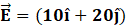
An electric field
N/C exists in the space. If the potential at the origin is taken to be zero, find the potential at (3m, 3m).
Text Solution
Verified by ExpertsThe correct answer is:
A
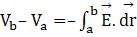
To find the electric potential at a point in an electric field, we can use the following relation:
$$ V = V_0 - \int_{C} \mathbf{E} \cdot d\mathbf{l} $$
where:
- $V$ is the potential at point (3m, 3m),
- $V_0$ is the potential at the origin (0,0), which is given as 0.
- $\mathbf{E}$ is the electric field vector.
- $d\mathbf{l}$ is the differential path element along the path of integration.
Given the electric field:
$$ \mathbf{E} = (10\hat{i} + 20\hat{j}) \text{ N/C} $$
And we need to move from the origin (0, 0) to the point (3m, 3m). We can take a straight-line path for simplicity. The path can be represented parametrically as:
$$(x, y) = (t, t)$$ where $t$ goes from 0 to 3.
Now, the differential path element $d\mathbf{l}$ is:
$$ d\mathbf{l} = (dx, dy) = (dt, dt) = \hat{i} dt + \hat{j} dt = (1\hat{i} + 1\hat{j}) dt $$
Now we calculate the integral:
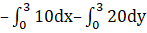
$$ V = 0 - \int_{0}^{3} \mathbf{E} \cdot d\mathbf{l} = -\int_{0}^{3} (10\hat{i} + 20\hat{j}) \cdot (1\hat{i} + 1\hat{j}) dt $$
Calculating the dot product:
$$ \mathbf{E} \cdot d\mathbf{l} = 10(1) + 20(1) = 30 $$
Now we have:
$$ V = -\int_{0}^{3} 30 dt = -30t \bigg|_{0}^{3} = -30(3) + 30(0) = -90 $$
Thus, the electric potential at point (3m, 3m) is V = -90 V.
$$ V = V_0 - \int_{C} \mathbf{E} \cdot d\mathbf{l} $$
where:
- $V$ is the potential at point (3m, 3m),
- $V_0$ is the potential at the origin (0,0), which is given as 0.
- $\mathbf{E}$ is the electric field vector.
- $d\mathbf{l}$ is the differential path element along the path of integration.
Given the electric field:
$$ \mathbf{E} = (10\hat{i} + 20\hat{j}) \text{ N/C} $$
And we need to move from the origin (0, 0) to the point (3m, 3m). We can take a straight-line path for simplicity. The path can be represented parametrically as:
$$(x, y) = (t, t)$$ where $t$ goes from 0 to 3.
Now, the differential path element $d\mathbf{l}$ is:
$$ d\mathbf{l} = (dx, dy) = (dt, dt) = \hat{i} dt + \hat{j} dt = (1\hat{i} + 1\hat{j}) dt $$
Now we calculate the integral:
$$ V = 0 - \int_{0}^{3} \mathbf{E} \cdot d\mathbf{l} = -\int_{0}^{3} (10\hat{i} + 20\hat{j}) \cdot (1\hat{i} + 1\hat{j}) dt $$
Calculating the dot product:
$$ \mathbf{E} \cdot d\mathbf{l} = 10(1) + 20(1) = 30 $$
Now we have:
$$ V = -\int_{0}^{3} 30 dt = -30t \bigg|_{0}^{3} = -30(3) + 30(0) = -90 $$
Thus, the electric potential at point (3m, 3m) is V = -90 V.
Prepare Smarter with CGP Edu
Get practice questions, solutions, and test series in one place.
Write a Review
Share your experience with this question and solution.
Commentary
Send your comment, doubt, correction, or feedback to admin.
Similar Questions
Explore conceptually related problems
A parallel plate capacitor is connected across a 2 V battery and charged. The battery is then disco…
If = 2y + 2x , then find V (x, y, z)
If V = x 2 y + y 2 z then find (x, y, z)
If V = 2r 2 then find out
(i) (1, 0, –2)
(ii)
An electric field exists in space, where B = 20 V/m 2 . Taking the potential at (2 m, 4 m) to be z…
Column I gives a situation in which two dipoles of dipole moment p and are placed at origin. A ci…