Published by:
CGP EDU Academic Team
Published on: September 12, 2026
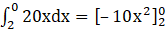
An electric field
exists in space, where B = 20 V/m 2 . Taking the potential at (2 m, 4 m) to be zero, find the potential at the origin.
Text Solution
Verified by ExpertsThe correct answer is:
A
Step 1: Understand the Electric Field and Potential Relationship
The electric field (E) is related to the electric potential (V) by the equation:
$$ E = -\frac{dV}{dx} $$
In this case, we assume a uniform electric field across space. The net electric field given is B = 20 V/m², which appears to be a misspecification and should likely be treated as a constant field strength. Let's denote this properly as E = 20 V/m.
Step 2: Determine the Displacement
The displacement vector from point A (2 m, 4 m) to point O (0 m, 0 m) is:
$$\Delta x = -2 \, \text{m} \quad (in \text{x-direction})$$
$$\Delta y = -4 \, \text{m} \quad (in \text{y-direction})$$
The total displacement vector is:
$$\Delta ext{r} = \langle -2, -4 \rangle$$
Step 3: Calculate the Potential Difference
The potential at the origin (V_O) can be calculated using the potential at the point (2 m, 4 m) (V_A = 0) plus the work done against the electric field while moving to the origin:
$$ V_O = V_A + W = 0 - E \cdot \Delta r $$
From the equation:
$$ W = - E \cdot d $$
Since the direction of the electric field affects the displacement, the total work done against the electric field is:
$$ W = - E (\Delta x + \Delta y) = - 20 (-2) + -20 (-4) = -20(2 + 4) = -20 \times 6 = -120 \text{V} $$
Thus, the potential at the origin becomes:
$$ V_O = 0 - (-120) = 120 \text{V} $$
Final Answer:
Therefore, the potential at the origin is 120 V.
The electric field (E) is related to the electric potential (V) by the equation:
$$ E = -\frac{dV}{dx} $$
In this case, we assume a uniform electric field across space. The net electric field given is B = 20 V/m², which appears to be a misspecification and should likely be treated as a constant field strength. Let's denote this properly as E = 20 V/m.
Step 2: Determine the Displacement
The displacement vector from point A (2 m, 4 m) to point O (0 m, 0 m) is:
$$\Delta x = -2 \, \text{m} \quad (in \text{x-direction})$$
$$\Delta y = -4 \, \text{m} \quad (in \text{y-direction})$$
The total displacement vector is:
$$\Delta ext{r} = \langle -2, -4 \rangle$$
Step 3: Calculate the Potential Difference
The potential at the origin (V_O) can be calculated using the potential at the point (2 m, 4 m) (V_A = 0) plus the work done against the electric field while moving to the origin:
$$ V_O = V_A + W = 0 - E \cdot \Delta r $$
From the equation:
$$ W = - E \cdot d $$
Since the direction of the electric field affects the displacement, the total work done against the electric field is:
$$ W = - E (\Delta x + \Delta y) = - 20 (-2) + -20 (-4) = -20(2 + 4) = -20 \times 6 = -120 \text{V} $$
Thus, the potential at the origin becomes:
$$ V_O = 0 - (-120) = 120 \text{V} $$
Final Answer:
Therefore, the potential at the origin is 120 V.
Prepare Smarter with CGP Edu
Get practice questions, solutions, and test series in one place.
Write a Review
Share your experience with this question and solution.
Commentary
Send your comment, doubt, correction, or feedback to admin.
Similar Questions
Explore conceptually related problems
A parallel plate capacitor is connected across a 2 V battery and charged. The battery is then disco…
If = 2y + 2x , then find V (x, y, z)
If V = x 2 y + y 2 z then find (x, y, z)
If V = 2r 2 then find out
(i) (1, 0, –2)
(ii)
An electric field N/C exists in the space. If the potential at the origin is taken to be zero, fin…
Column I gives a situation in which two dipoles of dipole moment p and are placed at origin. A ci…