Published by:
CGP EDU Academic Team
Published on: September 12, 2026
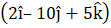
Find out the electric flux through an area 10 m 2 lying in XY plane due to an electric field

.
Text Solution
Verified by ExpertsThe correct answer is:
B
Step 1: Understanding the electric flux
Electric flux, \( \Phi_E \), through a surface is given by the formula:
\[ \Phi_E = \vec{E} \cdot \vec{A} \]
where \( \vec{E} \) is the electric field and \( \vec{A} \) is the area vector.
Step 2: Identifying the area vector
For an area of 10 m2 lying in the XY plane, the area vector \( \vec{A} \) is directed along the Z-axis (k-direction). Therefore, we can express it as:
\[ \vec{A} = 10 \, \hat{k} \] (since area is in the positive k-direction)
Step 3: Calculating the dot product
The given electric field is:
\[ \vec{E} = 2 \, \hat{i} - 10 \, \hat{j} + 5 \, \hat{k} \]
Now, we calculate the dot product \( \vec{E} \cdot \vec{A} \):
\[ \vec{E} \cdot \vec{A} = \left( 2 \, \hat{i} - 10 \, \hat{j} + 5 \, \hat{k} \right) \cdot \left( 10 \, \hat{k} \right) \]
Since both vectors have only the k-component when considering \( \hat{k} \):
\[ \vec{E} \cdot \vec{A} = 0 + 0 + (5)(10) = 50 \]
Step 4: Conclusion
The electric flux through the surface is:
\[ \Phi_E = 50 \, \text{Nm}^2/\text{C} \]
Therefore, the correct answer to the question is option B.
Electric flux, \( \Phi_E \), through a surface is given by the formula:
\[ \Phi_E = \vec{E} \cdot \vec{A} \]
where \( \vec{E} \) is the electric field and \( \vec{A} \) is the area vector.
Step 2: Identifying the area vector
For an area of 10 m2 lying in the XY plane, the area vector \( \vec{A} \) is directed along the Z-axis (k-direction). Therefore, we can express it as:
\[ \vec{A} = 10 \, \hat{k} \] (since area is in the positive k-direction)
Step 3: Calculating the dot product
The given electric field is:
\[ \vec{E} = 2 \, \hat{i} - 10 \, \hat{j} + 5 \, \hat{k} \]
Now, we calculate the dot product \( \vec{E} \cdot \vec{A} \):
\[ \vec{E} \cdot \vec{A} = \left( 2 \, \hat{i} - 10 \, \hat{j} + 5 \, \hat{k} \right) \cdot \left( 10 \, \hat{k} \right) \]
Since both vectors have only the k-component when considering \( \hat{k} \):
\[ \vec{E} \cdot \vec{A} = 0 + 0 + (5)(10) = 50 \]
Step 4: Conclusion
The electric flux through the surface is:
\[ \Phi_E = 50 \, \text{Nm}^2/\text{C} \]
Therefore, the correct answer to the question is option B.
Prepare Smarter with CGP Edu
Get practice questions, solutions, and test series in one place.
Write a Review
Share your experience with this question and solution.
Commentary
Send your comment, doubt, correction, or feedback to admin.
Similar Questions
Explore conceptually related problems
A cylinder of radius R and length L is placed in a uniform electric field E parallel to the cylinde…
Electric field at a point varies as $r_{0}$ for
An electric charge q is placed at the center of a cube of side α. The electric flux on one of its f…
Total electric flux coming out of a unit positive charge put in air is
For a given surface the Gauss's law is stated as $\oint \mathbf{E} \cdot d\mathbf{s} = 0$ . From th…
A cube of side l is placed in a uniform field E, where $\mathbf{E} = \mathbf{E} \hat{i}$ . The net …