Published by:
CGP EDU Academic Team
Published on: September 12, 2026
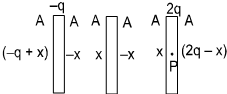
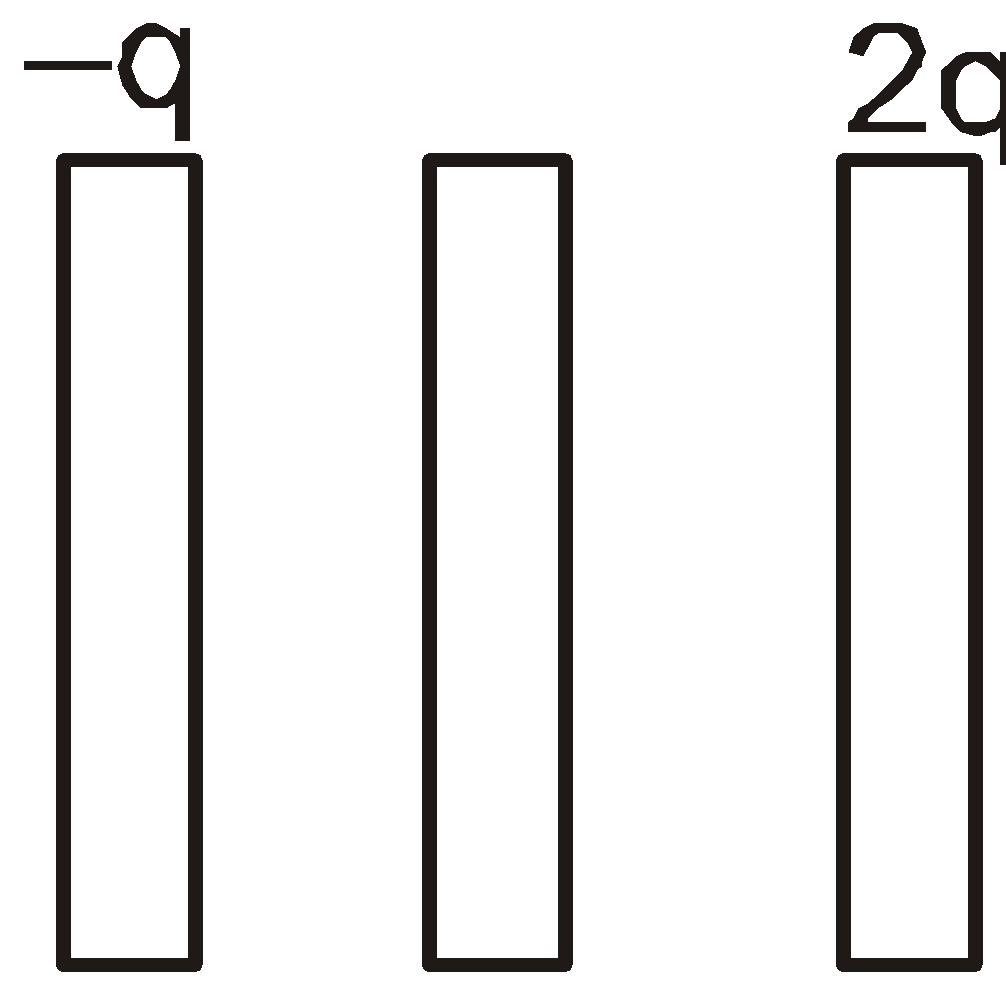
Three identical metal plates with large equal surface areas are kept parallel to each other as shown in figure. The leftmost plate is given a charge –q, the rightmost a charge 2q and the middle one remains neutral. Find the charge appearing on the outer surface of the leftmost plate.
Text Solution
Verified by ExpertsThe correct answer is:
A
Step 1: Understand the configuration of the plates. There are three plates: the leftmost with charge -q, the middle is neutral, and the rightmost with charge 2q.
Step 2: When the -q plate induces charges on the neutral plate, the neutral plate will have +q on the side facing the -q plate and -q on the side facing the 2q plate due to charge induction.
Step 3: The rightmost plate with +2q will also induce charges on the outer surface of the leftmost plate.
Step 4: By conservation of charge, the charge on the leftmost plate remains -q. But since it can induce charges on the outer surface due to the presence of additional electric fields, the outer surface of the leftmost plate will adjust accordingly.
Step 5: Therefore, the charge on the outer surface of the leftmost plate must remain -q in total to satisfy the conditions set by the other two plates.
Step 6: The induced charge on the inner surface of the leftmost plate due to the -q charge will attract +q, and thus the outer surface of the first plate will possess a charge of 0 to maintain neutrality with respect to the surrounding electric fields.
Therefore, the charge appearing on the outer surface of the leftmost plate is 0.
Step 2: When the -q plate induces charges on the neutral plate, the neutral plate will have +q on the side facing the -q plate and -q on the side facing the 2q plate due to charge induction.
Step 3: The rightmost plate with +2q will also induce charges on the outer surface of the leftmost plate.
Step 4: By conservation of charge, the charge on the leftmost plate remains -q. But since it can induce charges on the outer surface due to the presence of additional electric fields, the outer surface of the leftmost plate will adjust accordingly.
Step 5: Therefore, the charge on the outer surface of the leftmost plate must remain -q in total to satisfy the conditions set by the other two plates.
Step 6: The induced charge on the inner surface of the leftmost plate due to the -q charge will attract +q, and thus the outer surface of the first plate will possess a charge of 0 to maintain neutrality with respect to the surrounding electric fields.
Therefore, the charge appearing on the outer surface of the leftmost plate is 0.
Prepare Smarter with CGP Edu
Get practice questions, solutions, and test series in one place.
Write a Review
Share your experience with this question and solution.
Commentary
Send your comment, doubt, correction, or feedback to admin.
Similar Questions
Explore conceptually related problems
The electric field near the conducting surface of a uniform charge density σ will be –
An uncharged conductor A is brought close to another positive charged conductor B, then the charge …
The fig. shows lines of constant potential in a region in which an electric field is present. The v…
The electric charge in uniform motion produces –
Which of the following represents the correct graph for electric field intensity and the distance r…
A neutral metallic object is placed near a finite metal plate carrying a positive charge. The elect…