Figure shows two conducting spheres separated by large distance and of radius 2cm and 3cm containing charges 10µC and 20µC respectively. When the spheres are connected by a conducting wire then find out following:


(i) Ratio of the final charge.
(ii) Final charge on each sphere.
(iii) Ratio of final charge densities.
(iv) Heat produced during the process
Text Solution
Verified by ExpertsCHECK THE SOLUTION.
(i) 
(ii)  = 12 µC,
  = 18 µC
(iii) 
(iv) 2πε 0 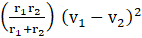 = 3/2 Joules
Sol.
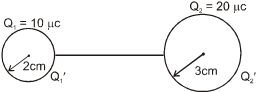
As shown, 10 µC and 20 µC are charge on two spheres before connecting with conducting wire.
Let after connecting with conducting wire, the charges on two spheres ⇒ Q 1 ' & Q 2 '
(i) After connection
Potentials of both spheres are equal
∴ V 1 = V 2
or  =
=  3 Q 1 ' = 2Q 2 '
 =
= 
(ii)  =
=  (i) & Q 1 '+ Q 2 '(ii) = 30 µC → charge conservation
∴ from (i) & (ii)
Q 2 ' +  = 30
= 30
or  = 30
= 30
or Q 2' =  µc = 18 µc
& Q 1' =  Q 2' =
  × 18 µc = 12 µc
(iii)  =
=  =
=  ×
× 
=  ×
×  =
= 
(iv) Heat produced during the process ⇒
initial energy of system – final energy of system
⇒ Ui – Uf
⇒ 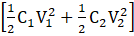 –
– 
Where; C 1 = 4 π∈ 0 r 1
C 2 = 4 π∈ 0 r 2
V 1 =  ; V 2 =
  & V =
& V =  ; C eq = (C 1 + C 2 )
∴ Heat ⇒ 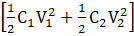 –
– 
 (C 1 + C 2 )
⇒  –
– 
⇒ 

⇒  = 2 π∈ 0
  (V 1 –V 2 ) 2
∴ Heat =  2 π∈ 0 (V 1 –V2) 2 ⇒
  ×
× 

 × 10–2 × 9 × 109
 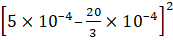 =
=  × 107
× 107  =
=  ×
×  ×10–1
×10–1
=  Joules
Prepare Smarter with CGP Edu
Get practice questions, solutions, and test series in one place.
Write a Review
Share your experience with this question and solution.
Commentary
Send your comment, doubt, correction, or feedback to admin.
Similar Questions
Explore conceptually related problems