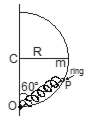
A smooth semicircular wire-track of radius R is fixed in a vertical plane shown in fig. One end of a massless spring of natural length (3R/4) is attached to the lower point O of the wire track. A small ring of mass m, which can slide on the track, is attached to the other end of the spring. The ring is held stationary at point P such that the spring makes an angle of 60° with the vertical. The spring constant K = mg/R. Consider the instant when the ring is released, If the tangential acceleration of the ring is  and the normal reaction is
  then calculate value of x + y.
Text Solution
Verified by ExpertsCHECK THE SOLUTION.
x + y = 8
Sol. CP = CO = Radius of circle (R)
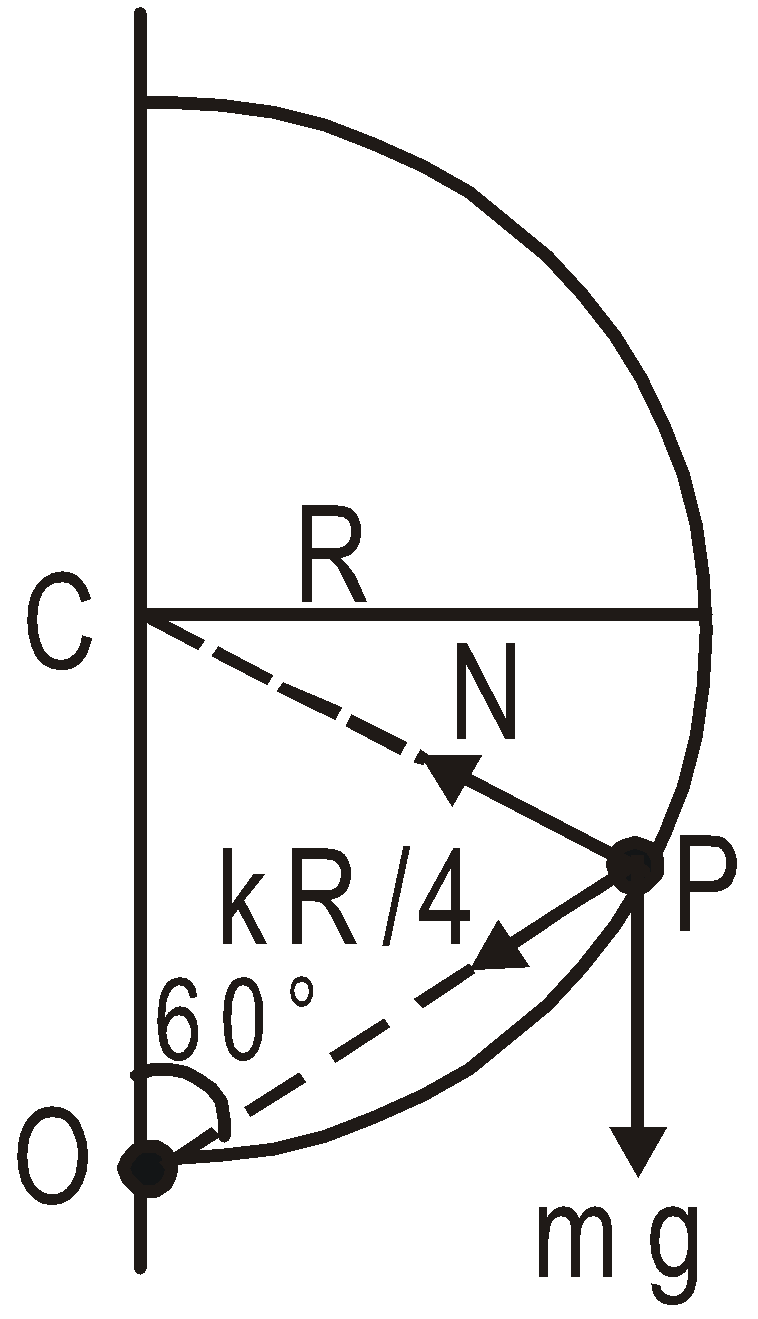

 COP =
COP =  CPO = 60º

 OCP is also 60º
Therefore,  OCP is an equilateral triangle.
Hence, OP = R
Natural length of spring is 3R/4.
 Extension in the spring
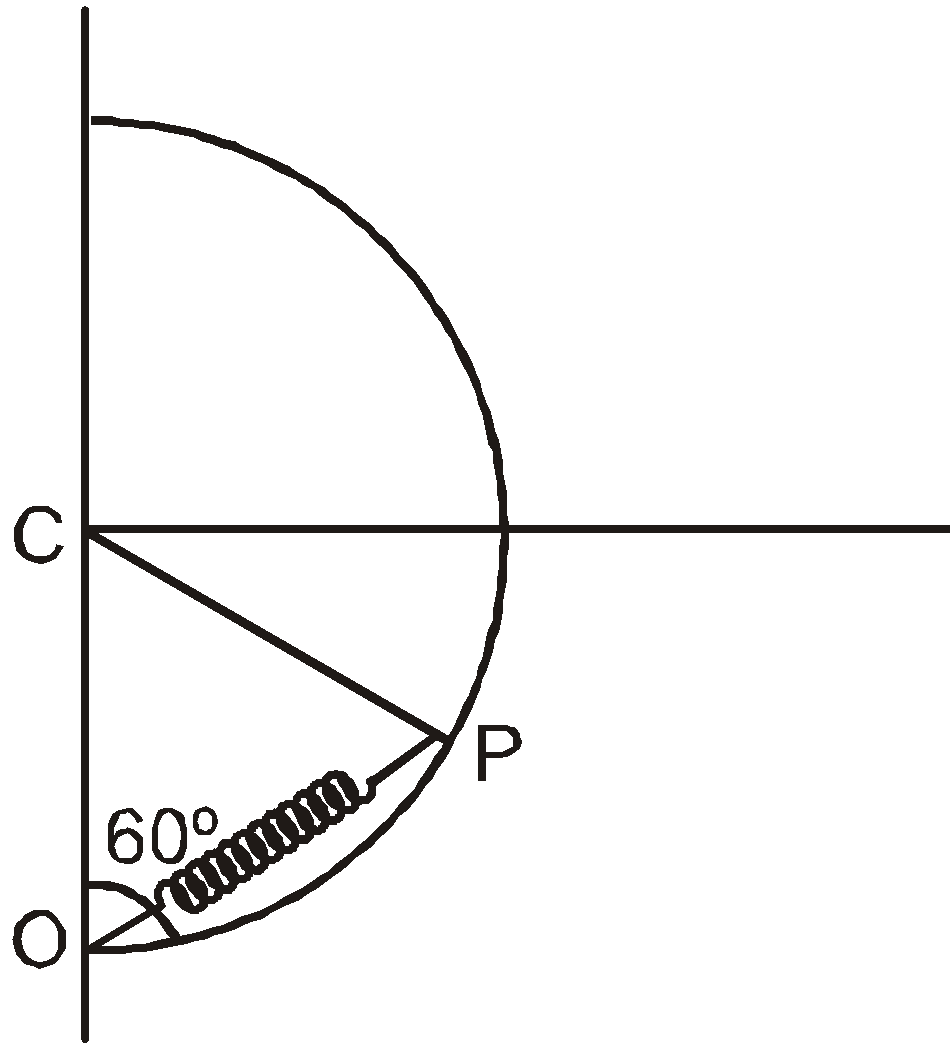
x = R –  =
= 
 Spring force, F = kx =
 =
= 
The free body diagram of the ring will be a shown.
Here; ,F = kx = 
and r N = Normal reaction
Tangential acceleration a r = The ring will move towards the x-axis just after the release. So, net
force along x-axis:
F x = F sin 60º + mg sin 60º = 
 + mg
+ mg 
F x =  mg
mg
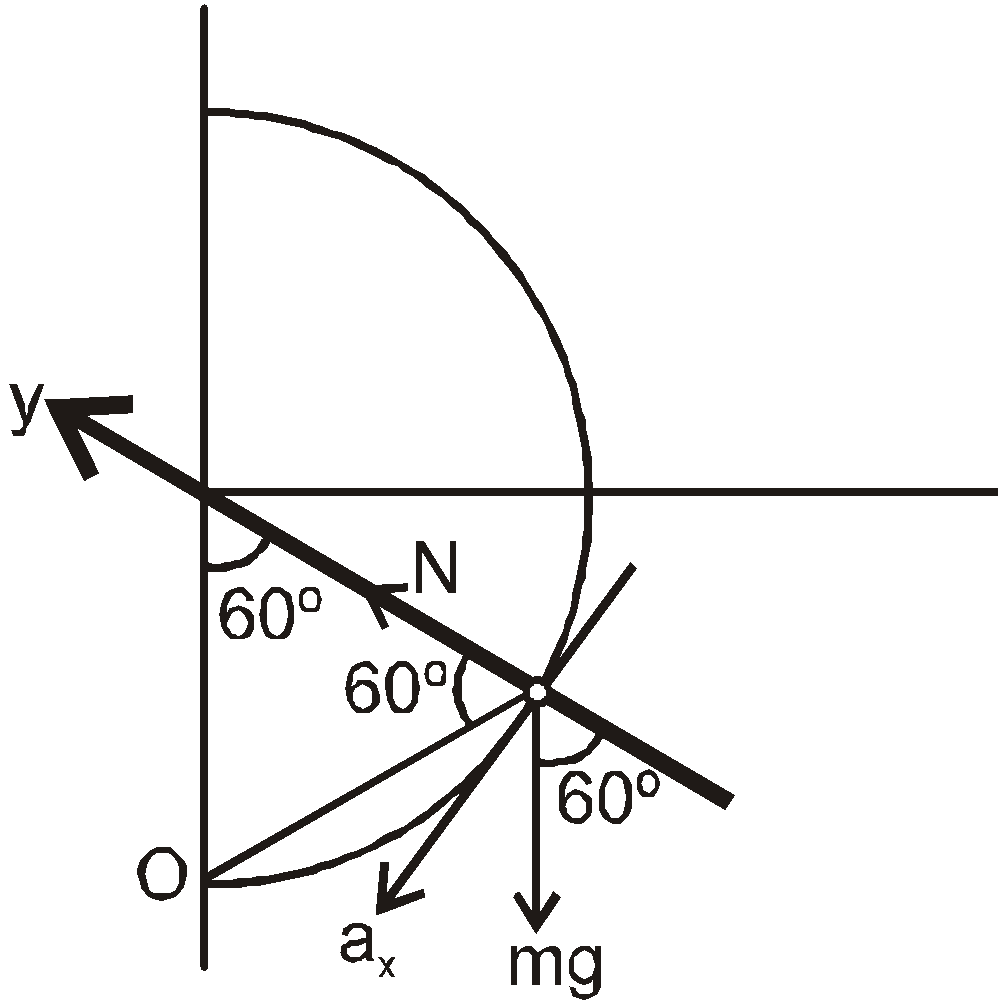
Therefore, tangential acceleration of the ring.
a T = a x =  =
=  g
g
a T =  g hence x = 5
Normal Reaction N: Net force along y-axis on the ring just after the release will be zero.
F y = 0
 N + F cos 60º = mg cos 60º
 N = mg cos 60º – F cos 60º =
  –
– 

=  –
– 
N =  Hence y = 3
Prepare Smarter with CGP Edu
Get practice questions, solutions, and test series in one place.
Write a Review
Share your experience with this question and solution.
Commentary
Send your comment, doubt, correction, or feedback to admin.
Similar Questions
Explore conceptually related problems