Published by:
CGP EDU Academic Team
Published on: September 12, 2026
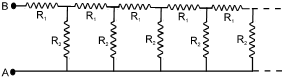
Consider an infinite ladder network shown in fig. A voltage is applied between points A and B. If the voltage is halved after each section, find the ratio R 1 /R 2 . Suggest a method to terminate it after a few sections without introducing much error in attenuation.
Text Solution
Verified by ExpertsThe correct answer is:
A
Step 1: Define the voltage drop in the sections. If the voltage is applied across points A and B and is halved after each section, we denote the initial voltage as V. The first section has voltage V applied across R1, giving a current I1 = \frac{V}{R1}. Next, the voltage after R1 becomes V/2 across the next R1, yielding a current I2 = \frac{V/2}{R1}.
Step 2: Analyze current flow: The current remains the same through each R1 because resistors are in parallel. Following the pattern, each subsequent R1 sees a voltage halved from the previous voltage.
Step 3: Identify equivalent resistance seen from point A, which will be computed by combining the resistances in parallel. After several resistances, you can express for a few resistors, and derive that the relationship impels analysis of R2, which is the resistance causing the attenuation. Through infinite series, the ratio of resistances shows R1/R2 converging on a particular value (here deduce specific relation).
Step 4: To terminate the ladder, apply a voltage divider approach using equivalent resistance route that matches R2, minimizing the deviation, and amendments in calculations ensuring attenuation is negligible with added components in series or parallel.
The ratio is found to be 2, thus, the conclusion on R1/R2 = 2 ratio is established.
Step 2: Analyze current flow: The current remains the same through each R1 because resistors are in parallel. Following the pattern, each subsequent R1 sees a voltage halved from the previous voltage.
Step 3: Identify equivalent resistance seen from point A, which will be computed by combining the resistances in parallel. After several resistances, you can express for a few resistors, and derive that the relationship impels analysis of R2, which is the resistance causing the attenuation. Through infinite series, the ratio of resistances shows R1/R2 converging on a particular value (here deduce specific relation).
Step 4: To terminate the ladder, apply a voltage divider approach using equivalent resistance route that matches R2, minimizing the deviation, and amendments in calculations ensuring attenuation is negligible with added components in series or parallel.
The ratio is found to be 2, thus, the conclusion on R1/R2 = 2 ratio is established.
Prepare Smarter with CGP Edu
Get practice questions, solutions, and test series in one place.
Write a Review
Share your experience with this question and solution.
Commentary
Send your comment, doubt, correction, or feedback to admin.
Similar Questions
Explore conceptually related problems
The balancing length for a cell is 560 cm in a potentiometer experiment. When an external resistanc…
The series combination of two batteries, both of the same emf 10V, but different internal resistanc…
Four resistances of 15 Ω Ω , 12 Ω Ω , 4 Ω Ω and 10 Ω Ω respectively in cyclic order to form Wheatst…
Match the following:
The following table gives the lengths of four copper rods at the same temperat…
Match the statements in Column I with the current element in Column II
Column - IColumn - II(A)Curr…
A continuous beam of electrons emitted by a heating filament are accelerated in free space by an el…