Published by:
CGP EDU Academic Team
Published on: September 12, 2026
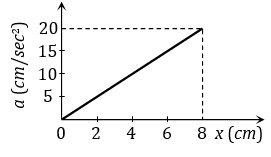
A 10 kg mass moves along x-axis. Its acceleration as function of its position is shown in the figure. What is the total work done on the mass by the force as the mass moves from x = 0 to x = 8 cm?
Text Solution
Verified by ExpertsThe correct answer is:
D
Step 1: Understanding the graph
The acceleration $a$ is represented as a function of the position $x$ (in cm). The graph consists of two parts:
- A linear increase from (0, 0) to (6, 20) cm/sec²
- A constant value of 20 cm/sec² from (6, 20) to (8, 20) cm/sec².
Step 2: Finding work done using the area under the curve
Work done $W$ on the mass can be found by calculating the area under the acceleration curve from $x = 0$ to $x = 8$ cm.
Step 3: Calculate area for the triangular part
The first part of the graph forms a triangle:
- Base = 6 cm
- Height = 20 cm/sec²
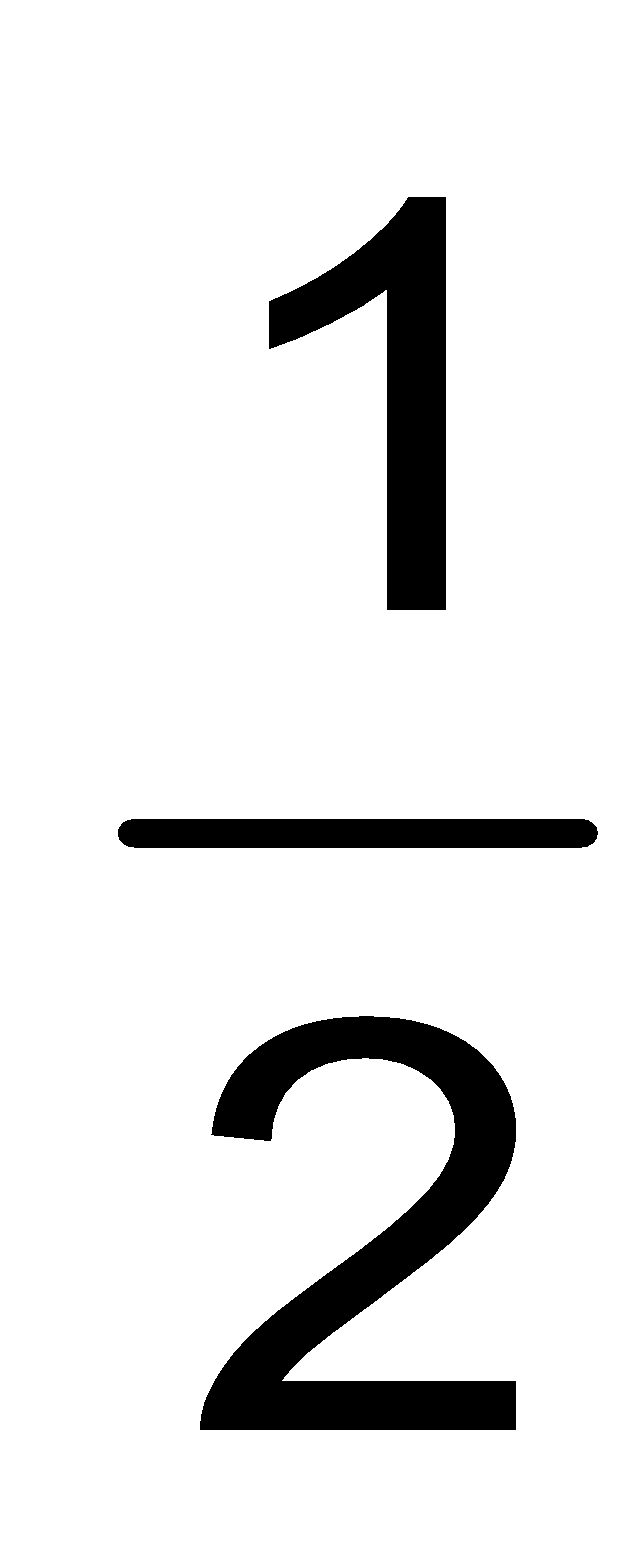
Area of the triangle $A_{triangle} = \frac{1}{2} \times base \times height = \frac{1}{2} \times 6 \times 20 = 60 ext{ cm/s}^2$
Step 4: Calculate area for the rectangular part
The second part of the graph forms a rectangle:
- Width = 2 cm (from 6 to 8 cm)
- Height = 20 cm/sec²
Area of the rectangle $A_{rectangle} = width \times height = 2 \times 20 = 40 ext{ cm/s}^2$
Step 5: Total work done
Total area under the curve = Area of triangle + Area of rectangle = 60 + 40 = 100 cm/s².
Step 6: Conversion to Joules
To convert this to work done: $W = mass \times area = 10 ext{ kg} \times 100 ext{ cm/s}^2 = 1000 \text{ cm}^2/s^2$ = 10 Joules (since 1 J = 100 cm²/s²).
Therefore, the total work done is 10 Joules.
The acceleration $a$ is represented as a function of the position $x$ (in cm). The graph consists of two parts:
- A linear increase from (0, 0) to (6, 20) cm/sec²
- A constant value of 20 cm/sec² from (6, 20) to (8, 20) cm/sec².
Step 2: Finding work done using the area under the curve
Work done $W$ on the mass can be found by calculating the area under the acceleration curve from $x = 0$ to $x = 8$ cm.
Step 3: Calculate area for the triangular part
The first part of the graph forms a triangle:
- Base = 6 cm
- Height = 20 cm/sec²
Area of the triangle $A_{triangle} = \frac{1}{2} \times base \times height = \frac{1}{2} \times 6 \times 20 = 60 ext{ cm/s}^2$
Step 4: Calculate area for the rectangular part
The second part of the graph forms a rectangle:
- Width = 2 cm (from 6 to 8 cm)
- Height = 20 cm/sec²
Area of the rectangle $A_{rectangle} = width \times height = 2 \times 20 = 40 ext{ cm/s}^2$
Step 5: Total work done
Total area under the curve = Area of triangle + Area of rectangle = 60 + 40 = 100 cm/s².
Step 6: Conversion to Joules
To convert this to work done: $W = mass \times area = 10 ext{ kg} \times 100 ext{ cm/s}^2 = 1000 \text{ cm}^2/s^2$ = 10 Joules (since 1 J = 100 cm²/s²).
Therefore, the total work done is 10 Joules.
Prepare Smarter with CGP Edu
Get practice questions, solutions, and test series in one place.
Write a Review
Share your experience with this question and solution.
Commentary
Send your comment, doubt, correction, or feedback to admin.
Similar Questions
Explore conceptually related problems
If the unit of force and length each be increased by four times, then the unit of energy is increas…
A man pushes a wall and fails to displace it. He does
The same retarding force is applied to stop a train. The train stops after 80 m. If the speed is do…
You lift a heavy book from the floor of the room and keep it in the book-shelf having a height 2 m.…
A body of mass m kg is lifted by a man to a height of one meter in 30 sec. Another man lifts the sa…
A force $\mathbf{F} = (5\hat{\imath} + 3\hat{\jmath})$ newton is applied over a particle which disp…