Published by:
CGP EDU Academic Team
Published on: September 12, 2026
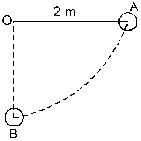
The bob of a pendulum is released from a horizontal position A as shown in figure. If the length of the pendulum is 2 m, what is the speed with which the bob arrives at the lowermost point B, given that it dissipated 10% of its initial potential energy w.r.t. B point against air resistance? (g = 10 m/s 2 )
Text Solution
Verified by ExpertsThe correct answer is:
B
Step 1: Calculate the initial potential energy (PE) at point A.
The height of point A above point B is equal to the length of the pendulum, which is 2 m. Therefore, the potential energy at point A is given by:
$$ PE = mgh = mg(2) $$
The value of g is 10 m/s², so:
$$ PE = 2mg $$
Step 2: Calculate the energy dissipated due to air resistance.
Given that 10% of the initial potential energy is dissipated, we can find the dissipated energy:
$$ ext{Dissipated energy} = 0.1 imes PE = 0.1 imes 2mg = 0.2mg $$
Step 3: Calculate the final potential energy at point B.
At point B, the potential energy is 0 (since it is the lowest point). Therefore, the remaining mechanical energy at point B after dissipation is:
$$ ext{Remaining energy} = PE - ext{Dissipated energy} = 2mg - 0.2mg = 1.8mg $$
Step 4: Use the remaining energy to calculate the speed at point B.
The remaining energy is converted into kinetic energy (KE) at point B. Therefore:
$$ KE = rac{1}{2} mv^2 $$
Setting this equal to the remaining energy:
$$ rac{1}{2} mv^2 = 1.8mg $$
Step 5: Simplify and solve for v:
Cancelling m from both sides (assuming m ≠ 0):
$$ rac{1}{2} v^2 = 1.8g $$
Hence,
$$ v^2 = 3.6g = 3.6 imes 10 $$
$$ v^2 = 36 $$
$$ v = 6 ext{ m/s} $$
Therefore, the speed with which the bob arrives at the lowermost point B is 6 m/s.
The height of point A above point B is equal to the length of the pendulum, which is 2 m. Therefore, the potential energy at point A is given by:
$$ PE = mgh = mg(2) $$
The value of g is 10 m/s², so:
$$ PE = 2mg $$
Step 2: Calculate the energy dissipated due to air resistance.
Given that 10% of the initial potential energy is dissipated, we can find the dissipated energy:
$$ ext{Dissipated energy} = 0.1 imes PE = 0.1 imes 2mg = 0.2mg $$
Step 3: Calculate the final potential energy at point B.
At point B, the potential energy is 0 (since it is the lowest point). Therefore, the remaining mechanical energy at point B after dissipation is:
$$ ext{Remaining energy} = PE - ext{Dissipated energy} = 2mg - 0.2mg = 1.8mg $$
Step 4: Use the remaining energy to calculate the speed at point B.
The remaining energy is converted into kinetic energy (KE) at point B. Therefore:
$$ KE = rac{1}{2} mv^2 $$
Setting this equal to the remaining energy:
$$ rac{1}{2} mv^2 = 1.8mg $$
Step 5: Simplify and solve for v:
Cancelling m from both sides (assuming m ≠ 0):
$$ rac{1}{2} v^2 = 1.8g $$
Hence,
$$ v^2 = 3.6g = 3.6 imes 10 $$
$$ v^2 = 36 $$
$$ v = 6 ext{ m/s} $$
Therefore, the speed with which the bob arrives at the lowermost point B is 6 m/s.
Prepare Smarter with CGP Edu
Get practice questions, solutions, and test series in one place.
Write a Review
Share your experience with this question and solution.
Commentary
Send your comment, doubt, correction, or feedback to admin.
Similar Questions
Explore conceptually related problems
A projectile is fired from the top of a 40 m high cliff with an initial speed of 50 m/s at an unkno…
A rain drop of radius 2 mm falls from a height of 250 m above the ground. What is the work done by …
Calculate the velocity of the bob of a simple pendulum at its mean position if it is able to rise t…
The heavier block in an Atwood machine has a mass twice that of the lighter one. The tension in the…
The two blocks in an Atwood machine have masses 2.0 kg and 3.0 kg. Find the work done by gravity du…
A 1 kg block situated on a rough inclined plane is connected to a spring of spring constant 100 N m…