Published by:
CGP EDU Academic Team
Published on: September 12, 2026
The potential energy function of a particle in a region of space is given as:
U = (2x 2 + 3y 3 + 2z) J
Here x, y and z are in meters. Find the force acting on the particle at point P (1m, 2m, 3m)
Text Solution
Verified by ExpertsThe correct answer is:
A
Given potential energy function:
U(x, y, z) = 2x^2 + 3y^3 + 2z
To find the force, we use the relation:
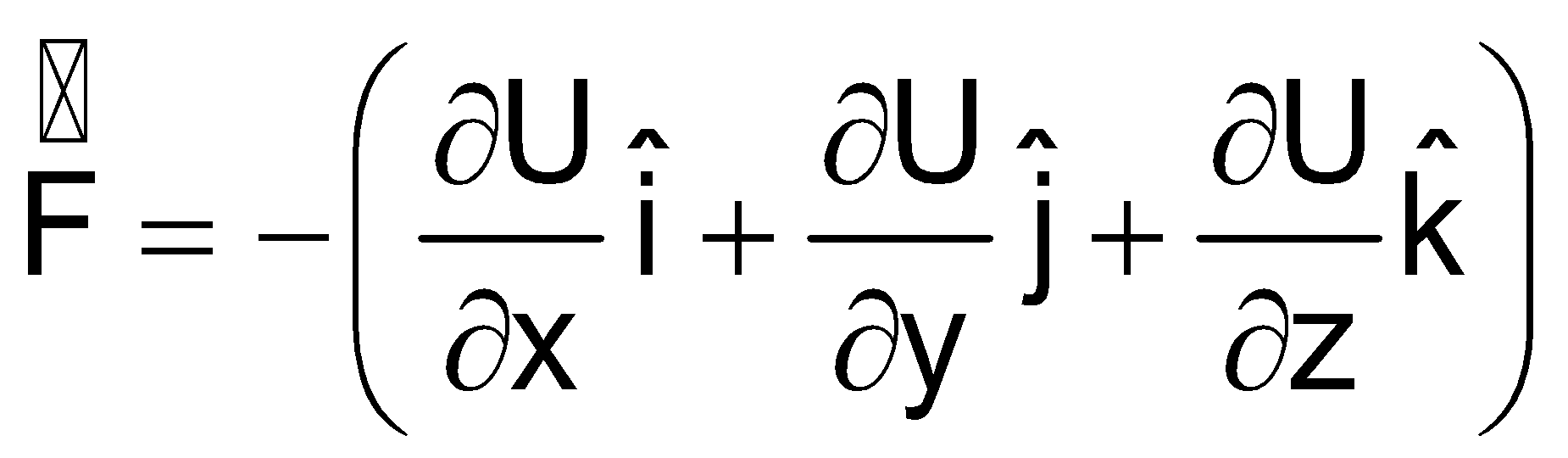
F = -\nabla U = -\left( \frac{\partial U}{\partial x}, \frac{\partial U}{\partial y}, \frac{\partial U}{\partial z} \right)
Step 1: Calculate the partial derivatives of U.
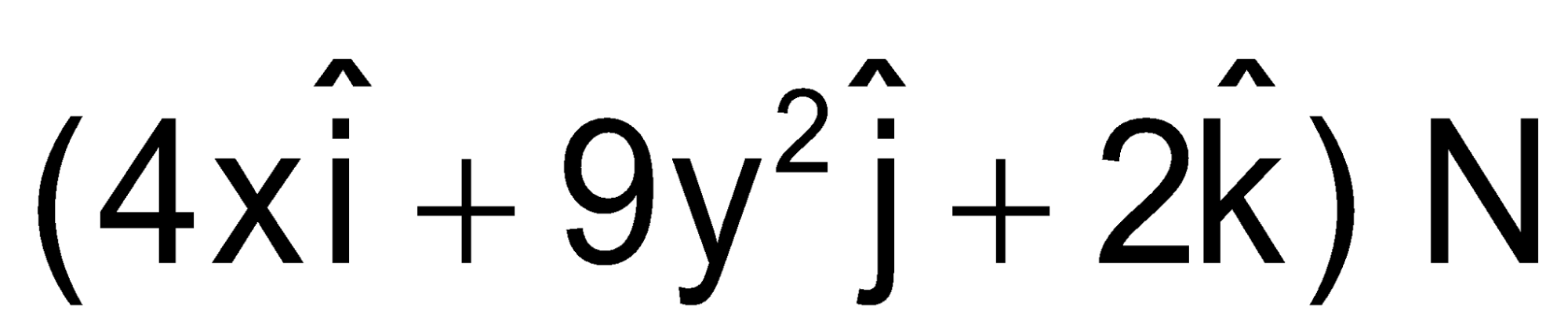
\( \frac{\partial U}{\partial x} = \frac{\partial}{\partial x}(2x^2 + 3y^3 + 2z) = 4x \)
\( \frac{\partial U}{\partial y} = \frac{\partial}{\partial y}(2x^2 + 3y^3 + 2z) = 9y^2 \)
\( \frac{\partial U}{\partial z} = \frac{\partial}{\partial z}(2x^2 + 3y^3 + 2z) = 2 \)
Step 2: Evaluate the derivatives at point P (1m, 2m, 3m).
\( \frac{\partial U}{\partial x}|_{(1,2,3)} = 4(1) = 4 \)
\( \frac{\partial U}{\partial y}|_{(1,2,3)} = 9(2)^2 = 9(4) = 36 \)
\( \frac{\partial U}{\partial z}|_{(1,2,3)} = 2 \)
Step 3: Calculate the force components.
F = -\left( 4, 36, 2 \right) = -4\hat{i} - 36\hat{j} - 2\hat{k}
Therefore, the force acting on the particle at point P (1m, 2m, 3m) is:
F = -4\hat{i} - 36\hat{j} - 2\hat{k}.
U(x, y, z) = 2x^2 + 3y^3 + 2z
To find the force, we use the relation:
F = -\nabla U = -\left( \frac{\partial U}{\partial x}, \frac{\partial U}{\partial y}, \frac{\partial U}{\partial z} \right)
Step 1: Calculate the partial derivatives of U.
\( \frac{\partial U}{\partial x} = \frac{\partial}{\partial x}(2x^2 + 3y^3 + 2z) = 4x \)
\( \frac{\partial U}{\partial y} = \frac{\partial}{\partial y}(2x^2 + 3y^3 + 2z) = 9y^2 \)
\( \frac{\partial U}{\partial z} = \frac{\partial}{\partial z}(2x^2 + 3y^3 + 2z) = 2 \)
Step 2: Evaluate the derivatives at point P (1m, 2m, 3m).
\( \frac{\partial U}{\partial x}|_{(1,2,3)} = 4(1) = 4 \)
\( \frac{\partial U}{\partial y}|_{(1,2,3)} = 9(2)^2 = 9(4) = 36 \)
\( \frac{\partial U}{\partial z}|_{(1,2,3)} = 2 \)
Step 3: Calculate the force components.
F = -\left( 4, 36, 2 \right) = -4\hat{i} - 36\hat{j} - 2\hat{k}
Therefore, the force acting on the particle at point P (1m, 2m, 3m) is:
F = -4\hat{i} - 36\hat{j} - 2\hat{k}.
Prepare Smarter with CGP Edu
Get practice questions, solutions, and test series in one place.
Write a Review
Share your experience with this question and solution.
Commentary
Send your comment, doubt, correction, or feedback to admin.
Similar Questions
Explore conceptually related problems
A force F = x 2 y 2 i + x 2 y 2 j (N) acts on a particle which moves in the XY plane.
Calculate the forces F(y) associated with the following one-dimensional potential energies:
The potential energy function of a particle in a region of space is given as:
U = (2x 2 + 3y 3 + 2z…
Force acting on a particle in a conservative force field is:
(i)
(ii)
(iii)
The potential energy function for a particle executing linear simple harmonic motion is given by U …
The potential energy for a force field is given by U (x, y) = sin (x + y). The force acting on the…