Published by:
CGP EDU Academic Team
Published on: September 12, 2026
In the following questions, statement I is followed by statement II. Each question has the
following four choices out of which only one is correct.
Statement I: A body is moving along a straight line such that its velocity varies with time, as shown in the figure. Magnitude of displacement of the body from
to
is the same as that distance travelled by it in the given time duration.
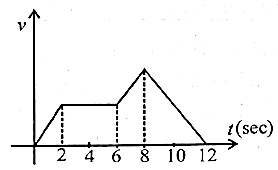
Statement II: For unidirectional motion of a body, |displacement| = distance.
Text Solution
Verified by ExpertsThe correct answer is:
A
Step 1: Analyze the given velocity-time graph. The area under the curve represents the displacement of the body.
Step 2: Calculate the area for each segment of the graph:
- From t = 0 to t = 2s: The velocity is at 4 m/s, so area = base (2s) × height (4 m/s) = 2 × 4 = 8 m.
- From t = 2s to t = 4s: The velocity is 0 m/s, so area = 0.
- From t = 4s to t = 6s: The velocity is 2 m/s, so area = base (2s) × height (2 m/s) = 2 × 2 = 4 m.
- From t = 6s to t = 8s: The velocity is 6 m/s, so area = base (2s) × height (6 m/s) = 2 × 6 = 12 m.
- From t = 8s to t = 10s: The velocity is 4 m/s, so area = base (2s) × height (4 m/s) = 2 × 4 = 8 m.
- From t = 10s to t = 12s: The velocity is 0 m/s, so area = 0.
Step 3: Total displacement = 8 + 0 + 4 + 12 + 8 + 0 = 32 m.
Step 4: Displacement calculation matches with the total distance traveled, as the body moves in a straight line without any change in direction. Hence, Statement I is true.
Step 5: Statement II states that for unidirectional motion, |displacement| equals distance, which is true as well.
Conclusion: Both statements I and II are true, hence the correct answer is Option A.
Step 2: Calculate the area for each segment of the graph:
- From t = 0 to t = 2s: The velocity is at 4 m/s, so area = base (2s) × height (4 m/s) = 2 × 4 = 8 m.
- From t = 2s to t = 4s: The velocity is 0 m/s, so area = 0.
- From t = 4s to t = 6s: The velocity is 2 m/s, so area = base (2s) × height (2 m/s) = 2 × 2 = 4 m.
- From t = 6s to t = 8s: The velocity is 6 m/s, so area = base (2s) × height (6 m/s) = 2 × 6 = 12 m.
- From t = 8s to t = 10s: The velocity is 4 m/s, so area = base (2s) × height (4 m/s) = 2 × 4 = 8 m.
- From t = 10s to t = 12s: The velocity is 0 m/s, so area = 0.
Step 3: Total displacement = 8 + 0 + 4 + 12 + 8 + 0 = 32 m.
Step 4: Displacement calculation matches with the total distance traveled, as the body moves in a straight line without any change in direction. Hence, Statement I is true.
Step 5: Statement II states that for unidirectional motion, |displacement| equals distance, which is true as well.
Conclusion: Both statements I and II are true, hence the correct answer is Option A.
Prepare Smarter with CGP Edu
Get practice questions, solutions, and test series in one place.
Write a Review
Share your experience with this question and solution.
Commentary
Send your comment, doubt, correction, or feedback to admin.
Similar Questions
Explore conceptually related problems
The three initial and final positions of a man on the x-axis are give as
(1) (-3 m, 7 m) (2) (7m, -…
Which of the following statements are incorrect?
(i) Average velocity is path length divided by tim…
Which of the following graphs cannot possibly represent one dimensional motion of a particle?
…
The three initial and final positions of a man on the x-axis are give as
(1) (-3 m, 7 m) (2) (7m, -…
Which of the following statements are incorrect?
(i) Average velocity is path length divided by tim…
statement -1 For an observer looking out through the window of a fast moving train, the nearby obje…