The initial velocity of a particle moving along the  -axis is
  (at
(at  and
and  ), and its
acceleration  is given by
  . Which of the following equation show correct relation between velocity (v) and position (x)?
A
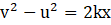
B
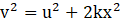
C
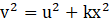
D
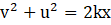
Text Solution
Verified by ExpertsThe correct answer is:
C
No detailed text explanation provided yet.
Prepare Smarter with CGP Edu
Get practice questions, solutions, and test series in one place.
Write a Review
Share your experience with this question and solution.
Commentary
Send your comment, doubt, correction, or feedback to admin.
Similar Questions
Explore conceptually related problems
An object is moving in 1-D along the -axis. Graph of position vs. time is given. Find
which stat…
A car moving with constant acceleration covers the distance between two points, 60 m
apart, in 6 s.…
Usain bolt runs in a 500 m race with uniform acceleration, and during part of the race, he
covers t…
A particle starts from a point along the positive -axis with a velocity varying
according to the …
In previous question, find the average velocity for to motion.
The initial and final position vectors for a particle are respectively
. and . The displacement …