Published by:
CGP EDU Academic Team
Published on: September 13, 2026
A travelling wave represented by y(x, t) = a sin (kx –  t) is superimposed on another wave represented by y(x, t) = a sin (kx +
  t). The resultant is a
A
Standing wave having nodes at x =  n = 0, 1, 2, ....
n = 0, 1, 2, ....
B
Standing wave having nodes at x =  ; n = 0, 1, 2, ...
; n = 0, 1, 2, ...
C
Wave travelling along + x direction
D
Wave travelling along – x direction
Text Solution
Verified by ExpertsThe correct answer is:
B
According to the principle of superposition, the resultant wave is

 …. (i)
It represent a standing wave. In the standing wave, there will be nodes (where amplitude is zero) and antinodes (where amplitude is largest).
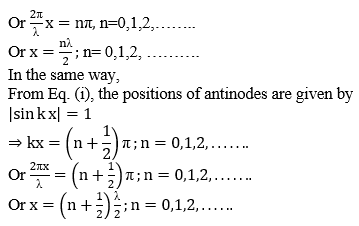
For Eq. (i), the positions of nodes are given by
Sin k x = 0
 n = 0,1,2, ……..
Prepare Smarter with CGP Edu
Get practice questions, solutions, and test series in one place.
Write a Review
Share your experience with this question and solution.
Commentary
Send your comment, doubt, correction, or feedback to admin.
Similar Questions
Explore conceptually related problems
There is a destructive interference between the two waves of wavelength λ λ coming from two differe…
When two sound waves with a phase difference of $\pi/2$ , and each having amplitude A and frequency…
If the phase difference between the two wave is 2 π π during superposition, then the resultant ampl…
The superposition takes place between two waves of frequency f and amplitude a. The total intensity…
If two waves of same frequency and same amplitude respectively, on superimposition produced a resul…
Two sources of sound A and B produces the wave of 350 Hz, they vibrate in the same phase. The parti…