Published by:
CGP EDU Academic Team
Published on: September 12, 2026
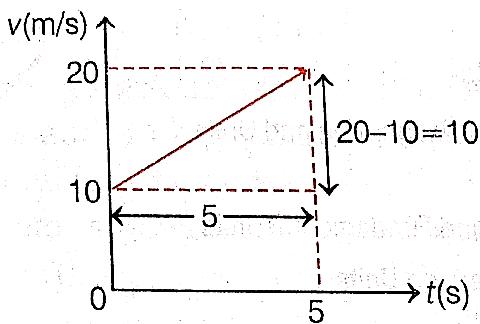
A car changes its velocity linearly from
to
in 5 s. Plot
-
graph and write
velocity as a function.
Text Solution
Verified by ExpertsThe correct answer is:
A
Step 1: Identify the initial and final velocities. Here, the initial velocity is 10 m/s and the final velocity is 20 m/s.
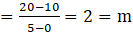
Step 2: Calculate the acceleration using the equation \( a = \frac{\Delta v}{\Delta t} \), where \( \Delta v = v_f - v_i = 20 m/s - 10 m/s = 10 m/s \) and \( \Delta t = 5 s \). Hence, \( a = \frac{10 m/s}{5 s} = 2 m/s² \).
Step 3: Write the velocity as a function of time. Since the motion is linear, the equation can be written as \( v(t) = v_i + at \) which gives \( v(t) = 10 m/s + 2 m/s² \cdot t \).
Therefore, the function describing velocity as a function of time is \( v(t) = 10 + 2t \).
Step 4: The graph of this function will be a straight line starting from (0, 10) to (5, 20) on a velocity-time graph.
Step 2: Calculate the acceleration using the equation \( a = \frac{\Delta v}{\Delta t} \), where \( \Delta v = v_f - v_i = 20 m/s - 10 m/s = 10 m/s \) and \( \Delta t = 5 s \). Hence, \( a = \frac{10 m/s}{5 s} = 2 m/s² \).
Step 3: Write the velocity as a function of time. Since the motion is linear, the equation can be written as \( v(t) = v_i + at \) which gives \( v(t) = 10 m/s + 2 m/s² \cdot t \).
Therefore, the function describing velocity as a function of time is \( v(t) = 10 + 2t \).
Step 4: The graph of this function will be a straight line starting from (0, 10) to (5, 20) on a velocity-time graph.
Prepare Smarter with CGP Edu
Get practice questions, solutions, and test series in one place.
Write a Review
Share your experience with this question and solution.
Commentary
Send your comment, doubt, correction, or feedback to admin.
Similar Questions
Explore conceptually related problems