A given object takes  times the time to slide down
  rough inclined plane as it takes the time to slide down an identical perfectly smooth
  inclined plane. The coefficient of kinetic friction between the object and the surface of inclined plane is:


Text Solution
Verified by ExpertsA
To determine the coefficient of kinetic friction, let's analyze the time taken by the object to slide down each plane and use the equations of motion for both scenarios.
First, consider the perfectly smooth  inclined plane (no friction). The acceleration of the object on this plane can be calculated using the component of gravitational force parallel to the incline. Since there is no friction, the only force acting down the plane is the component of the gravitational force:
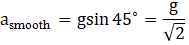
Let the time taken to slide down this smooth
Let the time taken to slide down this smooth plane be  . The distance
  covered by the object can be expressed using the equation of motion:

Now, consider the rough  inclined plane. The acceleration down the rough plane can be found by considering both the component of gravitational force and the kinetic friction force. Here, the friction force is
  , where
 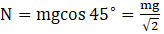 . Thus the frictional force is:

The net force acting on the object down the plane would be:

So the net acceleration  is:
is:

The time taken to slide down the rough plane is given as  . So, the distance
  can be written as:

Setting the distances equal for both cases, we get:

Simplifying, we find:

Therefore:
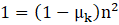
Solving for  , we get:

Thus, the coefficient of kinetic friction between the object and the surface of inclined plane is: 
Prepare Smarter with CGP Edu
Get practice questions, solutions, and test series in one place.
Write a Review
Share your experience with this question and solution.
Commentary
Send your comment, doubt, correction, or feedback to admin.
Similar Questions
Explore conceptually related problems