A photo emissive substance is illuminated with a radiation of wavelength  so that it releases electrons with de-Broglie wavelength
  . The longest wavelength of radiation that can emit photoelectron is
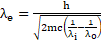
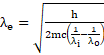
  . Expression for de-Broglie wavelength is given by:
(m: mass of the electron, h: Planck's constant and c: speed of light)


Text Solution
Verified by ExpertsC
Kinetic Energy (K.E.): The kinetic energy of the emitted electron is given by subtracting the work function (W) of the material from the energy of the incident radiation (E).

Expressions for Energy:
The energy of the incoming radiation  is calculated using the formula:

The work function  , which is the minimum energy needed to release an electron, when the radiation wavelength is at its longest
  , is:
, is:

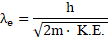
De-Broglie Wavelength of the Electron:
The de-Broglie wavelength  of the emitted electron is given by:
Substituting the Values:
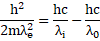
The kinetic energy of the emitted electron can be expressed in terms of energies as:
Final Expression for  :
:
Solving for  , the de-Broglie wavelength of the electron, we have:
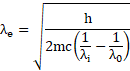
This expression determines the de-Broglie wavelength of the emitted electron based on the wavelengths of the incident and threshold radiation.
Prepare Smarter with CGP Edu
Get practice questions, solutions, and test series in one place.
Write a Review
Share your experience with this question and solution.
Commentary
Send your comment, doubt, correction, or feedback to admin.
Similar Questions
Explore conceptually related problems