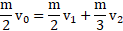
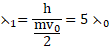
Particle  of mass
  moving along the x -axis with velocity
  collides elastically with another particle B at rest having mass
  . If both particles move along the x-axis after the collision, the change
  in de-Broglie wavelength of particle
  , in terms of its de-Broglie wavelength (
  ) before collision is:
A

B

C

D

Text Solution
Verified by ExpertsThe correct answer is:
B




Prepare Smarter with CGP Edu
Get practice questions, solutions, and test series in one place.
Write a Review
Share your experience with this question and solution.
Commentary
Send your comment, doubt, correction, or feedback to admin.
Similar Questions
Explore conceptually related problems
In a hydrogen atom the electron makes a transition from level on the level. If n >> 1, the freque…
A particle is moving 5 times as fast as an electron. The ratio of the de-Broglie wavelength of the …
When the wavelength of the radiation falling on a metal is changed from 500nm to 200 nm, the maximu…
Two sources of light emit X-rays of wavelength 1 nm and visible light of wavelength 500nm respectiv…
Given figure shows few data points in a photo electric effect experiment for a certain metal. The m…
In a photoelectric effect experiment, the graph of stopping potential V versus reciprocal of wavele…