A deep-sea diver is suspended beneath the surface of Loch Ness by a 100-m long cable that is attached to a boat on the surface (Fig.). The diver and his suit have a total mass of 120 kg and a volume of 0.0800 m 3 . The cable has a diameter of 2.00 cm and a linear mass density of µ = 1.10 kg/m. The diver thinks he sees something moving in the murky depths and jerks the end of the cable back and forth to send transverse waves up the cable as a signal to his companions in the boat.
 . The speed therefore varies along the cable, since the tension is not constant. (This expression neglects the damping force that the water exerts on the moving cable.) Integrate to find the time required for the first signal to reach the surface.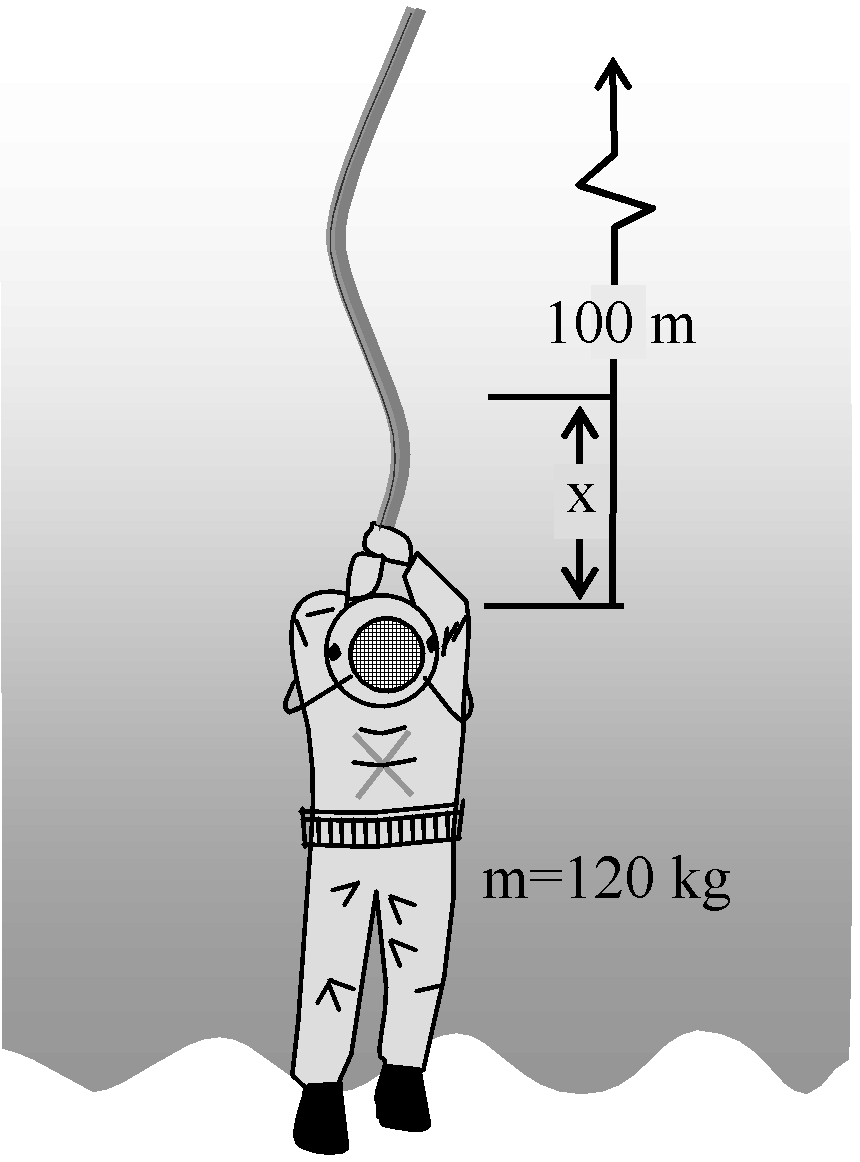
Text Solution
Verified by Experts(x) = (392 N); (x) = F 0
The tension is the difference between the diver's weight and the buoyant force,
F = (m – ρ water V)g = (120 kg – 1000 kg/m 3 )(0.0800 m 3 )(9.80 m/s 2 )) = 392 N.
The increase in tension will be the weight of the cable between the diver and the point at x, minus the buoyant force. This increase in tension is then
(µx – ρ(Ax)) g = (1.10 kg/m – (1000 kg/m 3 ) 𝜋 (1.00 × 10 –2 m) 2 )(9.80 m/s 2 ) x = (7.70 N/m)x
The tension as a function of x is then F (x) = (392 N) + (7.70 N/m)x.
Denote the tension as F(x) = F 0 + ax, where F 0 = 392 N and a = 7.70 N/m. Then, the speed of transverse waves as a function of x is v =  =
=  and the time t needed for a wave to reach the surface is found from
t =  =
=  =
=  dx.
dx.
Let the length of the cable be L, so
t =  =
= 
= 
= 

= 3.98 s.
Prepare Smarter with CGP Edu
Get practice questions, solutions, and test series in one place.
Write a Review
Share your experience with this question and solution.
Commentary
Send your comment, doubt, correction, or feedback to admin.
Similar Questions
Explore conceptually related problems