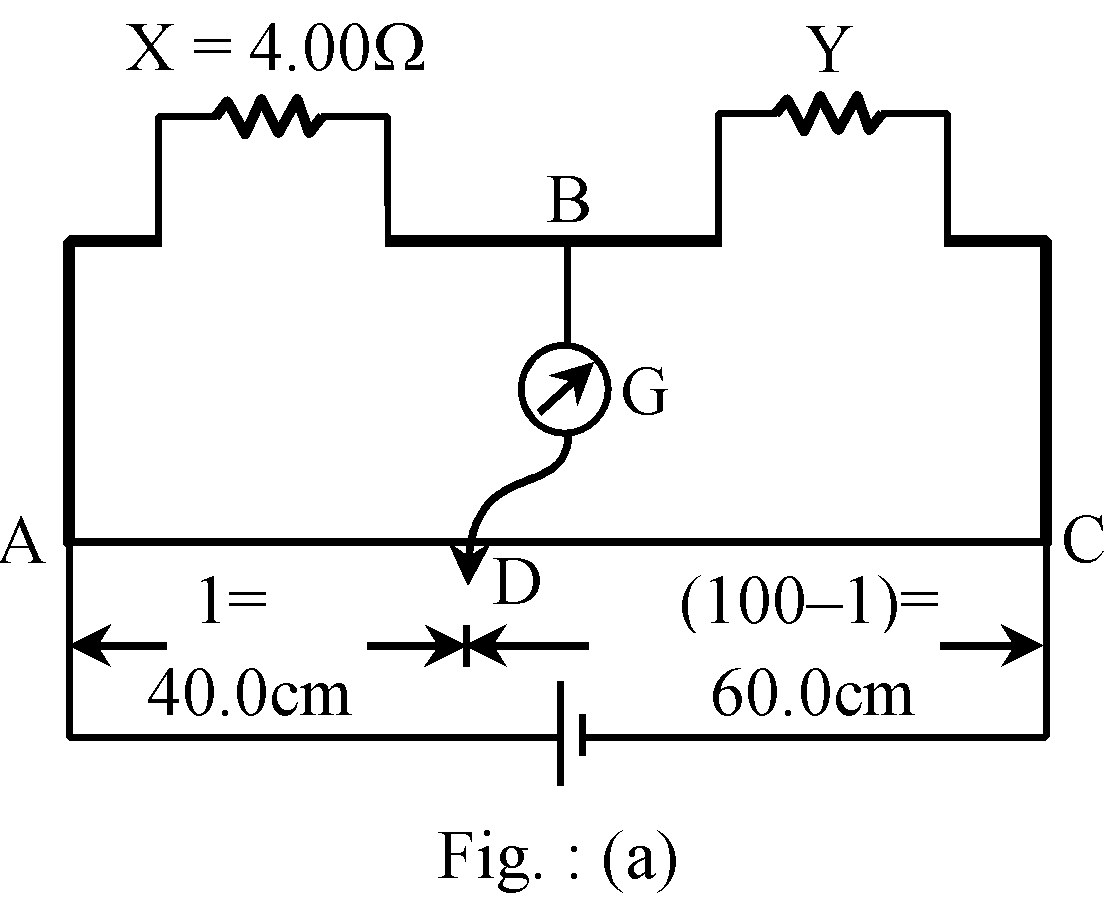
Fig. Shows a meter bridge consisting of two resistances X and Y together in parallel with a meter-long constantan wire AC of uniform cross-section. D is a movable contact that can slide along the wire AC. The resistors X, Y and resistances of segments AD and DC of the wire constitute the four arms of the bridge. The length of wire AC is 100 cm. X is a standard 4.00 Ω resistor and Y is a coil of wire. With Y immersed in melting ice the null point is found to be at a distance of 40.0 m from point A. When the coil Y is heated to 100º C, a 100 Ω resistor has to be connected in parallel with Y in order to keep the bridge balanced at the same point. Calculate the temperature coefficient of resistance of the coil.
Text Solution
Verified by ExpertsSol. The resistances of the two segments of the wire AD and DC are in the ratio of their lengths. If R 0 is the resistance of Y in melting ice (0ºC), the balance condition of Whetstone bridge gives
 =
=  =
= 
where k is the resistance per centimeter of wire AC. Now, l = 40.0 cm and X = 4.00 Ω . Substituting these values, we get R 0 = 6.00 Ω . Let R t be the resistance of Y when heated to a temperature t = 100ºC. When it is connected in parallel with 100 Ω resistor as shown in Fig. , the net resistance becomes
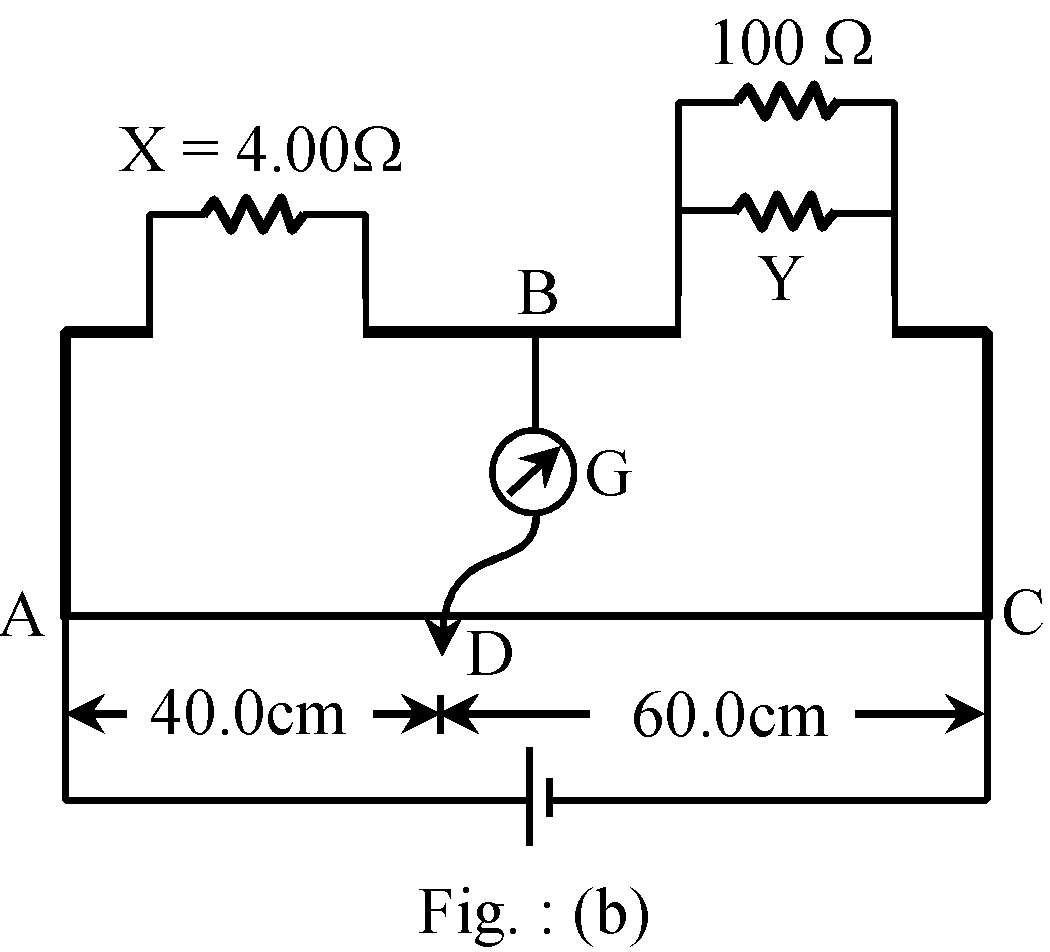
R' = 
Since the null point remains unchanged, we have
 =
=  ⇒ R' = 6.00 Ω
Thus 6.00 =  ⇒ R t = 6.38 Ω
Temperature coefficient of resistance of the coil Y is
α =  =
=  = 6.3 × 10 –4 K –1 .
Prepare Smarter with CGP Edu
Get practice questions, solutions, and test series in one place.
Write a Review
Share your experience with this question and solution.
Commentary
Send your comment, doubt, correction, or feedback to admin.
Similar Questions
Explore conceptually related problems