A vehicle of mass m starts moving along a horizontal circle of radius R such that its speed varies with distance s covered by the vehicle as v = K √ s, where K is a constant. Calculate
(i) tangential and normal force on vehicle as function of s,
(ii) distance s in terms of time t and
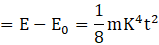
(iii) work done by the resultant force in first t seconds after the beginning of motion.
Text Solution
Verified by ExpertsCHECK THE SOLUTION.
(i)  mK 2 ,
  ; (ii)
  K 2 t 2 ; (iii)
  mK 4 t 2
Since, the vehicle is moving along a circle, therefore, it is necessarily subjected to a centripetal acceleration.
The acceleration 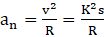
The normal force 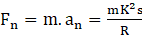
Since, speed v of particle is increasing, therefore, it is necessary subjected to a tangerial acceleration also,
The acceleration 
Tangential forces,  .
. 
Since, s is the distance moved by the particle, therefore, speed v is  .
.
Hence, 

Integrating the above equation, 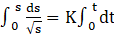

Work done by resultant force is used to increase kinetic energy of the particle.
Kinetic energy at time t, 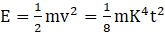
Initial kinetic energy,  .
.
Increase in kinetic energy
Prepare Smarter with CGP Edu
Get practice questions, solutions, and test series in one place.
Write a Review
Share your experience with this question and solution.
Commentary
Send your comment, doubt, correction, or feedback to admin.
Similar Questions
Explore conceptually related problems