When an object moves through a fluid, as when a ball falls through air or a glass sphere falls through water, the fluid exerts a viscous force F on the object. This force tends to slow the object. For a small sphere of radius r, moving slowly at a speed v, the magnitude of the viscous force is given by Stocke’s law, Fv = 6 πη rv. In this formula, η is the coefficient of viscosity of the fluid, which is the proportionality constant that determines how much tangential force is required to move a fluid layer at a constant speed v, when the layer has an area A and is located a perpendicular distance z from an immobile surface. The magnitude of the force is given by F = η Av/z. For a viscous fluid to move from location 2 to location 1 along a pipe of radius R and length L, the pressure at location 2 must exceed that at location 1. Poiseuille’s law gives the volume flow rate Q that results from such a pressure difference P 2 – P 1 . The flow rate is expressed by the formula:

Poiseuille’s law remains valid as long as the fluid flow is laminar. For a sufficiently high speed, however, the flow becomes turbulent. Flow is laminar as long as the Reynolds number is less than approximately 2000. This number is given by the formula:
Re = 
in which  is the average speed, ρ is the density. η is the coefficient of viscosity of the fluid, and R is the radius of the pipe. Take the density of water to be ρ = 1000 kg/m 3 .
(i)Which of the following may be concluded from the information in the passage?
1 × 10 –6 m 3 of solution can be injected in 3.0 seconds?
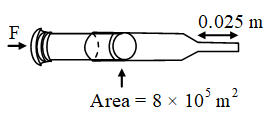 1.00 N (iii)A blood vessel is 0.10 m in length and has a radius of 1.5 × 10– 3 m. Blood flows at a rate of 1 × 10 –7 m 3 /sec through this vessel. The pressure difference that must be maintained for this flow, between the two ends of the vessel, is 20 Pa. What is the viscosity coefficient of blood? 5 × 10 4 Pa.s
Text Solution
Verified by Experts0.25
Ans.
(i)
Sol. The volume flow rate and the mass flow rate are greater for less viscous fluids
(ii)
Sol. 0.25 N
(iii)
Sol. 4 × 10 –3 Pa.s
Prepare Smarter with CGP Edu
Get practice questions, solutions, and test series in one place.
Write a Review
Share your experience with this question and solution.
Commentary
Send your comment, doubt, correction, or feedback to admin.
Similar Questions
Explore conceptually related problems