Small liquid drops of various sizes are in a closed container, to whose walls the liquid does not adhere. Over a sufficiently long time, the size of the smallest drops is found to decrease whilst that of the larger ones increases, until finally only one large drop remains in the container. What is the explanation for this phenomenon?
Text Solution
Verified by ExpertsSol. Consider a closed vessel containing a volume of liquid, with saturated vapour of this liquid filling the rest of the vessel. As illustrated in the figure, let a capillary tube of radius r be immersed in the liquid, which does not wet its walls.
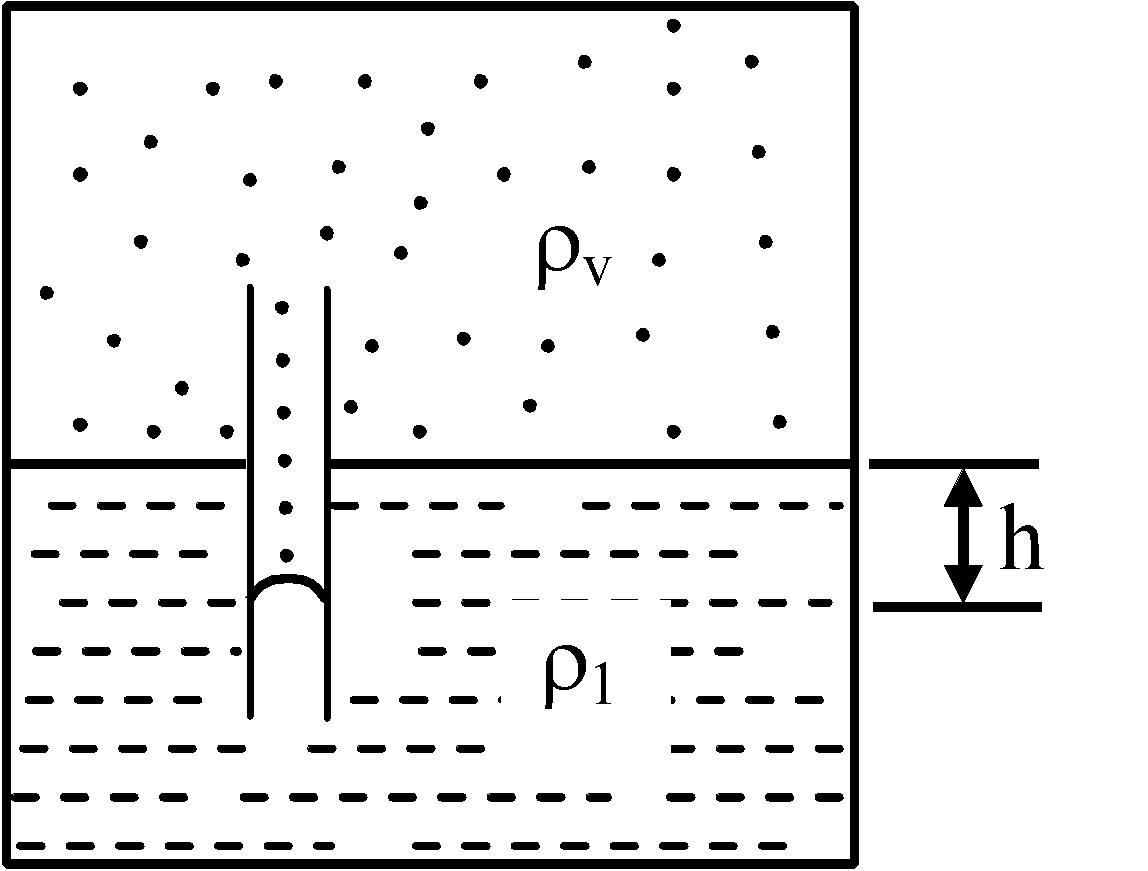
In such circumstances, the level in the capillary tube falls to a depth h below the liquid surface. The magnitude of h can be found using the equilibrium relationship between hydrostatic force and the surface tension of the liquid 2 π r γ = ρ 1 gh π r 2 , where γ is the surface tension of the liquid and ρ 1 is its density. This gives h = 2 γ /( ρ 1 gr).
The liquid is in equilibrium with its saturated vapour, both in the capillary tube and at the plane surface of the liquid. In the capillary tube, however, the pressure of the vapour is a little higher at the interface. The difference is caused by the pressure of the vapour column, of height h and density ρ v , above it. It follows that
Δ p v = ρ v gh = 
 .
.
As ρ v << ρ 1 , this difference between the pressures is much smaller than the pressure of curvature corresponding to the radius r, but, given long enough, it
is sufficient to bring about the phenomenon described.
Prepare Smarter with CGP Edu
Get practice questions, solutions, and test series in one place.
Write a Review
Share your experience with this question and solution.
Commentary
Send your comment, doubt, correction, or feedback to admin.
Similar Questions
Explore conceptually related problems