Published by:
CGP EDU Academic Team
Published on: September 13, 2026
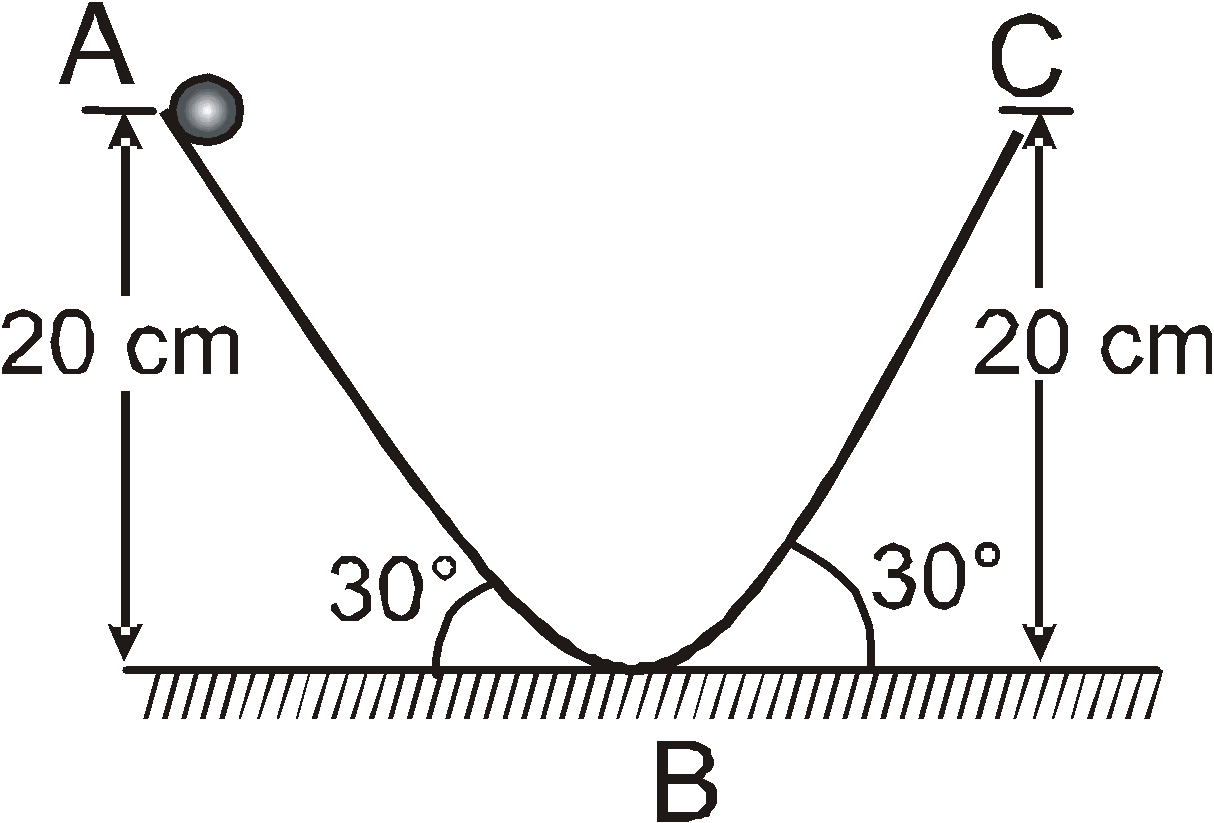
Assuming all the surfaces to be smooth, if the time period of motion of the ball is N × 10 –1 sec then find N. Neglect the small effect of bend near the bottom. (g = 10m/s 2 )
Text Solution
Verified by ExpertsThe correct answer is:
16
(16)
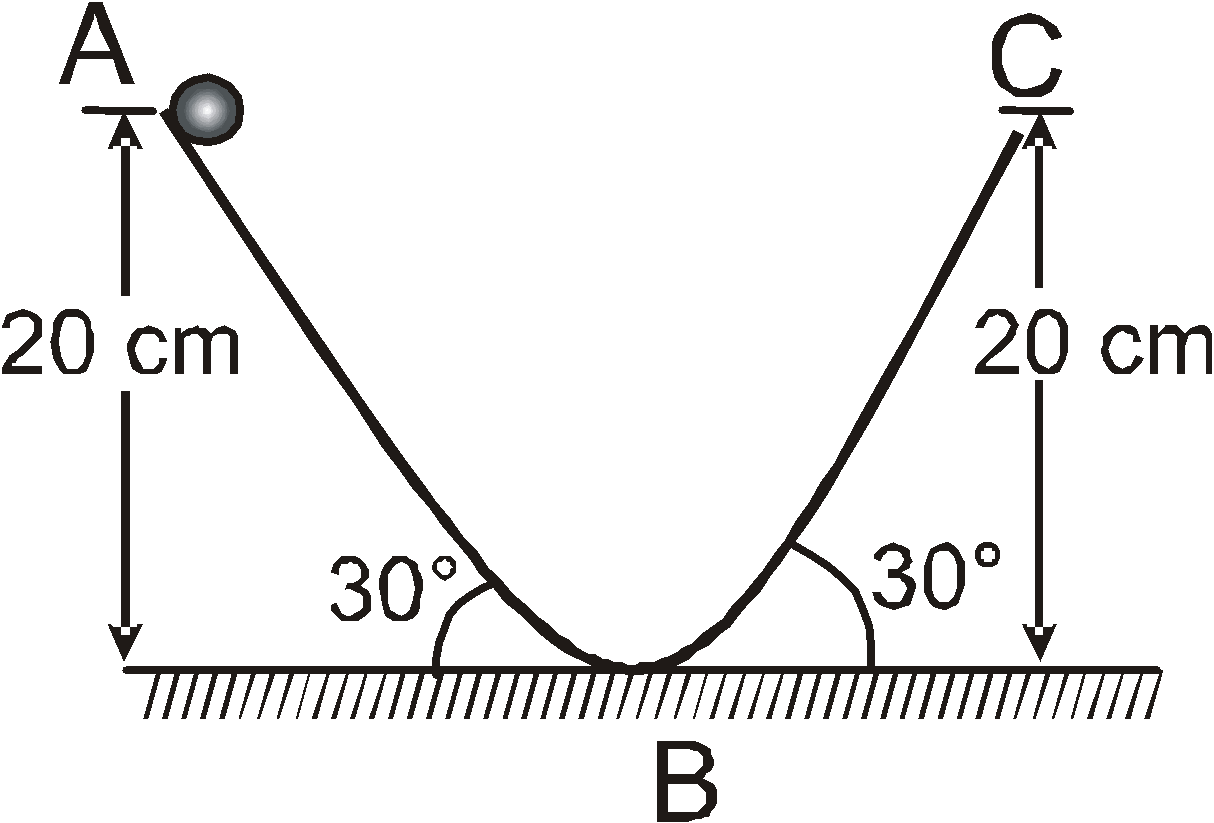
S =  , a = g sin 30, h = 20 cm, u = 0
S = ut + 
⇒ t =  =
=  = 0.4
= 0.4
v = 0 + (g sin30) (0.4) = 2
For BC max height reached by the particle will be same as h = 20 cm
(by energy conservation)
and for BA and BC t = 0.4
Total time period = 0.4 × 4 = 1.6 second = 16×10 –1 sec
∴ N= 16
Prepare Smarter with CGP Edu
Get practice questions, solutions, and test series in one place.
Write a Review
Share your experience with this question and solution.
Commentary
Send your comment, doubt, correction, or feedback to admin.
Similar Questions
Explore conceptually related problems
The total energy of a particle executing S.H.M. is proportional to
The angular velocity and the amplitude of a simple pendulum is ꞷ and a respectively. At a displacem…
<p>If <E> and <U> denote the average kinetic and the average potential energies respect…
A particle of mass m is hanging veritcally by an ideal spring of force constant K. If the mass is m…
A body is moving in a room with a velocity of 20 m /s perpendicular to the two walls separated by 5…
When the kinetic energy of a body executing S.H.M. is 1/3 of the potential energy. The displacement…