When a particle of mass m moves on the x-axis in a potential of the form V(x) = kx 2 , it performs simple harmonic motion. The corresponding time period is proportional to  , as can be seen easily using dimensional analysis. However, the motion of a particle can be periodic even when its potential energy increases on both sides of x = 0 in a way different from kx 2 and its total energy is such that the particle does not escape to infinity. Consider a particle of mass m moving on the x-axis. Its potential energy is V(x) = αx 4 (α > 0) for |x| near the origin and becomes a constant equal to V 0 for |x|
  X 0 (see figure)
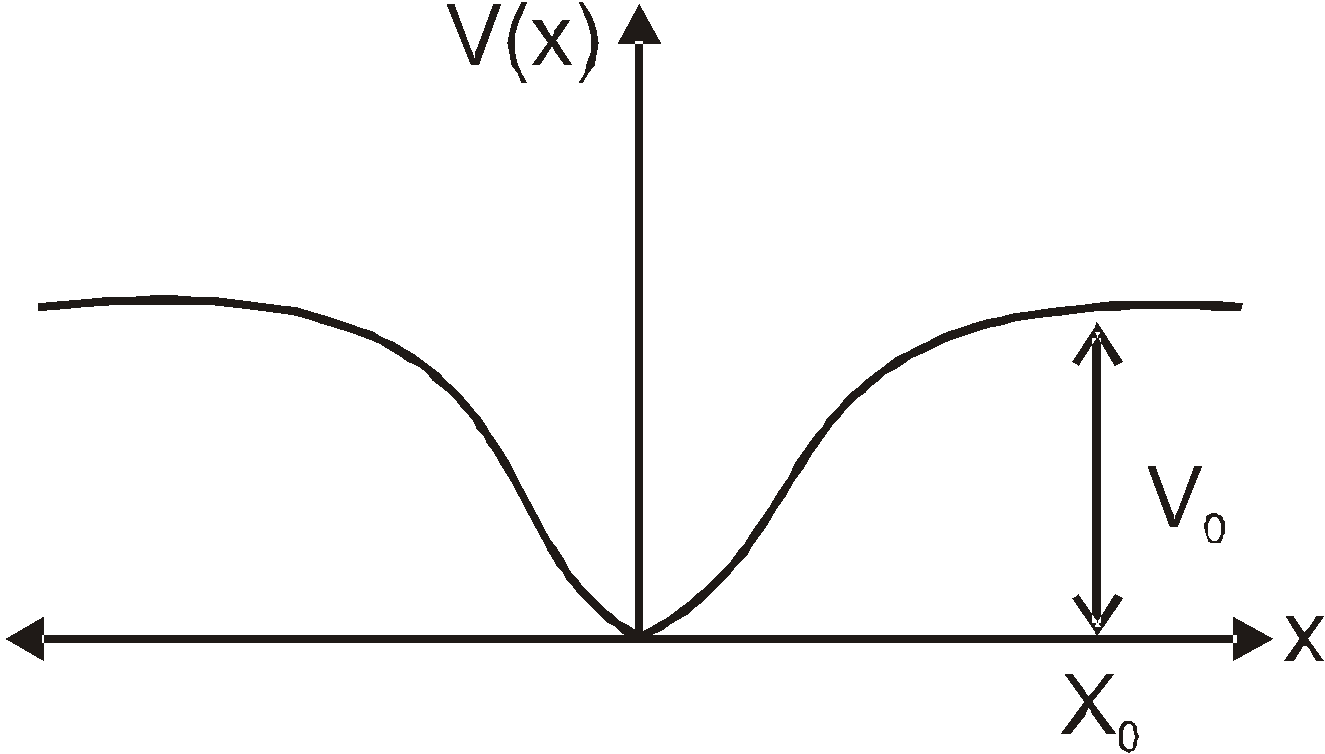
(i) If the total energy of the particle is E, it will perform periodic motion only if:
Text Solution
Verified by Experts(i) When 0 ; (ii) V ; (iii) F ; (iv) , torque is same for both the cases
(i) When 0 < E < V 0 there will be acting a restoring force to perform oscillation because in this case particle will be in the region |x|  x 0 .
x 0 .
(ii) V = αx 4
T.E. =  mꞷ 2 A 2 = αA 4 (not strictly applicable just for dimension matching it is used)
ꞷ 2 = 
⇒ T ∝ 
(iii) F = 
as for |x| > x 0, V = V 0 = constant
⇒  = 0
= 0
⇒ F = 0
(iv) ,
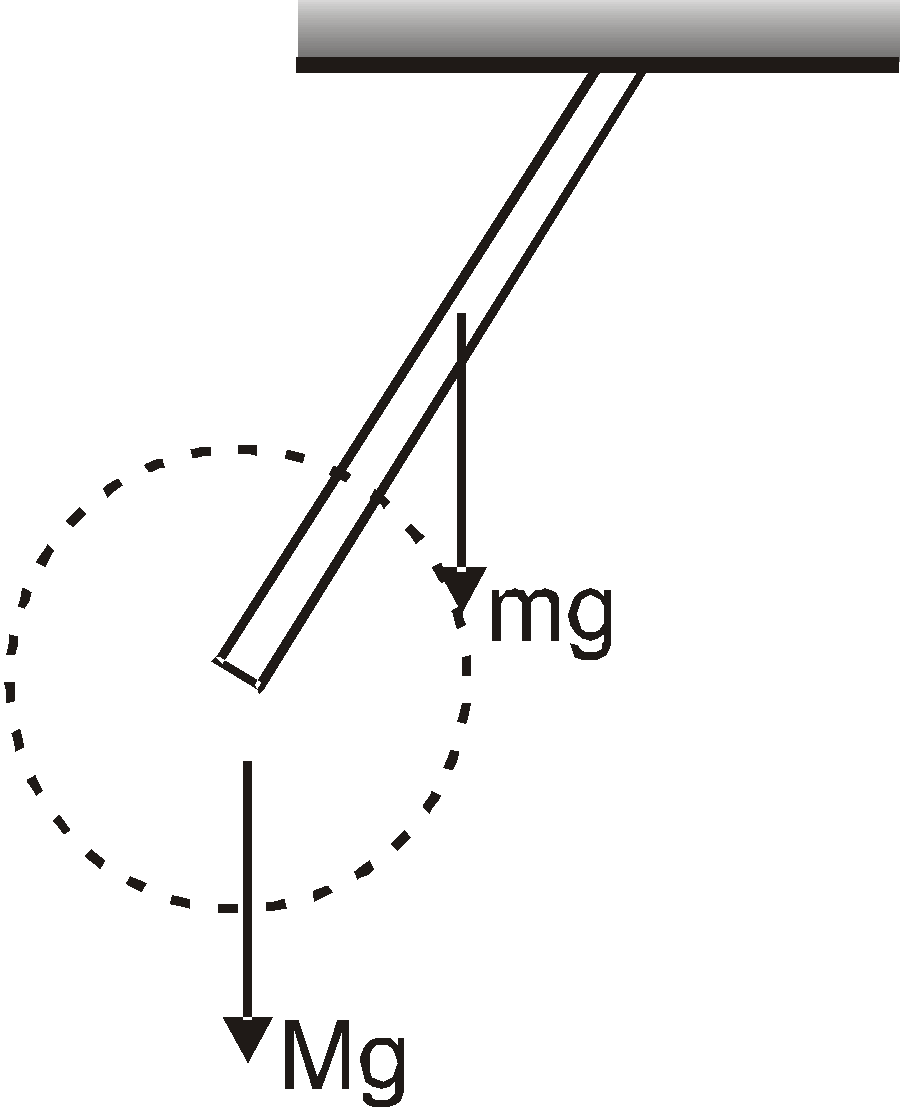
torque is same for both the cases.
T = 
I A > I B
ꞷ A < ꞷ B
Prepare Smarter with CGP Edu
Get practice questions, solutions, and test series in one place.
Write a Review
Share your experience with this question and solution.
Commentary
Send your comment, doubt, correction, or feedback to admin.
Similar Questions
Explore conceptually related problems