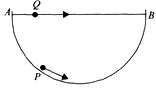
A particle P is sliding down a frictionless hemispherical bowl. It passes the point A and t = 0. At this instant of time, the horizontal component of its velocity is v A bead Q of the same mass as P is ejected from A at t = 0 along the horizontal string AB with speed v. Friction between the bead and the string may be neglected. Let t p and t o be the respective times taken by P and Q to reach point B, then
 .
.
Text Solution
Verified by ExpertsA
Horizontal displacement of both particles is equal. For particle Q, the horizontal velocity is
always equal to v.
For particle P, at the start the motion will be accelerated one, causing increase in velocity.
Thus t p < t Q .
Prepare Smarter with CGP Edu
Get practice questions, solutions, and test series in one place.
Write a Review
Share your experience with this question and solution.
Commentary
Send your comment, doubt, correction, or feedback to admin.
Similar Questions
Explore conceptually related problems