Published by:
CGP EDU Academic Team
Published on: September 12, 2026
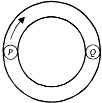
Two balls P and Q are at opposite ends of the diameter of a frictionless horizontal circular groove. P is projected along the groove and at the end of T second, it strikes ball Q. Let difference in their final velocities be proportional to the initial velocity of ball P and coefficient of proportionally is e then second strike occurs at
Text Solution
Verified by ExpertsThe correct answer is:
A
Let u be the initial velocity of ball P, then u =  and difference in final velocities, v' – v =
ev(given)
Time for second strike = 
= 
Prepare Smarter with CGP Edu
Get practice questions, solutions, and test series in one place.
Write a Review
Share your experience with this question and solution.
Commentary
Send your comment, doubt, correction, or feedback to admin.
Similar Questions
Explore conceptually related problems
A body of mass \(\pi\pi\) hangs at one end of a string of length l , the other end of which is fixe…
The tension in the string revolving in a vertical circle with a mass m at the end which is at the l…
A stone of mass m is tied to a string and is moved in a vertical circle of radius r making n revolu…
A tube of length l is filled completely with an incompressible liquid of mass \(\mathbf{M}\) and cl…
The kinetic energy k of a particle moving along a circle of radius R depends on the distance covere…
A car is moving in a circular horizontal track of radius 10 m with a constant speed of 10 m/sec . A…