

Chemical Bonding and Molecular Structure describes the forces that keep molecules together and how atoms combine to create molecules. It starts with the Köss notion of valence electrons and continues to bonding theories such covalent bonding, ionic bonding, and the Octet Rule.
The stability of molecules is determined by bond characteristics such as bond length, bond angle, and bond energy, which are taught to students. This chapter provides the foundation for comprehending chemical interactions and is crucial for competitive exams like JEE and NEET as well as board examinations.
Class 11 Chemistry Chapter 4 Overview
The Chemical Bonding and Molecular Structure chapter explains how atoms combine to form molecules through ionic, covalent and coordinate bonds. It covers Lewis structures, the octet rule, formal charge, resonance and bond parameters. Students also learn molecular shapes through VSEPR theory and different types of hybridisation such as sp, sp² and sp³. Valence Bond Theory and Molecular Orbital Theory explain bond formation, stability, bond order and magnetic behaviour. The chapter also discusses sigma and pi bonds, polarity, dipole moment and hydrogen bonding.
Answer the Following Questions
Question 1: Explain the formation of a chemical bond.
Answer: A chemical bond is the attractive force that holds atoms, ions or other constituents together in a chemical species.
Chemical bond formation occurs because atoms tend to attain a lower-energy and more stable electronic configuration. Noble gases are comparatively unreactive because their outermost shells are completely filled. Atoms with incomplete valence shells generally combine by transferring or sharing electrons to attain a stable duplet or octet.
A covalent bond is formed by the sharing of electron pairs, while an ionic bond is formed by the transfer of electrons from one atom to another. Chemical bonding is explained through the electronic theory, VSEPR theory, valence bond theory and molecular orbital theory.
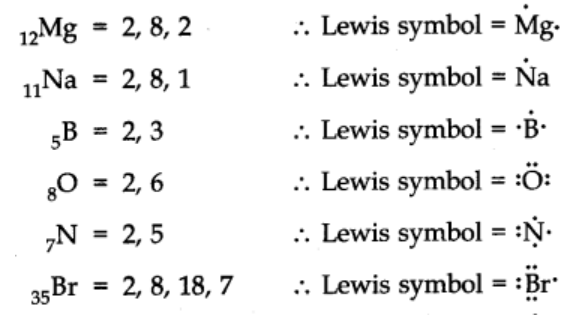
Question 2: Write Lewis dot symbols for atoms of the following elements Mg, Na, B, O, N and Br.
Answer:
Question 3: Write Lewis symbols for S and S²⁻, Al and Al³⁺, H and H⁻.
Answer:
(i) S and S 2–
The number of valence electrons in sulphur is 6.
The Lewis dot symbol of sulphur (S) is  .
.
The dinegative charge infers that there will be two electrons more in addition to the six valence electrons. Hence, the Lewis dot symbol of S 2– is  .
.
(ii) Al and 
The number of valence electrons in aluminium is 3.
The Lewis dot symbol of aluminium (Al) is. AI
The tripositive charge on a species infers that it has donated its three electrons. Hence, the Lewis dot symbol is  .
.
(iii) H and H–
The number of valence electrons in hydrogen is 1.
The Lewis dot symbol of hydrogen (H) is H.
The uninegative charge infers that there will be one electron more in addition to the one valence electron. Hence, the Lewis dot symbol is  .
.
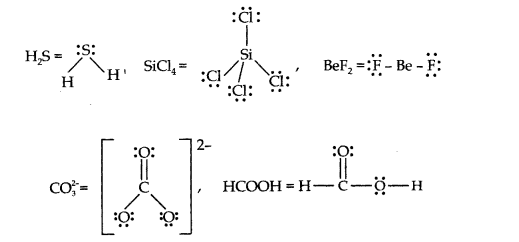
Question 4: Draw the Lewis structures of H₂S, SiCl₄, BeF₂, CO₃²⁻ and HCOOH.
Answer:
Question 5: Define the octet rule. Write its significance and limitations.
Answer:
The octet rule or the electronic theory of chemical bonding was developed by Kossel and Lewis. According to this rule, atoms can combine either by transfer of valence electrons from one atom to another or by sharing their valence electrons in order to attain the nearest noble gas configuration by having an octet in their valence shell.
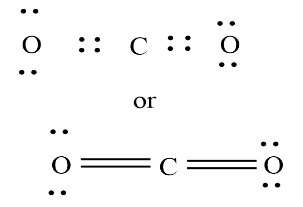
The octet rule successfully explained the formation of chemical bonds depending upon the nature of the element.
Limitations of the octet theory:
The following are the limitations of the octet rule:
(a) The rule failed to predict the shape and relative stability of molecules.
(b) It is based upon the inert nature of noble gases. However, some noble gases like xenon and krypton form compounds such as XeF2, KrF2 etc.
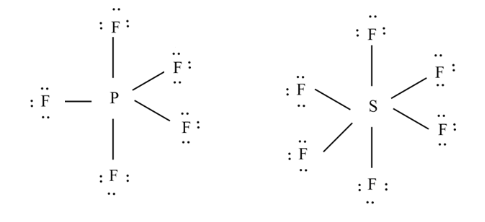
(c) The octet rule cannot be applied to the elements in and beyond the third period of the periodic table. The elements present in these periods have more than eight valence electrons around the central atom. For example: PF 5 , SF 6 , etc.
(d) The octet rule is not satisfied for all atoms in a molecule having an odd number of electrons. For example, NO and NO 2 do not satisfy the octet rule.
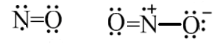
(e) This rule cannot be applied to those compounds in which the number of electrons surrounding the central atom is less than eight. For example, LiCl, BeH2, AlCl3 etc. do not obey the octet rule.
Question 6: Write the favourable factors for the formation of an ionic bond.
Answer:
An ionic bond is formed by the transfer of one or more electrons from one atom to another. Hence, the formation of ionic bonds depends upon the ease with which neutral atoms can lose or gain electrons. Bond formation also depends upon the lattice energy of the compound formed.
Hence, favourable factors for ionic bond formation are as follows:
(i) Low ionization enthalpy of metal atom.
(ii) High electron gain enthalpy (Δeg H) of a non-metal atom.
(iii) High lattice energy of the compound formed.
Question 7: Discuss the shapes of the molecules using the VSEPR model.
BeCl₂, BCl₃, SiCl₄, AsF₅, H₂S and PH₃
Answer
BeCl 2 :

The central atom has no lone pair and there are two bond pairs. i.e., BeCl 2 is of the type AB 2 . Hence, it has a linear shape.
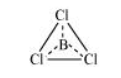
BCl 3 :

The central atom has no lone pair and there are three bond pairs. Hence, it is of the type AB 3 . Hence, it is trigonal planar.
SiCl 4 :

The central atom has no lone pair and there are four bond pairs. Hence, the shape of SiCl4 is tetrahedral being the AB4 type molecule.
AsF 5 :
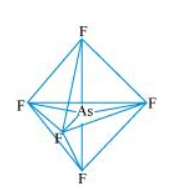
The central atom has no lone pair and there are five bond pairs. Hence, AsF 5 is of the type AB 5 . Therefore, the shape is trigonal bipyramidal.
H 2 S:

The central atom has one lone pair and there are two bond pairs. Hence, H 2 S is of the type AB 2 E. The shape is Bent.
PH 3 :

The central atom has one lone pair and there are three bond pairs. Hence, PH 3 is of the AB 3 E type. Therefore, the shape is trigonal pyramidal.
Question 8:Although geometries of NH₃ and H₂O molecules are distorted tetrahedral, bond angle in water is less than that of ammonia. Discuss.
Answer
The molecular geometry of NH 3 and H 2 O can be shown as:
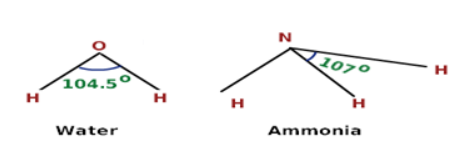
The central atom (N) in NH3 has one lone pair and there are three bond pairs. In H 2 O, there are two lone pairs and two bond pairs.
The two lone pairs present in the oxygen atom of H 2 O molecule repels the two bond pairs. This repulsion is stronger than the repulsion between the lone pair and the three bond pairs on the nitrogen atom.
Since the repulsions on the bond pairs in H 2 O molecule are greater than that in NH 3 , the bond angle in water is less than that of ammonia.
Question 9: How do you express the is bond strength in terms of bond order?
Answer
Bond strength represents the extent of bonding between two atoms forming a molecule. The larger the bond energy, the stronger is the bond and the greater is the bond order.
Question 10: Define bond length.
Answer
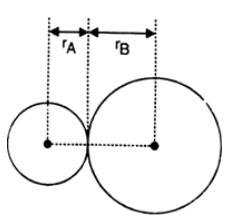
Bond length is the equilibrium distance between the nuclei of two bonded atoms in a molecule. It is commonly expressed in picometres (pm) or angstroms (Å), where 1 Å = 10⁻¹⁰ m and 1 pm = 10⁻¹² m.
For an ionic compound, the internuclear distance is approximately the sum of the ionic radii: d = r⁺ + r⁻. For a covalent bond between atoms A and B, it is approximately the sum of their covalent radii: d = rA + rB.
Question 11:Explain the important aspects of resonance with reference to the CO₃²⁻.
Answer
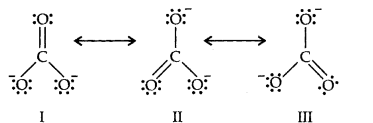
According to experimental findings, all carbon to oxygen bonds in  are equivalent. Hence, it is inadequate to represent
  ion by a single Lewis structure having two single bonds and one double bond.
Therefore, carbonate ion is described as a resonance hybrid of the following structures:
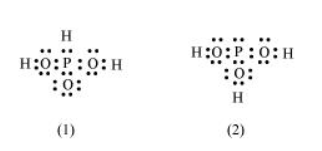
Question 12: H₃PO₃ Can be represented by structures 1 and 2 show below. Can the two commonly shown structures of H₃PO₃ be treated as resonance forms? Give a reason.
Answer
No. Resonance structures must have the same arrangement of atoms and may differ only in the positions of electrons, pi bonds and formal charges. If the positions of hydrogen or oxygen atoms change, the structures are structural isomers or tautomers rather than resonance forms. The accepted structure of phosphorous acid is H-P(=O)(OH)₂.
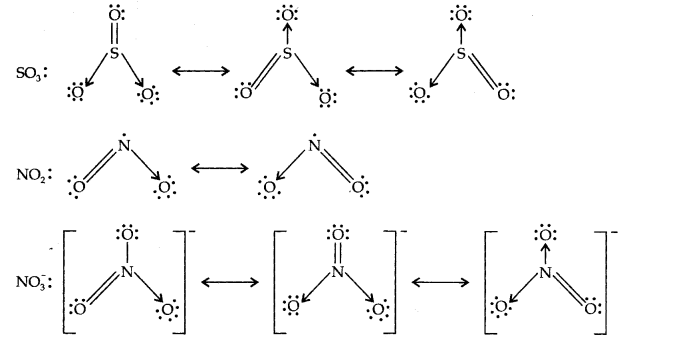
Question 13: Write the resonance structures for SO₃, NO₂ and NO₃⁻.
Answer
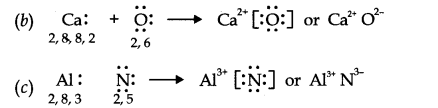
Question 14:Use Lewis symbols to show electron transfer between the following atoms to form cations and anions: (a) K and S (b) Ca and O (c) Al and N.
Answer

Question 15: Although both CO 2 and H 2 O are triatomic molecules, the shape of H 2 O molecule is bent while that of CO 2 is linear. Explain this on the basis of dipole moment.
Answer
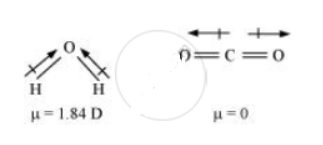
According to experimental results, the dipole moment of carbon dioxide is zero. This is possible only if the molecule is linear so that the dipole moments of C–O bonds are equal and opposite to nullify each other.
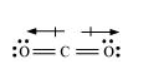
Resultant μ = 0 D
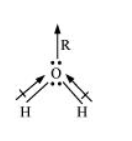
H 2 O, on the other hand, has a dipole moment value of 1.84 D (though it is a triatomic molecule as CO 2 ). The value of the dipole moment suggests that the structure of H 2 O molecule is bent where the dipole moment of O–H bonds are unequal.
Question 16: Write the significance / applications of dipole moment.
Answer
In heteronuclear molecules, polarization arises due to a difference in the electronegativities of the constituents of atoms. As a result, one end of the molecule acquires a positive charge while the other end becomes negative. Hence, a molecule is said to possess a dipole.
The product of the magnitude of the charge and the distance between the centres of positive-negative charges is called the dipole moment (μ) of the molecule. It is a vector quantity and is represented by an arrow with its tail at the positive centre and head pointing towards a negative centre.
Dipole moment (μ) = charge (Q) × distance of separation (r)
The SI unit of a dipole moment is ‘esu’.
1 esu = 3.335 × 11–30 Cm
Dipole moment is the measure of the polarity of a bond. It is used to differentiate between polar and non-polar bonds since all non-polar molecules (e.g. H2, O2) have zero dipole moments. It is also helpful in calculating the percentage ionic character of a molecule.
Question 17: Define electronegativity. How does it differ from electron gain enthalpy?
Answer
Electronegativity is the ability of an atom in a chemical compound to attract a bond pair of electrons towards itself.
Electronegativity of any given element is not constant. It varies according to the element to which it is bound. It is not a measurable quantity. It is only a relative number.
On the other hand, electron gain enthalpy is the enthalpy change that takes place when an electron is added to a neutral gaseous atom to form an anion. It can be negative or positive depending upon whether the electron is added or removed. An element has a constant value of the electron gain enthalpy that can be measured experimentally.
Question 18: Explain with the help of suitable example polar covalent bond.
Answer
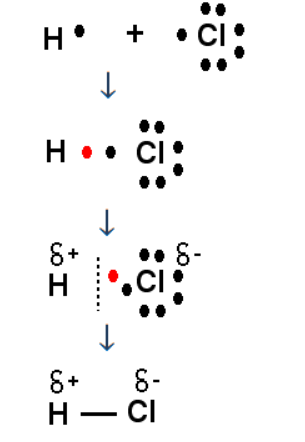
When two dissimilar atoms having different electronegativities combine to form a covalent bond, the bond pair of electrons is not shared equally. The bond pair shifts towards the nucleus of the atom having greater electronegativity. As a result, electron distribution gets distorted and the electron cloud is displaced towards the electronegative atom.
As a result, the electronegative atom becomes slightly negatively charged while the other atom becomes slightly positively charged. Thus, opposite poles are developed in the molecule and this type of a bond is called a polar covalent bond.
HCl, for example, contains a polar covalent bond. Chlorine atom is more electronegative than hydrogen atom. Hence, the bond pair lies towards chlorine and therefore, it acquires a partial negative charge.
Question 19:Arrange the bonds in order of increasing ionic character in the molecules: LiF, K 2 O, N 2 , SO 2 and ClF 3 .
Answer
Ionic character generally increases with the electronegativity difference between the bonded atoms. The expected increasing order is:
N₂ < SO₂ < ClF₃ < K₂O < LiF
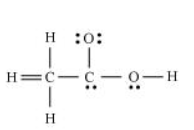
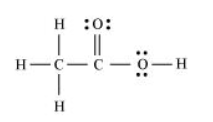
Question 20:The skeletal structure of CH 3 COOH as shown below is correct, but some of the bonds are shown incorrectly. Write the correct Lewis structure for acetic acid.
Answer
The correct Lewis structure for acetic acid is as follows:
Question 21:Apart from tetrahedral geometry, another possible geometry for CH 4 is square planar with the four H atoms at the corners of the square and the C atom at its centre. Explain why CH 4 is not square planar?
Answer
Electronic configuration of carbon atom:
6C: 1s 2 2s 2 2p 2
In the excited state, the orbital picture of carbon can be represented as:
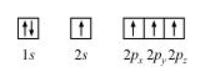
Hence, carbon atom undergoes sp 3 hybridization in CH 4 molecule and takes a tetrahedral shape.
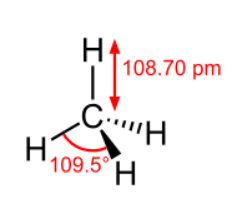
For a square planar shape, the hybridization of the central atom has to be dsp 2 . However, an atom of carbon does not have d-orbitalsto undergo dsp 2 hybridization. Hence, the structure of CH 4 cannot be square planar.
Moreover, with a bond angle of 90° in square planar, the stability of CH 4 will be very less because of the repulsion existing between the bond pairs. Hence, VSEPR theory also supports a tetrahedral structure for CH 4 .
Question 22: Explain why BeH 2 molecule has a zero dipole moment although the Be–H bonds are polar.
Solution
The Lewis structure for BeH 2 is as follows:

There is no lone pair at the central atom (Be) and there are two bond pairs. Hence, BeH 2 is of the type AB 2 . It has a linear structure.
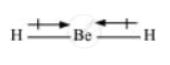
Dipole moments of each H–Be bond are equal and are in opposite directions. Therefore, they nullify each other. Hence, BeH2 molecule has zero dipole moment.
Question 23: Which out of NH 3 and NF 3 has higher dipole moment and why?
Answer
In both molecules i.e., NH3 and NF3 , the central atom (N) has a lone pair electron and there are three bond pairs. Hence, both molecules have a pyramidal shape. Since fluorine is more electronegative than hydrogen, it is expected that the net dipole moment of NF3 is greater than NH3 . However, the net dipole moment of NH3 (1.46 D) is greater than that of NF3 (0.24 D).
This can be explained on the basis of the directions of the dipole moments of each individual bond in NF 3 and NH 3 . These directions can be shown as:
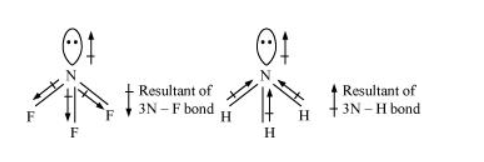
Thus, the resultant moment of the N–H bonds add up to the bond moment of the lone pair (the two being in the same direction), whereas that of the three N – F bonds partly cancels the moment of the lone pair.
Hence, the net dipole moment of NF3 is less than that of NH3.
Question 24: What is meant by hybridisation of atomic orbitals? Describe the shapes of sp, sp2 , sp3 hybrid orbitals.
Answer
Hybridization is defined as an intermixing of a set of atomic orbitals of slightly different energies, thereby forming a new set of orbitals having equivalent energies and shapes.
For example, one 2s-orbital hybridizes with two 2p-orbitals of carbon to form three new sp 2 hybrid orbitals.
These hybrid orbitals have minimum repulsion between their electron pairs and thus, are more stable. Hybridization helps indicate the geometry of the molecule.
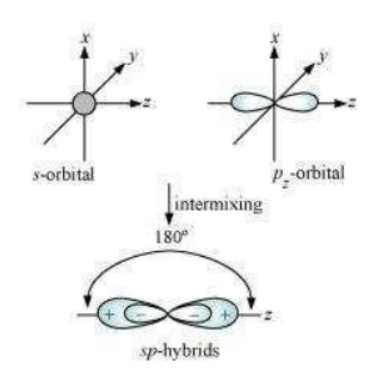
Shape of sp hybrid orbitals: sp hybrid orbitals have a linear shape.
They are formed by the intermixing of s and p orbitals as:
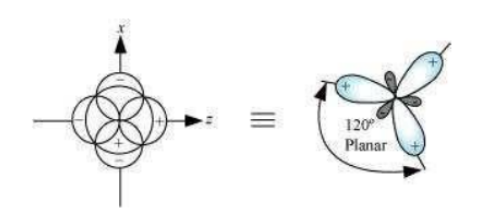
Shape of sp 2 hybrid orbitals:
sp 2 hybrid orbitals are formed as a result of the intermixing of one s-orbital and two 2p-orbitals. The hybrid orbitals are oriented in a trigonal planar arrangement as:
Shape of sp 3 hybrid orbitals:
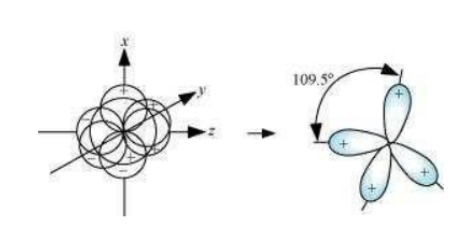
Four sp 3 hybrid orbitals are formed by intermixing one s-orbital with three p-orbitals.
The four sp 3 hybrid orbitals are arranged in the form of a tetrahedron as:
Question 25:Describe the change in hybridisation (if any) of the Al atom in the following reaction.
AlCl 3 + Cl – → AlCl – 4
Answer
Electronic configuration of 13Al = 1s2 2s2 2p6 3s1 3px13py1
(excited state)
Hence, hybridisation will be SP2
In AlCl–4, the empty 3pz orbital is also involved. So, the hybridisation is sp3 and the shape is tetrahedral.
Question 26: Is there any change in the hybridisation of B and N atoms as a result of the following reaction?
BF 3 + NH 3 → F 3 B.NH 3
Answer
In BF3, B atom is sp2 hybridised. In NH3, N is sp3 hybridised.
After the reaction, hybridisation of B changes from sp2 to sp3.
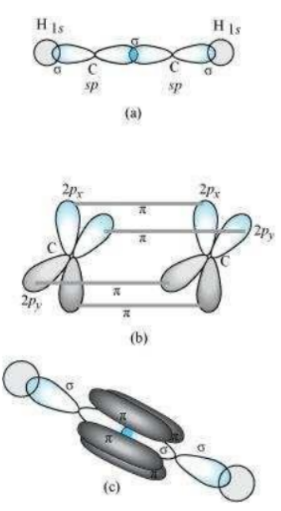
Question 27: Draw diagrams showing the formation of a double bond and a triple bond between carbon atoms in C 2 H 4 and C 2 H 2 molecules.
Answer
C 2 H 4 :
The electronic configuration of C-atom in the excited state is:
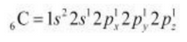
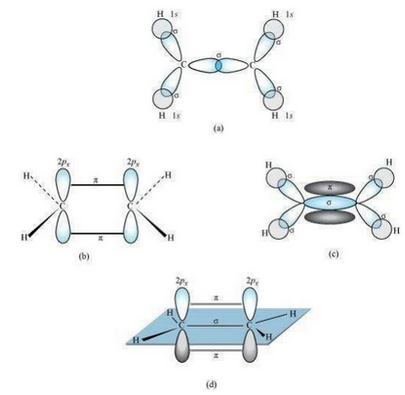
In the formation of an ethane molecule (C 2 H 4 ), one sp2 hybrid orbital of carbon overlaps a sp2 hybridized orbital of another carbon atom, thereby forming a C-C sigma bond.
The remaining two sp 2 orbitals of each carbon atom form a sp 2 -s sigma bond with two hydrogen atoms. The unhybridized orbital of one carbon atom undergoes sidewise overlap with the orbital of a similar kind present on another carbon atom to form a weak π-bond.
C 2 H 2 :
In the formation of C 2 H 2 molecule, each C–atom is sp hybridized with two 2p-orbitals in an unhybridized state.
One sp orbital of each carbon atom overlaps with the other along the internuclear axis forming a C–C sigma bond. The second sp orbital of each C–atom overlaps a half-filled 1s-orbital to form a σ bond.
The two unhybridized 2p-orbitals of the first carbon undergo sidewise overlap with the 2p orbital of another carbon atom, thereby forming two pi (π) bonds between carbon atoms. Hence, the triple bond between two carbon atoms is made up of one sigma and two π-bonds.
Question 28: What is the total number of sigma and pi bonds in the following molecules?
(a) C 2 H 2
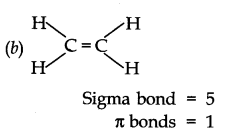
(b) C 2 H 4
Answer
(a) H—C = C—H
Sigma bond = 3 Π bonds = 2
Question 29: Considering x-axis as the internuclear axis which out of the following will not form a sigma bond and why? (a) 1s and 1s (b) 1s and 2px (c) 2py and 2py (d) 1s and 2s.
Answer
2py and 2py orbitals will not a form a sigma bond. Taking x-axis as the internuclear axis, 2py and 2py orbitals will undergo lateral overlapping, thereby forming a pi (π) bond.
Question 30: Which hybrid orbitals are used by carbon atoms in the following molecules?
CH 3 –CH 3 ; (b) CH 3 –CH=CH 2 ; (c) CH 3 -CH 2 -OH; (d) CH 3 -CHO (e) CH 3 COOH
Answer
(a)
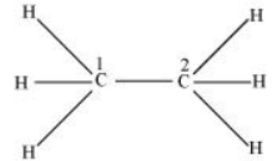
Both C 1 and C 2 are sp 3 hybridized.
(b)
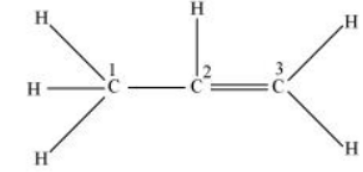
C 1 is sp 3 hybridized, while C 2 and C 3 are sp 2 hybridized.
(c)
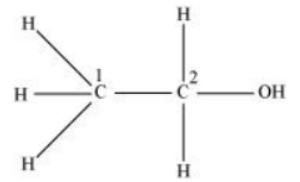
Both C 1 and C 2 are sp 3 hybridized.
(d)
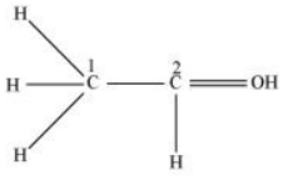
C 1 is sp 3 hybridized and C 2 is sp 2 hybridized.
(e)
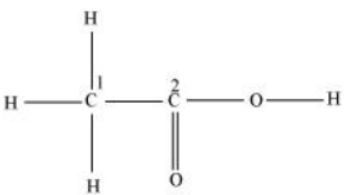
C 1 is sp 3 hybridized and C 2 is sp 2 hybridized.
Question 31: What do you understand by bond pairs and lone pairs of electrons? Illustrate by giving one example of each type.
Answer
When two atoms combine by sharing their one or more valence electrons, a covalent bond is formed between them.
The shared pairs of electrons present between the bonded atoms are called bond pairs. All valence electrons may not participate in bonding. The electron pairs that do not participate in bonding are called lone pairs of electrons.
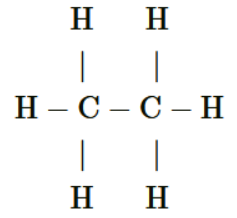
For example, in C 2 H 6 (ethane), there are seven bond pairs but no lone pair present.
In H2O, there are two bond pairs and two lone pairs on the central atom (oxygen).
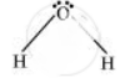
Question 32: Distinguish between sigma and pi bonds.
Answer
The following are the differences between sigma and pi-bonds:
| Sigma (σ) Bond | Pi (π) Bond |
|---|---|
| (a) It is formed by the end to end overlap of orbitals. | It is formed by the lateral overlap of orbitals. |
| (b) The orbitals involved in the overlapping are s–s, s–p, or p–p. | These bonds are formed by the overlap of p–p orbitals only. |
| (c) It is a strong bond. | It is weak bond. |
| (d) The electron cloud is symmetrical about the line joining the two nuclei. | The electron cloud is not symmetrical. |
| (e) It consists of one electron cloud, which is symmetrical about the internuclear axis. | There are two electron clouds lying above and below the plane of the atomic nuclei. |
| (f) Free rotation about σ bonds is possible. | Rotation is restricted in case of pi-bonds. |
Question 33. Explain the formation of H 2 molecule on the basis of valence bond theory.
Answer
Let us assume that two hydrogen atoms (A and B) with nuclei (NA and NB) and electrons (eA and eB) are taken to undergo a reaction to form a hydrogen molecule.
When A and B are at a large distance, there is no interaction between them. As they begin to approach each other, the attractive and repulsive forces start operating.
Attractive force arises between:
(a) Nucleus of one atom and its own electron i.e., NA – eA and NB – eB.
(b) Nucleus of one atom and electron of another atom i.e., NA – eB and NB – eA.
Repulsive force arises between:
(a) Electrons of two atoms i.e., eA – eB.
(b) Nuclei of two atoms i.e., NA – NB.
The force of attraction brings the two atoms together, whereas the force of repulsion tends to push them apart.
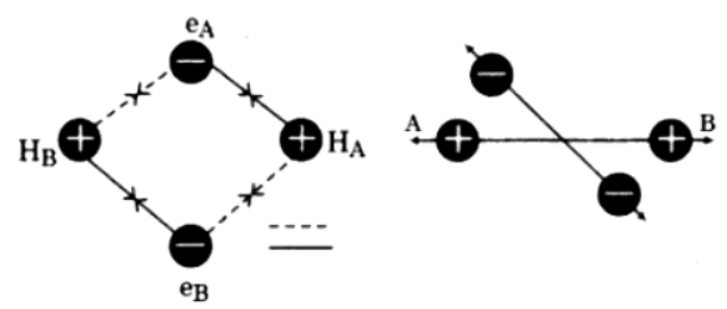
The magnitude of the attractive forces is more than that of the repulsive forces. Hence, the two atoms approach each other. As a result, the potential energy decreases. Finally, a state is reached when the attractive forces balance the repulsive forces and the system acquires minimum energy. This leads to the formation of a dihydrogen molecule.
Question 34: Write the important conditions required for the linear combination of atomic orbitals to form molecular orbitals.
Answer
The given conditions should be satisfied by atomic orbitals to form molecular orbitals:
(a) The combining atomic orbitals must have the same or nearly the same energy. This means that in a homonuclear molecule, the 1s-atomic orbital of an atom can combine with the 1s-atomic orbital of another atom, and not with the 2s-orbital.
(b) The combining atomic orbitals must have proper orientations to ensure that the overlap is maximum.
(c) The extent of overlapping should be large.
Question 35: Use molecular orbital theory to explain why the Be 2 molecule does not exist.
Answer
The electronic configuration of Beryllium is 1s 2 2s 2
The molecular orbital electronic configuration for Be 2 molecule can be written as:
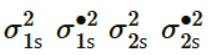
Hence, the bond order for Be2 is 1/2(Nb – Na)
Where,
Nb = Number of electrons in bonding orbitals
Na = Number of electrons in anti-bonding orbitals
∴ Bond order of Be2 1/2(4 – 4) = 0
A negative or zero bond order means that the molecule is unstable. Hence, Be2 molecule does not exist.
Question 36: Compare the relative stability of the following species and indicate their magnetic properties;
O 2 ,O 2 + ,O 2 – (superoxide), O 2 2- (peroxide)
Answer
O2— Bond order = 2, paramagnetic
O2+— Bond order = 2.5, paramagnetic
O2–— Bond order = 1.5, paramagnetic
O22- — Bond order = 1, diamagnetic
Order of relative stability is
O2+ > O2 > O2– > O22-
(2.5) (2.0) (1.5) (1.0)
Question 37: Write the significance of a plus and a minus sign shown in representing the orbitals.
Answer
Molecular orbitals are represented by wave functions. A plus sign in an orbital indicates a positive wave function while a minus sign in an orbital represents a negative wave function.
Question 38: Describe the hybridisation in case of PCl5. Why are the axial bonds longer as compared to equatorial bonds?
Answer
The ground state E.C. and the excited state E.C. of phosphorus are represented as:
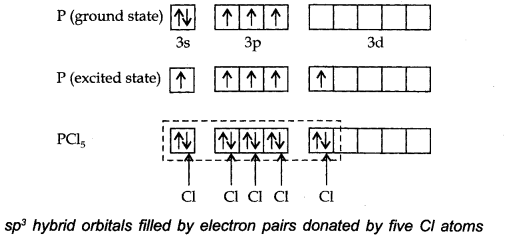
The one s, three-p and one d-orbitals hybridise to yield five sets of SP3 d hybrid orbitals which are directed towards the five corners of a trigonal bipyramidal as in Fig.
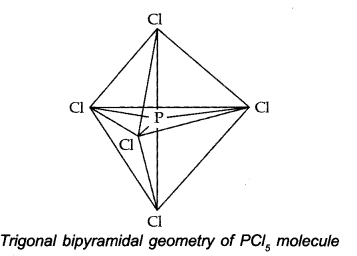
Because axial bond pairs suffer more repulsive interaction from the equatorial bond pairs, therefore axial bonds have been found to be slightly longer and hence slightly weaker than equatorial bonds.
Question 39: Define hydrogen bond. Is it weaker or stronger than the van der Waals forces?
Answer
A hydrogen bond is defined as an attractive force acting between the hydrogen attached to an electronegative atom of one molecule and an electronegative atom of a different molecule (may be of the same kind).
Due to a difference between electronegativities, the bond pair between hydrogen and the electronegative atom gets drifted far away from the hydrogen atom. As a result, a hydrogen atom becomes electropositive with respect to the other atom and acquires a positive charge.

The magnitude of H-bonding is maximum in the solid state and minimum in the gaseous state.
There are two types of H-bonds:
(i) Intermolecular H-bond e.g., HF, H 2 O etc.
(ii) Intramolecular H-bond e.g., o-nitrophenol
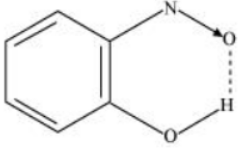
Hydrogen bonds are stronger than Van der Walls forces since hydrogen bonds are regarded as an extreme form of dipole-dipole interaction.
Question 40: What is meant by the term bond order? Calculate the bond order of: N 2 , O 2 ,O 2 + and O 2 – .
Answer
Bond order is defined as one half of the difference between the number of electrons present in the bonding and anti-bonding orbitals of a molecule.
If Na is equal to the number of electrons in an anti-bonding orbital, then Nb is equal to the number of electrons in a bonding orbital.
Bond order = [no. of electrons in bonding MO – no. of electrons in antibonding MO]/2
If Nb > Na, then the molecule is said be stable. However, if Nb ≤ Na, then the molecule is considered to be unstable.
Bond order of N 2 can be calculated from its electronic configuration as:

Number of bonding electrons, Nb = 11
Number of anti-bonding electrons, Na = 4
Bond order of nitrogen molecule 1/2(11 – 4) = 3
There are 16 electrons in a dioxygen molecule, 8 from each oxygen atom. The electronic configuration of oxygen molecule can be written as:

Since the 1s orbital of each oxygen atom is not involved in boding, the number of bonding electrons = 8 = Nb and the number of anti-bonding electrons = 4 = Na.
Bond order 1/2(8-4)
= 2
Hence, the bond order of oxygen molecule is 2.
Similarly, the electronic configuration of  can be written as:

Nb = 8
Na = 3
Bond order of 1/2(8 – 5)
= 2.5
Thus, the bond order of  is 2.5.
The electronic configuration of  ion will be:

Nb = 8
Na = 5
Bond order of 1/2(8 – 5)
= 1.5
Thus, the bond order of  ion is 1.5.
Why Class 11 Chemistry Chapter 4 Matters in NEET and JEE
Class 11 Chemistry Chapter 4 is highly important for NEET and JEE because chemical bonding forms the foundation of inorganic and organic chemistry. Questions are frequently asked from Lewis structures, the octet rule, formal charge, resonance, VSEPR theory, hybridisation, molecular shapes and bond parameters. Students must also understand dipole moment, hydrogen bonding, sigma and pi bonds, Molecular Orbital Theory, bond order and magnetic behaviour. JEE often includes reasoning-based and numerical questions involving molecular geometry, hybridisation and bond order. NEET commonly tests NCERT-based facts, structures, exceptions and the magnetic nature of molecules such as O₂. A strong understanding of this chapter helps students solve questions from coordination compounds, p-block chemistry, organic reaction mechanisms and molecular structure more accurately.
Preparation Tips for Class 11 Chemistry Chapter 4
Begin by understanding the octet rule, Lewis structures, formal charge, resonance and the formation of ionic and covalent bonds. Learn how to count valence electrons and draw correct structures before studying molecular shapes. Prepare a chart of VSEPR types, bond pairs, lone pairs, hybridisation, geometry and bond angles. Focus on the difference between electron-pair geometry and molecular shape. Regularly practise molecules such as BeCl₂, BCl₃, CH₄, NH₃, H₂O, PCl₅ and SF₆.
Study sigma and pi bonds, dipole moment, hydrogen bonding and bond parameters carefully. Learn the basic rules of Molecular Orbital Theory and practise calculating bond order and predicting magnetic behaviour. Pay attention to important comparisons such as NH₃ and NF₃, CO₂ and H₂O, and O₂, O₂⁺, O₂⁻ and O₂²⁻. Complete all NCERT examples and exercise questions before attempting JEE and NEET previous-year questions. Regular revision of structures, shapes, hybridisation and exceptions will improve speed and accuracy.
FAQs
What are the most important topics in Class 11 Chemistry Chapter 4?
The most important topics are Lewis structures, the octet rule, ionic and covalent bonds, formal charge, resonance, VSEPR theory, hybridisation, molecular shapes, dipole moment, hydrogen bonding, Molecular Orbital Theory and bond order.
How can students identify the shape of a molecule?
Students should first draw the Lewis structure and count the bond pairs and lone pairs around the central atom. The molecular shape can then be predicted using VSEPR theory by considering the repulsions between electron pairs.
What is the difference between sigma and pi bonds?
A sigma bond is formed by head-on overlap of atomic orbitals and is generally stronger. A pi bond is formed by sidewise overlap of parallel p orbitals. Single bonds contain one sigma bond, double bonds contain one sigma and one pi bond, and triple bonds contain one sigma and two pi bonds.
Why is the bond angle in H₂O smaller than in NH₃?
H₂O contains two lone pairs on the oxygen atom, while NH₃ contains one lone pair on nitrogen. Lone pair repulsions are stronger than bond pair repulsions, so the O to H bonds are pushed closer together, reducing the bond angle in water.
What is bond order and why is it important?
Bond order is half the difference between the number of electrons in bonding and antibonding molecular orbitals. A higher bond order generally indicates a stronger and shorter bond. A molecule with zero or negative bond order is usually unstable.
Is Chemical Bonding and Molecular Structure important for JEE and NEET?
Yes. JEE and NEET frequently include questions on Lewis structures, molecular shapes, hybridisation, dipole moment, hydrogen bonding, bond order and magnetic behaviour. This chapter is also essential for understanding inorganic chemistry, organic chemistry and coordination compounds.