
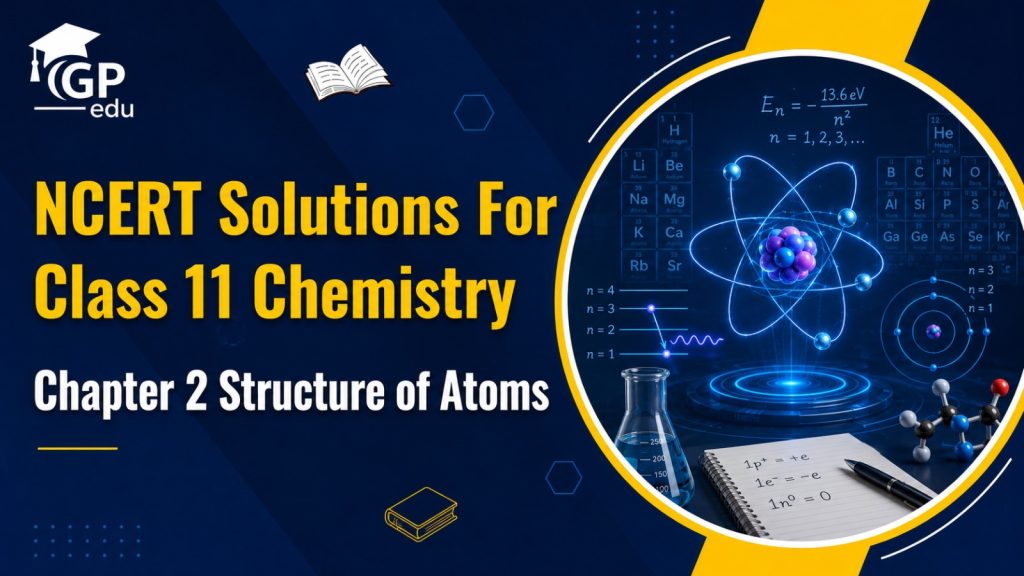
The Structure of Atom chapter explains the discovery of electrons, protons, and neutrons and describes their masses, charges, and locations inside an atom. It discusses Thomson’s atomic model, Rutherford’s nuclear model, and Bohr’s model of the hydrogen atom. Students also learn about atomic number, mass number, isotopes, and isobars. The chapter introduces electromagnetic radiation, wavelength, frequency, wave number, and Planck’s quantum theory. It also explains the hydrogen spectrum and the movement of electrons between different energy levels.
The chapter further discusses the dual nature of matter, de Broglie’s equation, and the Heisenberg Uncertainty Principle. These ideas lead to the quantum mechanical model, which describes electrons in terms of probability instead of fixed circular paths. Students learn about the four quantum numbers and the shapes of s, p, d, and f orbitals. The Aufbau Principle, Pauli Exclusion Principle, and Hund’s Rule are used to write electronic configurations correctly. These concepts provide the foundation for chemical bonding, periodic properties, and molecular structure.
NCERT Solutions For Class 11 Chemistry Chapter 2-Structure of Atom
Question 2.1:
(i) Calculate the number of electrons which will together weigh one gram.
(ii) Calculate the mass and charge of one mole of electrons.
Solution:
(i) Mass of 1 electron = 9.10939 × 10⁻²⁸ g
Number of electrons in 1 g = 19.10939 × 10⁻²⁸ = 1.098 × 10²⁷ electrons
(ii) Mass of 1 mole of e⁻ = (9.10939 × 10⁻³¹ kg) × (6.022 × 10²³) = 5.48 × 10⁻⁴ kg
Charge of 1 mole of e⁻ = (1.6022 × 10⁻¹⁹ C) × (6.022 × 10²³) = 9.647 × 10⁴ C
Question 2.2:
(i) Calculate the total number of electrons present in one mole of methane.
(ii) Find (a) the total number and (b) the total mass of neutrons in 7 mg of ¹⁴C. (Assume mass of a neutron = 1.675 × 10⁻²⁷ kg).
(iii) Find (a) the total number and (b) the total mass of protons in 34 mg of NH₃ at STP. Will the answer change if the temperature and pressure are changed?
Solution:
(i) 1 molecule of CH₄ contains 6 + 4 = 10 electrons.
Total electrons in 1 mole = 10 × 6.022 × 10²³ = 6.022 × 10²⁴ electrons.
(ii) Moles of ¹⁴C = 0.007 g14 g mol⁻¹ = 0.5 × 10⁻³ mol.
Neutrons per atom = 14 – 6 = 8.
(a) Total neutrons = 0.5 × 10⁻³ × 6.022 × 10²³ × 8 = 2.4088 × 10²¹ neutrons.
(b) Total mass = 2.4088 × 10²¹ × 1.675 × 10⁻²⁷ kg = 4.035 × 10⁻⁶ kg.
(iii) Moles of NH₃ = 0.034 g17 g mol⁻¹ = 2 × 10⁻³ mol.
Protons per molecule = 7 + 3 = 10.
(a) Total protons = 2 × 10⁻³ × 6.022 × 10²³ × 10 = 1.2044 × 10²² protons.
(b) Total mass = 1.2044 × 10²² × 1.6726 × 10⁻²⁷ kg = 2.014 × 10⁻⁵ kg.
No, the answer will not change as the mass and number of fundamental particles are independent of temperature and pressure.
Question 2.3:
How many neutrons and protons are there in the following nuclei?
¹³₆C, ¹⁶₈O, ²⁴₁₂Mg, ⁵⁶₂₆Fe, ⁸⁸₃₈Sr
Solution:
- ¹³₆C: Protons = 6, Neutrons = 13 – 6 = 7
- ¹⁶₈O: Protons = 8, Neutrons = 16 – 8 = 8
- ²⁴₁₂Mg: Protons = 12, Neutrons = 24 – 12 = 12
- ⁵⁶₂₆Fe: Protons = 26, Neutrons = 56 – 26 = 30
- ⁸⁸₃₈Sr: Protons = 38, Neutrons = 88 – 38 = 50
Question 2.4:
Write the complete symbol for the atom with the given atomic number (Z) and Atomic mass (A):
(i) Z = 17, A = 35 (ii) Z = 92, A = 233 (iii) Z = 4, A = 9
Solution:
- (i) Z = 17 (Chlorine) ⇒ ³⁵₁₇Cl
- (ii) Z = 92 (Uranium) ⇒ ²³³₉₂U
- (iii) Z = 4 (Beryllium) ⇒ ⁹₄Be
Question 2.5:
Yellow light emitted from a sodium lamp has a wavelength (λ) of 580 nm. Calculate the frequency (ν) and wave number (ν̄) of the yellow light.
Solution:
Frequency (ν) = cλ = 3.0 × 10⁸ m s⁻¹580 × 10⁻⁹ m = 5.17 × 10¹⁴ s⁻¹
Wave number (ν̄) = 1λ = 1580 × 10⁻⁹ m = 1.72 × 10⁶ m⁻¹
Question 2.6:
Find energy of each of the photons which:
(i) correspond to light of frequency 3 × 10¹⁵ Hz.
(ii) have wavelength of 0.50 Å.
Solution:
(i) E = hν = (6.626 × 10⁻³⁴ J s) × (3 × 10¹⁵ s⁻¹) = 1.988 × 10⁻¹⁸ J
(ii) E = hcλ = (6.626 × 10⁻³⁴)(3 × 10⁸)0.50 × 10⁻¹⁰ = 3.98 × 10⁻¹⁵ J
Question 2.7:
Calculate the wavelength, frequency, and wave number of a light wave whose period is 2.0 × 10⁻¹⁰ s.
Solution:
Frequency (ν) = 1T = 12.0 × 10⁻¹⁰ s = 5.0 × 10⁹ s⁻¹
Wavelength (λ) = cν = 3.0 × 10⁸5.0 × 10⁹ = 6.0 × 10⁻² m
Wave number (ν̄) = 10.06 = 16.66 m⁻¹
Question 2.8:
What is the number of photons of light with a wavelength of 4000 pm that provide 1 J of energy?
Solution:
E_photon = (6.626 × 10⁻³⁴)(3 × 10⁸)4000 × 10⁻¹² = 4.9695 × 10⁻¹⁷ J
Number of photons = 1 J4.9695 × 10⁻¹⁷ J = 2.012 × 10¹⁶ photons
Question 2.9:
A photon of wavelength 4 × 10⁻⁷ m strikes on metal surface, the work function of the metal being 2.13 eV. Calculate (i) the energy of the photon (eV), (ii) the kinetic energy of the emission, and (iii) the velocity of the photoelectron.
Solution:
(i) E = 4.9695 × 10⁻¹⁹ J1.6020 × 10⁻¹⁹ J eV⁻¹ = 3.10 eV
(ii) K.E. = E – W₀ = 3.10 eV – 2.13 eV = 0.97 eV = 1.554 × 10⁻¹⁹ J
(iii) v = √(2 × 1.554 × 10⁻¹⁹)9.109 × 10⁻³¹ = 5.84 × 10⁵ m s⁻¹
Question 2.10:
Electromagnetic radiation of wavelength 242 nm is just sufficient to ionise the sodium atom. Calculate the ionisation energy of sodium in kJ mol⁻¹.
Solution:
E_per_mol = (6.626 × 10⁻³⁴)(3 × 10⁸)(6.022 × 10²³)242 × 10⁻⁹ × 1000 = 494.7 kJ mol⁻¹
Question 2.11:
A 25 watt bulb emits monochromatic yellow light of wavelength of 0.57 μm. Calculate the rate of emission of quanta per second.
Solution:
E_quantum = (6.626 × 10⁻³⁴)(3 × 10⁸)0.57 × 10⁻⁶ = 3.487 × 10⁻¹⁹ J
Quanta per second = 25 J s⁻¹3.487 × 10⁻¹⁹ J = 7.17 × 10¹⁹ s⁻¹
Question 2.12:
Electrons are emitted with zero velocity from a metal surface when it is exposed to radiation of wavelength 6800 Å. Calculate threshold frequency (ν₀) and work function (W₀) of the metal.
Solution:
ν₀ = 3 × 10⁸6.8 × 10⁻⁷ = 4.41 × 10¹⁴ s⁻¹
W₀ = hν₀ = (6.626 × 10⁻³⁴)(4.41 × 10¹⁴) = 2.922 × 10⁻¹⁹ J
Question 2.13:
What is the wavelength of light emitted when the electron in a hydrogen atom undergoes transition from an energy level with n = 4 to an energy level with n = 2?
Solution:
1λ = 1.09677 × 10⁷ × 316 ⇒ λ = 486 nm
Question 2.14:
How much energy is required to ionise a H atom if the electron occupies n = 5 orbit? Compare your answer with the ionization enthalpy of H atom.
Solution:
E₅ = -2.18 × 10⁻¹⁸25 = -8.72 × 10⁻²⁰ J
Energy to ionize = 8.72 × 10⁻²⁰ J.
Comparison: 8.72 × 10⁻²⁰2.18 × 10⁻¹⁸ = 125 of IE from n = 1.
Question 2.15:
What is the maximum number of emission lines when the excited electron of a H atom in n = 6 drops to the ground state?
Solution:
Lines = n(n – 1)2 = 6(5)2 = 15 lines
Question 2.16:
(i) The energy associated with the first orbit in the hydrogen atom is -2.18 × 10⁻¹⁸ J/atom. What is the energy associated with the fifth orbit?
(ii) Calculate the radius of Bohr’s fifth orbit for a hydrogen atom.
Solution:
(i) E₅ = -2.18 × 10⁻¹⁸5² = -8.72 × 10⁻²⁰ J atom⁻¹
(ii) r₅ = 0.0529 nm × 5² = 1.3225 nm
Question 2.17:
Calculate the wavenumber for the longest wavelength transition in the Balmer series of atomic hydrogen.
Solution:
ν̄ = 1.09677 × 10⁷ × 536 = 1.523 × 10⁶ m⁻¹
Question 2.18:
What is the energy in joules required to shift the electron of the hydrogen atom from the first Bohr orbit to the fifth Bohr orbit, and what is the wavelength of the light emitted when the electron returns to the ground state? The ground state electron energy is -2.18 × 10⁻¹¹ ergs.
Solution:
E₁ = -2.18 × 10⁻¹⁸ J | E₅ = -8.72 × 10⁻²⁰ J
ΔE = E₅ – E₁ = 2.0928 × 10⁻¹⁸ J
λ = hcΔE = (6.626 × 10⁻³⁴)(3 × 10⁸)2.0928 × 10⁻¹⁸ = 9.498 × 10⁻⁸ m (95 nm)
Question 2.19:
The electron energy in a hydrogen atom is given by En = (-2.18 × 10⁻¹⁸) / n² J. Calculate the energy required to remove an electron completely from the n = 2 orbit. What is the longest wavelength of light in cm that can be used to cause this transition?
Solution:
ΔE = 0 – (-2.18 × 10⁻¹⁸ / 4) = 5.45 × 10⁻¹⁹ J
λ = hcΔE = 3.647 × 10⁻⁷ m = 3.647 × 10⁻⁵ cm
Question 2.20:
Calculate the wavelength of an electron moving with a velocity of 2.05 × 10⁷ m/s.
Solution:
λ = hm v = 6.626 × 10⁻³⁴(9.109 × 10⁻³¹)(2.05 × 10⁷) = 3.55 × 10⁻¹¹ m
Question 2.21:
The mass of an electron is 9.11 × 10⁻³¹ kg. If its K.E. is 3.0 × 10⁻²⁵ J, calculate its wavelength.
Solution:
v = √[ (2 × 3.0 × 10⁻²⁵) / (9.11 × 10⁻³¹) ] = 811.6 m s⁻¹
λ = hm v = 6.626 × 10⁻³⁴(9.11 × 10⁻³¹)(811.6) = 8.96 × 10⁻⁷ m
Question 2.22:
Which of the following are isoelectronic species i.e., those having the same number of electrons?
Na⁺, K⁺, Mg²⁺, Ca²⁺, S²⁻, Ar
Solution:
- 10 e⁻ group: Na⁺, Mg²⁺
- 18 e⁻ group: K⁺, Ca²⁺, S²⁻, Ar
Question 2.23:
(i) Write the electronic configurations of: (a) H⁻ (b) Na⁺ (c) O²⁻ (d) F⁻
(ii) Atomic numbers of elements with outermost electrons: (a) 3s¹ (b) 2p³ (c) 3p⁵?
(iii) Identify atoms: (a) [He]2s¹ (b) [Ne]3s²3p³ (c) [Ar]4s²3d¹.
Solution:
(i) (a) H⁻: 1s² | (b) Na⁺: 1s² 2s² 2p⁶ | (c) O²⁻: 1s² 2s² 2p⁶ | (d) F⁻: 1s² 2s² 2p⁶
(ii) (a) 11 (Sodium) | (b) 7 (Nitrogen) | (c) 17 (Chlorine)
(iii) (a) Lithium (Li) | (b) Phosphorus (P) | (c) Scandium (Sc)
Question 2.24:
What is the lowest value of n that allows g orbitals to exist?
Solution:
For ‘g’ subshell, l = 4. Since l ≤ n – 1, lowest n = 4 + 1 = 5.
Question 2.25:
An electron is in one of the 3d orbitals. Give the possible values of n, l, and ml for this electron.
Solution:
For 3d orbital: n = 3, l = 2, and ml = -2, -1, 0, +1, +2.
Question 2.26:
An atom of an element contains 29 electrons and 35 neutrons. Deduce (i) the number of protons and (ii) the electronic configuration of the element.
Solution:
(i) Protons = 29.
(ii) Copper (Cu): 1s² 2s² 2p⁶ 3s² 3p⁶ 3d¹⁰ 4s¹.
Question 2.27:
Give the number of electrons in the species H₂⁺, H₂ and O₂⁺.
Solution:
- H₂⁺: 1 + 1 – 1 = 1 electron
- H₂: 1 + 1 = 2 electrons
- O₂⁺: 8 + 8 – 1 = 15 electrons
Question 2.28:
(i) An atomic orbital has n = 3. What are the possible values of l and ml?
(ii) List the quantum numbers (ml and l) of electrons for the 3d orbital.
(iii) Which of the following orbitals are possible? 1p, 2s, 2p and 3f.
Solution:
(i) l = 0 (ml=0); l = 1 (ml=-1,0,+1); l = 2 (ml=-2,-1,0,+1,+2)
(ii) l = 2; ml = -2, -1, 0, +1, +2
(iii) 2s and 2p are possible.
Question 2.29:
Using s, p, d notations, describe the orbital with the following quantum numbers.
(a) n=1, l=0; (b) n=3, l=1; (c) n=4, l=2; (d) n=4, l=3.
Solution:
- (a) 1s
- (b) 3p
- (c) 4d
- (d) 4f
Question 2.30:
Explain, giving reasons, which of the following sets of quantum numbers are not possible.
(a) n = 0, l = 0, ml = 0, ms = +1/2
(b) n = 1, l = 0, ml = 0, ms = -1/2
(c) n = 1, l = 1, ml = 0, ms = +1/2
(d) n = 2, l = 1, ml = 0, ms = -1/2
(e) n = 3, l = 3, ml = -3, ms = +1/2
(f) n = 3, l = 1, ml = 0, ms = +1/2
Solution:
- (a) Not possible (n starting value is 1).
- (b) Possible.
- (c) Not possible (l cannot be equal to n).
- (d) Possible.
- (e) Not possible (l cannot equal n).
- (f) Possible.
Question 2.31:
How many electrons in an atom may have the following quantum numbers?
(a) n = 4, ms = -1/2 (b) n = 3, l = 0
Solution:
- (a) Total 32 electrons, half have ms = -1/2 ⇒ 16 electrons
- (b) 3s orbital ⇒ 2 electrons
Question 2.32:
Show that the circumference of the Bohr orbit for the hydrogen atom is an integral multiple of the de Broglie wavelength associated with the electron revolving around the orbit.
Solution:
mvr = nh2π ⇒ 2πr = nhmv ⇒ 2πr = nλ
Question 2.33:
What transition in the hydrogen spectrum would have the same wavelength as the Balmer transition n = 4 to n = 2 of the He⁺ spectrum?
Solution:
For He⁺: 1λ = R_H × 2² × (14 – 116) = R_H × 34
Matches H atom transition from n = 2 to n = 1.
Question 2.34:
Calculate the energy required for the process: He⁺(g) → He²⁺(g) + e⁻. The ionization energy for the H atom in the ground state is 2.18 × 10⁻¹⁸ J/atom.
Solution:
E = 2.18 × 10⁻¹⁸ × Z² = 2.18 × 10⁻¹⁸ × 2² = 8.72 × 10⁻¹⁸ J atom⁻¹
Question 2.35:
If the diameter of a carbon atom is 0.15 nm, calculate the number of carbon atoms which can be placed side by side in a straight line across length of scale of length 20 cm long.
Solution:
Atoms = 20 × 10⁻² m0.15 × 10⁻⁹ m = 1.33 × 10⁹ atoms
Question 2.36:
2 × 10⁸ atoms of carbon are arranged side by side. Calculate the radius of a carbon atom if the length of this arrangement is 2.4 cm.
Solution:
Diameter = 2.4 × 10⁻² m2 × 10⁸ = 1.2 × 10⁻¹⁰ m ⇒ Radius = 0.06 nm (60 pm)
Question 2.37:
The diameter of zinc atom is 2.6 Å. Calculate (a) radius of zinc atom in pm and (b) number of atoms present in a length of 1.6 cm if the zinc atoms are arranged side by side lengthwise.
Solution:
(a) Radius = 1.3 Å = 130 pm
(b) Atoms = 1.6 × 10⁻² m2.6 × 10⁻¹⁰ m = 6.15 × 10⁷ atoms
Question 2.38:
A certain particle carries 2.5 × 10⁻¹⁶ C of static electric charge. Calculate the number of electrons present in it.
Solution:
Electrons = 2.5 × 10⁻¹⁶ C1.602 × 10⁻¹⁹ C = 1560 electrons
Question 2.39:
In Millikan’s experiment, static electric charge on the oil drops has been obtained by shining X-rays. If the static electric charge on the oil drop is -1.282 × 10⁻¹⁸ C, calculate the number of electrons present on it.
Solution:
n = 1.282 × 10⁻¹⁸ C1.602 × 10⁻¹⁹ C = 8 electrons
Question 2.40:
In Rutherford’s experiment, generally the thin foil of heavy atoms, like gold, platinum etc. have been used to be bombarded by the α-particles. If the thin foil of light atoms like aluminium etc. is used, what difference would be observed from the above results?
Solution:
Foil of light atoms (e.g., Al) possesses smaller positive nuclear charge, exerting weaker electrostatic repulsive force on α-particles. Thus, fewer deflections through large angles and almost no back-scattering will be observed.
Question 2.41:
Symbols ⁷⁹₃₅Br and ⁷⁹Br can be written, whereas symbols ³⁵₇₉Br and ³⁵Br are not acceptable. Answer briefly.
Solution:
By standard IUPAC conventions, Mass number (A) must be written as left superscript and Atomic number (Z) as left subscript. The symbol Br already uniquely specifies Z = 35.
Question 2.42:
An element with mass number 81 contains 31.7% more neutrons as compared to protons. Assign the atomic symbol.
Solution:
Let protons = x. Neutrons = 1.317x.
x + 1.317x = 81 ⇒ 2.317x = 81 ⇒ x = 35 (Bromine). Symbol: ⁸¹₃₅Br
Question 2.43:
An ion with mass number 37 possesses one unit of negative charge. If the ion contains 11.1% more neutrons than electrons, find the symbol of the ion.
Solution:
Let e⁻ = x. Protons = x – 1. Neutrons = 1.111x.
(x – 1) + 1.111x = 37 ⇒ 2.111x = 38 ⇒ x = 18.
Protons = 17 (Chlorine). Symbol: ³⁷₁₇Cl⁻
Question 2.44:
An ion with mass number 56 contains 3 units of positive charge and 30.4% more neutrons than electrons. Assign the symbol to this ion.
Solution:
Let e⁻ = x. Protons = x + 3. Neutrons = 1.304x.
(x + 3) + 1.304x = 56 ⇒ 2.304x = 53 ⇒ x = 23.
Protons = 26 (Iron). Symbol: ⁵⁶₂₆Fe³⁺
Question 2.45:
Arrange the following type of radiations in increasing order of frequency: (a) radiation from microwave oven (b) amber light from traffic signal (c) radiation from FM radio (d) cosmic rays from outer space and (e) X-rays.
Solution:
(c) FM radio < (a) Microwave < (b) Amber light < (e) X-rays < (d) Cosmic rays
Question 2.46:
Nitrogen laser produces radiation at a wavelength of 337.1 nm. If the number of photons emitted is 5.6 × 10²⁴, calculate the power of this laser.
Solution:
E_total = 5.6 × 10²⁴ × (6.626 × 10⁻³⁴)(3 × 10⁸)337.1 × 10⁻⁹ = 3.302 × 10⁶ J
Question 2.47:
Neon gas is generally used in the signboards. If it emits strongly at 616 nm, calculate (a) the frequency of emission, (b) distance traveled by this radiation in 30 s, (c) energy of quantum and (d) number of quanta present if it produces 2 J of energy.
Solution:
(a) ν = 3 × 10⁸ / 616 × 10⁻⁹ = 4.87 × 10¹⁴ s⁻¹
(b) Distance = 3 × 10⁸ × 30 = 9.0 × 10⁹ m
(c) E = hν = 3.227 × 10⁻¹⁹ J
(d) Quanta = 2 J3.227 × 10⁻¹⁹ = 6.2 × 10¹⁸ quanta
Question 2.48:
In astronomical observations, signals observed from the distant stars are generally weak. If the photon detector receives a total of 3.15 × 10⁻¹⁸ J from the radiations of 600 nm, calculate the number of photons received by the detector.
Solution:
Photons = 3.15 × 10⁻¹⁸ J3.313 × 10⁻¹⁹ J = 10 photons
Question 2.49:
Lifetimes of the molecules in the excited states are often measured by using pulsed radiation source of duration nearly in the nano second range. If the radiation source has the duration of 2 ns and the number of photons emitted during the pulse source is 2.5 × 10¹⁵, calculate the energy of the source.
Solution:
E = 2.5 × 10¹⁵ × (6.626 × 10⁻³⁴) × (5.0 × 10⁸ s⁻¹) = 8.28 × 10⁻¹⁰ J
Question 2.50:
The longest wavelength doublet absorption transition is observed at 589 and 589.6 nm. Calculate the frequency of each transition and energy difference between two excited states.
Solution:
ν₁ = 5.093 × 10¹⁴ Hz | ν₂ = 5.088 × 10¹⁴ Hz
ΔE = h(ν₁ – ν₂) = 3.31 × 10⁻²² J
Question 2.51:
The work function for caesium atom is 1.9 eV. Calculate (a) the threshold wavelength and (b) the threshold frequency of the radiation. If the caesium element is irradiated with a wavelength 500nm, calculate the kinetic energy and the velocity of the ejected photoelectron.
Solution:
(a) λ₀ = 654 nm
(b) ν₀ = 4.58 × 10¹⁴ s⁻¹
K.E. = 2.48 eV – 1.9 eV = 0.58 eV (9.3 × 10⁻²⁰ J)
Velocity (v) = 4.52 × 10⁵ m s⁻¹
Question 2.52:
Following results are observed when sodium metal is irradiated with different wavelengths. Calculate (a) threshold wavelength and, (b) Planck’s constant.
λ (nm): 500 | 450 | 400
v × 10⁻⁵ (cm/s): 2.55 | 4.35 | 5.20
Solution:
(a) Threshold Wavelength (λ₀) ≈ 540 nm
(b) Planck’s Constant (h) ≈ 6.66 × 10⁻³⁴ J s
Question 2.53:
The ejection of the photoelectron from the silver metal in the photoelectric effect experiment can be stopped by applying a voltage of 0.35 V when the radiation 256.7 nm is used. Calculate the work function for silver metal.
Solution:
W₀ = 4.83 eV – 0.35 eV = 4.48 eV (7.17 × 10⁻¹⁹ J)
Question 2.54:
If the photon of the wavelength 150 pm strikes an atom and one of its inner bound electrons is ejected out with a velocity of 1.5 × 10⁷ m/s, calculate the energy with which it is bound to the nucleus.
Solution:
Binding Energy = 1.325 × 10⁻¹⁵ – 1.0237 × 10⁻¹⁵ = 3.01 × 10⁻¹⁶ J
Question 2.55:
Emission transitions in the Paschen series end at orbit n = 3 and start from orbit n and can be represented as ν = 3.29 × 10¹⁵ (1/3² – 1/n²) Hz. Calculate the value of n if the transition is observed at 1285 nm. Find the region of the spectrum.
Solution:
Solving yields n = 5.
Region of spectrum: Infrared (IR) region.
Question 2.56:
Calculate the wavelength for the emission transition if it starts from the orbit having radius 1.3225 nm and ends at 211.6 pm. Name the series to which this transition belongs and the region of the spectrum.
Solution:
Initial n₁ = 5, Final n₂ = 2.
Series: Balmer Series (Visible Region).
Wavelength (λ) = 434 nm
Question 2.57:
Dual behaviour of matter proposed by de Broglie led to the discovery of electron microscope often used for the highly magnified images of biological molecules and other type of material. If the velocity of the electron in this microscope is 1.6 × 10⁶ m/s, calculate de Broglie wavelength associated with this electron.
Solution:
λ = 6.626 × 10⁻³⁴(9.109 × 10⁻³¹)(1.6 × 10⁶) = 4.55 × 10⁻¹⁰ m (455 pm)
Question 2.58:
Similar to electron diffraction, neutron diffraction microscope is also used for the determination of the structure of molecules. If the wavelength used here is 800 pm, calculate the characteristic velocity associated with the neutron.
Solution:
v = 6.626 × 10⁻³⁴(1.675 × 10⁻²⁷)(800 × 10⁻¹²) = 4.94 × 10² m s⁻¹
Question 2.59:
If the velocity of the electron in Bohr’s first orbit is 2.19 × 10⁶ m/s, calculate the de Broglie wavelength associated with it.
Solution:
λ = 6.626 × 10⁻³⁴(9.109 × 10⁻³¹)(2.19 × 10⁶) = 3.32 × 10⁻¹⁰ m (332 pm)
Question 2.60:
The velocity associated with a proton moving in a potential difference of 1000 V is 4.37 × 10⁵ m/s. If the hockey ball of mass 0.1 kg is moving with this velocity, calculate the wavelength associated with this velocity.
Solution:
λ = 6.626 × 10⁻³⁴(0.1)(4.37 × 10⁵) = 1.516 × 10⁻³⁸ m
Question 2.61:
If the position of the electron is measured within an accuracy of ± 0.002 nm, calculate the uncertainty in the momentum of the electron. Suppose the momentum of the electron is h / (4π × 0.05 nm), is there any problem in defining this value?
Solution:
Δp = 6.626 × 10⁻³⁴4π × (2 × 10⁻¹²) = 2.636 × 10⁻²³ kg m s⁻¹
Since Δp is greater than the defined momentum (1.055 × 10⁻²⁴ kg m s⁻¹), such momentum cannot be defined accurately.
Question 2.62:
The quantum numbers of six electrons are given below. Arrange them in order of increasing energies. If any of these combination(s) has/have the same energy lists:
1. n = 4, l = 2, ml = -2, ms = -1/2
2. n = 3, l = 2, ml = 1, ms = +1/2
3. n = 4, l = 1, ml = 0, ms = +1/2
4. n = 3, l = 2, ml = -2, ms = -1/2
5. n = 3, l = 1, ml = -1, ms = +1/2
6. n = 4, l = 1, ml = 0, ms = +1/2
Solution:
Increasing Order of Energy: 5 (3p) < 2 = 4 (3d) < 3 = 6 (4p) < 1 (4d).
Equal energy combinations: (2 and 4) and (3 and 6).
Question 2.63:
The bromine atom possesses 35 electrons. It contains 6 electrons in 2p orbital, 6 electrons in 3p orbital and 5 electron in 4p orbital. Which of these electron experiences the lowest effective nuclear charge?
Solution:
The 4p electrons experience the lowest effective nuclear charge as they are present in the outermost shell (n = 4) and shielded by inner core electrons.
Question 2.64:
Among the following pairs of orbitals, which orbital will experience the larger effective nuclear charge? (i) 2s and 3s, (ii) 4d and 4f, (iii) 3d and 3p.
Solution:
- (i) 2s
- (ii) 4d
- (iii) 3p
Question 2.65:
The unpaired electrons in Al and Si are present in the 3p orbital. Which electrons will experience a more effective nuclear charge from the nucleus?
Solution:
The 3p electrons in Silicon (Si) experience a greater effective nuclear charge due to its higher atomic number (Z = 14) compared to Aluminum (Z = 13).
Question 2.66:
Indicate the number of unpaired electrons in: (a) P, (b) Si, (c) Cr, (d) Fe, and (e) Kr.
Solution:
- (a) P ([Ne] 3s² 3p³) → 3
- (b) Si ([Ne] 3s² 3p²) → 2
- (c) Cr ([Ar] 3d⁵ 4s¹) → 6
- (d) Fe ([Ar] 3d⁶ 4s²) → 4
- (e) Kr (Noble gas) → 0
Question 2.67:
(a) How many sub-shells are associated with n = 4?
(b) How many electrons will be present in the sub-shells having ms value of -1/2 for n = 4?
Solution:
- (a) l = 0, 1, 2, 3 ⇒ 4 sub-shells (4s, 4p, 4d, 4f).
- (b) Total 32 electrons, half have ms = -1/2 ⇒ 16 electrons.
Why Class 11 Chemistry Chapter 2 Matters in NEET and JEE
Class 11 Chemistry Chapter 2 is important because it explains the arrangement and behaviour of electrons, protons and neutrons inside an atom. It helps students understand atomic models, electromagnetic radiation, hydrogen spectra, energy levels, orbitals, quantum numbers and electronic configurations. These concepts are used extensively in chemical bonding, periodic classification, molecular structure, coordination chemistry and spectroscopy. The chapter also strengthens numerical problem-solving skills through calculations involving wavelength, frequency, photon energy, electronic transitions and the de Broglie equation. Questions from atomic structure are regularly asked in school examinations, JEE and NEET. A clear understanding of this chapter makes advanced chemistry concepts easier to understand and apply.
Preparation Tips for Class 11 Chemistry Chapter 2
Class 11 Chemistry Chapter 2 is important because it explains the arrangement and behaviour of electrons, protons and neutrons inside an atom. It helps students understand atomic models, electromagnetic radiation, hydrogen spectra, energy levels, orbitals, quantum numbers and electronic configurations. These concepts are used extensively in chemical bonding, periodic classification, molecular structure, coordination chemistry and spectroscopy. The chapter also strengthens numerical problem-solving skills through calculations involving wavelength, frequency, photon energy, electronic transitions and the de Broglie equation. Questions from atomic structure are regularly asked in school examinations, JEE and NEET. A clear understanding of this chapter makes advanced chemistry concepts easier to understand and apply.
Class 11 Chemistry Chapter 2 FAQs
Why should I study the Structure of Atom Class 11 NCERT Solutions?
Studying these NCERT solutions helps you understand the chapter easily. The answers are explained simply, so you can learn the basics clearly. It also helps in solving textbook questions, preparing for exams, and revising during exams.
What is an atom?
An atom is the smallest unit of matter. Everything around us is made of atoms. It has a center called the nucleus, which includes protons and neutrons. Electrons move around the nucleus.
Are Class 11 Chemistry Chapter 2 NCERT Solutions tough to understand?
These NCERT solutions for Chemistry class 11 chapter 2 are written in a simple and clear way. If you read the textbook and the solutions, you will find the chapter easy to understand.
What does an atomic structure mean?
Atomic structure means how an atom is built. It explains where the protons, neutrons, and electrons are inside an atom. Learning atomic structure helps you understand the behavior of elements in Chemistry.
What is an electron?
An electron is a tiny particle present in an atom. It has a negative charge and moves around the nucleus in circular paths called orbits or shells. Electrons play a big role in chemical reactions and bonding.