
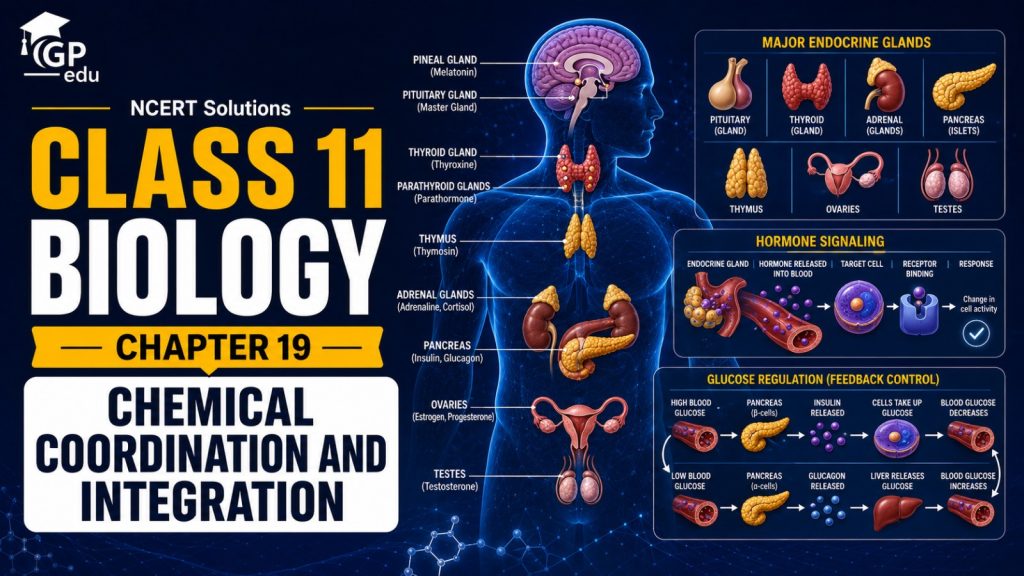
The chapter Chemical Coordination and Integration introduces students to the endocrine system and explains how hormones coordinate and regulate various physiological activities in the human body. It covers endocrine glands, hormones, the hypothalamus, pituitary gland, pineal gland, thyroid gland, parathyroid glands, thymus, adrenal glands, pancreas, testes, and ovaries.
Students learn about the major endocrine glands and their hormones, along with their locations, functions, target organs, and roles in maintaining homeostasis. The chapter explains important hormones such as growth hormone, prolactin, thyroid hormones, parathyroid hormone, insulin, glucagon, adrenaline, cortisol, aldosterone, melatonin, and reproductive hormones.
Students are introduced to the mechanisms of hormonal regulation and hormone action, including the role of intracellular and cell-surface receptors. The chapter also explains feedback mechanisms, particularly negative feedback, and how hormones regulate growth, metabolism, water and electrolyte balance, stress responses, reproduction, and other physiological processes.
Class 11 Biology Chapter 19 Overview
Students learn about the hypothalamus and pituitary gland and understand how they regulate several other endocrine glands. The chapter covers the hormones of the anterior and posterior pituitary, including growth hormone, thyroid-stimulating hormone, adrenocorticotropic hormone, follicle-stimulating hormone, luteinising hormone, oxytocin, and vasopressin.
The chapter also covers the thyroid, parathyroid, adrenal glands, pancreas, pineal gland, and thymus, explaining the functions of their major hormones. Students study the roles of thyroid hormones in metabolism, parathyroid hormone in calcium regulation, adrenal hormones in stress and electrolyte balance, and pancreatic hormones in maintaining blood glucose levels.
The chapter further discusses the testes and ovaries and their reproductive hormones, along with important endocrine disorders such as diabetes mellitus, diabetes insipidus, dwarfism, gigantism, acromegaly, goitre, cretinism, myxoedema, Graves’ disease, Addison’s disease, and Cushing’s syndrome. A clear understanding of Chemical Coordination and Integration helps students develop a strong foundation in human physiology, hormonal regulation, endocrine functions, metabolism, reproduction, homeostasis, and chemical coordination, making it an important chapter for NEET preparation.
NCERT Solutions for Class 11 Biology
Chapter 19 – Chemical Coordination and Integration
Question 19.1. Define the following:
(a) Exocrine gland
(b) Endocrine gland
(c) Hormone
Solution:
(a) Exocrine gland is a gland that pours its secretion on the surface or into a particular region by means of ducts for performing a metabolic activity, e.g., sebaceous glands, sweat glands, salivary glands and intestinal glands.
(b) Endocrine gland is an isolated gland (separates even from epithelium forming it) which secretes informational molecules or hormones that are poured into venous blood or lymph for reaching the target organ because the gland is not connected with the target organ by any duct. Therefore endocrine gland is also called ductless gland e.g., thyroid gland.
(c) Hormone is a substance that is manufactured and secreted in very small quantities into the blood stream by an endocrine gland or a specialized nerve cell and regulates the growth or functioning of a specific tissue organ in a distant part of the body e.g., insulin.
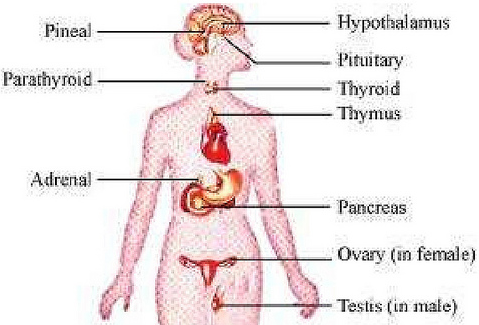
Question 19.2. Diagrammatically indicate the location of the various endocrine glands in our body.
Solution:
Question 19.3. List the hormones secreted by the following:
(a) Hypothalamus
(b) Pituitary
(c) Thyroid
(d) Parathyroid
(e) Adrenal
(f) Pancreas
(g) Testis
(h) Ovary
(i) Thymus
(j) Atrium
(k) Kidney
(l) G.I. Tract
Solution:
(a) Two types of hormones are produced by hypothalamus: releasing hormones (that stimulate secretion of pituitary hormones) and inhibiting hormones (that inhibit secretion of pituitary hormones). These hormones are:
– Thyrotrophin-releasing hormone
– Adrenocorticotrophin-releasing hormone
– Follicle-stimulating hormone-releasing hormone
– Luteinizing hormone-releasing hormone
– Growth hormone-releasing hormone
– Growth inhibiting hormone
– Prolactin releasing hormone
– Prolactin inhibiting hormone
– Melanocyte stimulating hormone-releasing hormone
– Melanocyte stimulating hormone-inhibiting hormone.
(b) Different parts of pituitary secrete different hormones.
– Hormones secreted by anterior lobe of pituitary are: Follicle stimulating hormone ($\text{FSH}$), Luteinizing hormone ($\text{LH}$), Thyroid stimulating hormone ($\text{TSH}$), Adrenocorticotrophic hormone ($\text{ACTH}$), Somatotrophic or Growth hormone ($\text{GH}$), Prolactin hormone ($\text{PRL}$) or Luteotrophic hormone.
– Middle (intermediate) lobe of pituitary: Melanocyte stimulating hormone ($\text{MSH}$).
– Posterior lobe of pituitary: (i) Oxytocin (ii) Vasopressin or antidiuretic hormone ($\text{ADH}$).
(c) Thyroid secretes 3 hormones:
– Thyroxine or tetraiodothyronine ($\text{T}_4$)
– Triiodothyronine ($\text{T}_3$)
– Calcitonin.
(d) Parathyroid gland secretes a single hormone called parathormone ($\text{PTH}$) or Collip’s hormone.
(e) Adrenal glands have two regions, namely, outer adrenal cortex and inner adrenal medulla. Both these regions secrete different hormones.
– Hormones of adrenal cortex are grouped into three categories: Glucocorticoids (e.g., cortisol), Mineralocorticoids (e.g., aldosterone), Sexcorticoids (e.g., testosterone).
– Adrenal medulla secretes two hormones: (i) Epinephrine (adrenaline) (ii) Nor-epinephrine (nor-adrenaline).
(f) Pancreas secretes following hormones:
– Insulin
– Glucagon
– Somatostatin.
(g) Testis secretes androgens such as testosterone.
(h) Ovary secretes:
– Estrogens such as estradiol
– Progesterone
– Relaxin.
(i) Thymus secretes thymosin hormone.
(j) Atrium secretes atrial natriuretic factor ($\text{ANF}$).
(k) Kidney secretes: (i) Renin (ii) Erythropoietin.
(l) G.I. tract secretes: Gastrin, Secretin, Cholecystokinin ($\text{CCK}$), Enterocrinin, Duocrinin, Villikinin.
Question 19.4. Fill in the blanks:
Hormones Target gland
(a) Hypothalamic hormones ………………..
(b) Thyrotrophin (TSH) ………………..
(c) Corticotrophin (ACTH) ………………..
(d) Gonadotrophins (LH, FSH) ………………..
(e) Melanotrophin (MSH) ………………..
Solution:
(a) Pituitary
(b) Thyroid
(c) Adrenal cortex
(d) Gonads – Testes in male and ovaries in female
(e) Skin.
Question 19.5. Write short notes on the functions of the following hormones:
(a) Parathyroid hormones (PTH)
(b) Thyroid hormones
(c) Thymosin
(d) Androgens
(e) Estrogens
(f) Insulin and Glucagon
Solution:
(a) Parathyroid hormone increases the level of calcium and decreases the level of phosphate in the blood.
(b) Thyroid gland secretes three hormones: thyroxine, triiodothyronine and calcitonin. Thyroxine and triiodothyronine control the general metabolism of the body, promote growth of body tissues and stimulate tissue differentiation. Calcitonin regulates the concentration of calcium in the blood.
(c) Thymosin is secreted by thymus. It accelerates cell division, stimulates the development and differentiation of T-lymphocytes and also hastens attainment of sexual maturity.
(d) Androgens are secreted by testis. They stimulate the development of male reproductive system, formation of sperms, development of male accessory sex characters and also determine the male sexual behaviour and the sex urge.
(e) Estrogens are secreted by ovaries. They stimulate the female reproductive tract to grow to full size and become functional, differentiation of ova and development of accessory sex characters.
(f) Insulin is secreted by the $\beta$-cells of the pancreas. It lowers blood glucose level, and promotes synthesis of proteins and fats. Glucagon is secreted by the $\alpha$-cells of the pancreas. It increases the level of glucose in the blood.
Question 19.6. Give example(s) of
(a) Hyperglycemic hormone and hypoglycemic hormone
(b) Hypercalcemic hormone
(c) Gonadotrophic hormones
(d) Progestational hormone
(e) Blood pressure lowering hormone
(f) Androgens and estrogens
Solution:
(a) Glucagon, Insulin
(b) Parathormone ($\text{PTH}$)
(c) Follicle stimulating hormone ($\text{FSH}$) and Luteinizing hormone ($\text{LH}$)
(d) Progesterone
(e) Atrial natriuretic factor ($\text{ANF}$)
(f) Testosterone and Estradiol.
Question 19.7. Which hormonal deficiency is responsible for the following:
(a) Diabetes mellitus
(b) Goitre
(c) Cretinism
Solution:
(a) Insulin
(b) Thyroxine and Triiodothyronine (due to iodine deficiency leading to undersecretion)
(c) Thyroxine and Triiodothyronine (congenital deficiency).
Question 19.8. Briefly mention the mechanism of action of FSH.
Solution:
Follicle stimulating hormone being glycoprotein is insoluble in lipids, therefore, cannot enter the target cells. It binds to the specific receptor molecules located on the surface of the cell membrane to form hormone-receptor complex. This complex causes the release of an enzyme adenylate cyclase from the receptor site. This enzyme forms the cell cyclic adenosine monophosphate ($\text{cAMP}$) from $\text{ATP}$. The $\text{cAMP}$ activates the existing enzyme system of the cell. This accelerates the metabolic reactions in the cell. The hormone is called the first messenger and the $\text{cAMP}$ is termed the second messenger. The hormone-receptor complex changes the permeability of the cell membrane to facilitate the passage of materials through it. This increases the activities of the cell as it receives the desired materials.
Question 19.9. Match the following:
| Column I | Column II |
|---|---|
| (a) $\text{T}_4$ | (i) Hypothalamus |
| (b) $\text{PTH}$ | (ii) Thyroid |
| (c) $\text{GnRH}$ | (iii) Pituitary |
| (d) $\text{LH}$ | (iv) Parathyroid |
Solution:
(a) – (ii); (b) – (iv); (c) – (i); (d) – (iii)
Why Class 11 Biology Chapter 19 Matters in NEET
Class 11 Biology Chapter 19: Chemical Coordination and Integration is highly important for NEET because it explains how hormones and chemical messengers regulate and coordinate various physiological activities in the human body. The chapter covers important concepts such as endocrine glands, hormones, hypothalamus, pituitary gland, thyroid gland, parathyroid gland, adrenal glands, pancreas, gonads, pineal gland, thymus, and the mechanism of hormone action. NEET frequently includes NCERT-based questions on endocrine glands, hormones, their sources, functions, target organs, feedback regulation, and hormonal disorders. A thorough understanding of this chapter helps students build a strong foundation in human physiology, endocrine regulation, metabolism, growth, reproduction, and homeostasis.
Preparation Tips for Class 11 Biology Chapter 19
Begin by endocrine system and the difference between endocrine and exocrine glands. Learn the major endocrine glands and their locations in the human body. Pay special attention to the hormones secreted by each gland and their major functions.
Study the hypothalamus and pituitary gland carefully. Understand the role of hypothalamic hormones and the hormones released by the anterior and posterior pituitary. Focus on growth hormone, prolactin, thyroid-stimulating hormone, adrenocorticotropic hormone, follicle-stimulating hormone, luteinising hormone, oxytocin, and vasopressin.
Study the thyroid and parathyroid glands in detail. Understand the functions of thyroxine, triiodothyronine, and parathyroid hormone and their roles in metabolism and calcium regulation. Revise important disorders such as hypothyroidism, hyperthyroidism, goitre, cretinism, and myxoedema.
FAQs
1. What are the most important topics in Class 11 Biology Chapter 19?
The most important topics include endocrine glands, hormones, hypothalamus, pituitary gland, thyroid gland, parathyroid gland, adrenal glands, pancreas, pineal gland, thymus, testes, ovaries, hormone action, feedback regulation, and endocrine disorders. These topics are important for NEET preparation.
2. What is an endocrine gland?
An endocrine gland is a ductless gland that releases hormones directly into the blood. These hormones travel to specific target cells or organs and regulate various physiological processes.
3. What are hormones?
Hormones are chemical messengers secreted by endocrine glands. They are transported through body fluids and regulate processes such as growth, metabolism, reproduction, development, and homeostasis.
4. What is the role of the pituitary gland?
The pituitary gland is an important endocrine gland that regulates several physiological processes through its hormones. It influences growth, reproduction, thyroid activity, adrenal function, and water balance and is closely controlled by the hypothalamus.
5. What is the role of the thyroid hormone?
Thyroid hormones, mainly thyroxine ($\text{T}_4$) and triiodothyronine ($\text{T}_3$), regulate basal metabolic rate and support normal growth and development. They also influence the metabolism of carbohydrates, proteins, and fats.
6. What is the function of insulin?
Insulin, secreted by the beta cells of the pancreas, helps lower blood glucose levels by promoting the uptake and utilisation of glucose by cells and supporting its storage.
7. What is the role of glucagon?
Glucagon is secreted by the alpha cells of the pancreas. It increases blood glucose levels, particularly by promoting the breakdown of stored glycogen and supporting glucose production when required.
8. What are the major hormones secreted by the adrenal gland?
The adrenal gland produces hormones including adrenaline, noradrenaline, cortisol, aldosterone, and adrenal androgens. These hormones are involved in stress responses, metabolism, electrolyte balance, and other physiological functions.