
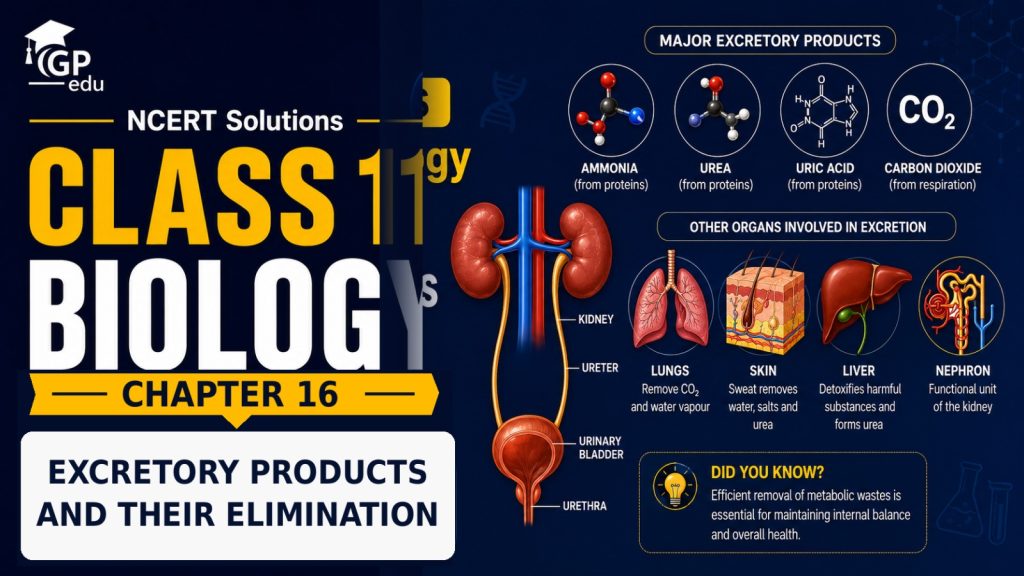
The chapter Excretory Products and Their Elimination introduces students to the process by which metabolic wastes are removed from the human body and explains the role of the excretory system in maintaining water, electrolyte, and acid-base balance. It covers nitrogenous wastes, the human excretory system, kidneys, nephrons, and the mechanisms involved in urine formation.
Students learn about different types of nitrogenous wastes, including ammonia, urea, and uric acid, along with ammonotelism, ureotelism, and uricotelism. The chapter also covers the structure and functions of the kidney, nephron, glomerulus, Bowman’s capsule, and renal tubules. Students understand glomerular filtration, selective reabsorption, tubular secretion, counter-current mechanisms, concentration of urine, osmoregulation, hormonal regulation, and micturition. A clear understanding of Excretory Products and Their Elimination provides a strong foundation for studying human physiology, homeostasis, renal function, and osmoregulation, making it an important topic for NEET preparation.
Class 11 Biology Chapter 16 Overview
Students learn about excretion and the different types of nitrogenous wastes produced during metabolism. The chapter explains ammonotelism, ureotelism, and uricotelism and introduces the human excretory system, including the kidneys, ureters, urinary bladder, and urethra.
Students are introduced to the detailed structure of the kidney and nephron, including the renal corpuscle, glomerulus, Bowman’s capsule, proximal convoluted tubule, loop of Henle, distal convoluted tubule, and collecting duct. The chapter explains the major steps of urine formation—glomerular filtration, selective reabsorption, and tubular secretion.
The chapter also covers the counter-current mechanism, regulation of kidney function by hormones such as $\text{ADH}$ and aldosterone, osmoregulation, concentration of urine, and the process of micturition. A clear understanding of Excretory Products and Their Elimination helps students develop a strong foundation in human physiology, renal function, water and electrolyte balance, homeostasis, and waste elimination, making it an important chapter for NEET preparation.
NCERT Solutions for Class 11 Biology Chapter 16 – Excretory Products and Their Elimination
Question 16.1. Define Glomerular Filtration Rate (GFR).
Solution:
The amount of filtrate formed by the kidneys per minute is called glomerular filtration rate ($\text{GFR}$). It is approximately $125\text{ mL/min}$ in a healthy person.
Question 16.2. Explain the autoregulatory mechanism of GFR.
Solution:
The kidneys have built-in mechanisms for the regulation of glomerular filtration rate. One such efficient mechanism is carried out by juxta glomerular apparatus ($\text{JGA}$). $\text{JGA}$ is a special sensitive region formed by cellular modifications in the distal convoluted tubule and the afferent arteriole at the location of their contact. A fall in $\text{GFR}$ can activate the JG cells to release renin which can stimulate the glomerular blood flow and thereby the $\text{GFR}$ back to normal.
Question 16.3. Indicate whether the following statements are true or false.
(a) Micturition is carried out by a reflex.
(b) ADH helps in water elimination, making the urine hypotonic.
(c) Protein-free fluid is filtered from blood plasma into the Bowman’s capsule.
(d) Henle’s loop plays an important role in concentrating the urine.
(e) Glucose is actively reabsorbed in the proximal convoluted tubule.
Solution:
(a) True
(b) False
(c) True
(d) True
(e) True
Question 16.4. Give a brief account of the counter current mechanism.
Solution:
The kidneys have a special mechanism for concentrating the urine, it is called counter current mechanism. The mechanism is said to be a counter current mechanism because the outflow (in the ascending limb) of Henle’s loop runs parallel to and in the opposite direction of the inflow (in the descending limb) and vasa recta. As the mechanism begins to function, the ascending limb of loop of Henle actively transports chloride and sodium ions out into the vasa recta from where it is secreted into the interstitial fluid. As a result the interstitial fluid around the loop of Henle contains large quantities of $\text{NaCl}$. The filtrate passes from the ascending limb of loop of Henle and enters a collecting duct. The collecting duct passes adjacent to the loop of Henle where the interstitial fluid contains large amounts of $\text{NaCl}$. The high osmotic pressure created by $\text{NaCl}$ causes water to diffuse out of the collecting duct in the interstitial fluid and eventually to the blood of vasa recta. The filtrate becomes greatly concentrated and is now called urine. A similar counter current mechanism operates between the interstitial fluid and blood passing through the vasa recta. As the blood capillary runs along the ascending limb of loop of Henle, $\text{NaCl}$ diffuses out of the blood. The direction is reversed as the blood capillary passes along the descending limb of Henle. The blood flows in the vasa recta around the loop of Henle from ascending to the descending side while the fluid passing through the loop of Henle goes in the opposite direction. The arrangement helps to maintain the concentration gradient of $\text{NaCl}$.
The overall function of counter current mechanism is to concentrate sodium chloride in the interstitial fluid and thereby cause water to diffuse out of the collecting ducts and concentrate the urine.
Question 16.5. Describe the role of liver, lungs and skin in excretion.
Solution:
Other than the kidneys, lungs, liver and skin also help in the elimination of excretory wastes. Lungs remove large amounts of $\text{CO}_2$ ($18\text{ litres/day}$) and also significant quantities of water every day. Liver secretes bile which contains substances like bilirubin, biliverdin, cholesterol, degraded steroid hormones, vitamins and drugs. Most of these substances ultimately pass out along with digestive wastes. The sweat and sebaceous glands in the skin can eliminate certain substances through their secretions. Sweat produced by the sweat glands is a watery fluid containing $\text{NaCl}$, small amounts of urea, lactic acid etc. Sebaceous glands eliminate certain substances like sterols, hydrocarbons and waxes through sebum.
Question 16.6. Explain micturition.
Solution:
The process of passing out urine from the urinary bladder is called micturition. Urine formed by the nephrons is ultimately carried to the urinary bladder where it is stored. This causes stretching of the wall of bladder that leads to the stimulation of stretch receptors on the walls of the bladder. This sends signal to the CNS. The CNS passes on motor messages to initiate the contraction of smooth muscles of the bladder and simultaneous relaxation of the urethral sphincter causing the release of urine.
Question 16.7. Match the items of column I with those of column II.
| Column I | Column II |
|---|---|
| (a) Ammonotelism | (i) Birds |
| (b) Bowman’s capsule | (ii) Water reabsorption |
| (c) Micturition | (iii) Bony fish |
| (d) Uricotelism | (iv) Urinary bladder |
| (e) ADH | (v) Renal tubule |
Solution:
(a) – (iii), (b) – (v), (c) – (iv), (d) – (i), (e) – (ii)
Question 16.8. What is meant by the term osmoregulation?
Solution:
The regulation of water and solute contents of the body fluids by the kidney is called osmoregulation.
Question 16.9. Terrestrial animals are generally either ureotelic or uricotelic, not ammonotelic, why?
Solution:
Ammonotelic animals are aquatic animals that excrete ammonia which is highly soluble in water, thus large amount of water is also excreted. Terrestrial animals cannot afford to lose such large quantities of water from their bodies as they live in environments having water scarcity. They, therefore, excrete either urea (ureotelic) or uric acid (uricotelic) as these are less soluble in water.
Question 16.10. What is the significance of juxta glomerular apparatus (JGA) in kidney function?
Solution:
Juxta glomerular apparatus ($\text{JGA}$) is a special sensitive region formed by cellular modifications in the distal convoluted tubule and the afferent arteriole at the location of their contact. The $\text{JGA}$ plays a complex regulatory role. A fall in glomerular blood flow / glomerular blood pressure / $\text{GFR}$ can activate the JG cells to release renin which converts angiotensinogen in blood to angiotensin I and further to angiotensin II. Angiotensin II, being a powerful vasoconstrictor, increases the glomerular blood pressure and thereby $\text{GFR}$. Angiotensin II also activates the adrenal cortex to release aldosterone. Aldosterone causes reabsorption of $\text{Na}^+$ and water from the distal parts of the tubule. This also leads to an increase in blood pressure and $\text{GFR}$.
Question 16.11. Name the following.
(a) A chordate animal having flame cells as excretory structures.
(b) Cortical portions projecting between the medullary pyramids in the human kidney.
(c) A loop of capillary running parallel to the Henle’s loop.
Solution:
(a) Cephalochordate – Amphioxus
(b) Columns of Bertini
(c) Vasa recta
Question 16.12. Fill in the gaps.
(a) Ascending limb of Henle’s loop is________to water whereas the descending limb is________to it.
(b) Reabsorption of water from distal parts of the tubules is facilitated by hormone________
(c) Dialysis fluid contains all the constituents as in plasma except________
(d) A healthy adult human excretes (on an average)________gm of urea/day.
Solution:
(a) Ascending limb of Henle’s loop is impermeable to water whereas the descending limb is permeable to it.
(b) Reabsorption of water from distal parts of the tubules is facilitated by hormone ADH.
(c) Dialysis fluid contains all the constituents as in plasma except nitrogenous wastes.
(d) A healthy adult human excretes (on an average) 25 – 30 gm of urea/day.
Why Class 11 Biology Chapter 16 Matters in NEET
Class 11 Biology Chapter 16: Excretory Products and Their Elimination is highly important for NEET because it explains how the human body removes metabolic wastes and maintains the internal balance of water, salts, and other substances. Students learn important concepts such as nitrogenous wastes, the human excretory system, kidney structure, nephron, urine formation, glomerular filtration, reabsorption, tubular secretion, and the regulation of urine concentration. NEET frequently includes direct NCERT-based questions on the structure and functions of the kidney, nephron, glomerulus, Bowman’s capsule, urine formation, counter-current mechanism, and the roles of hormones such as $\text{ADH}$ and aldosterone. A thorough understanding of this chapter helps students build a strong foundation in human physiology, osmoregulation, homeostasis, and renal function while improving their performance in the examination.
Preparation Tips for Class 11 Biology Chapter 16
Begin by understanding the concept of excretion and the different types of nitrogenous wastes, including ammonia, urea, and uric acid. Study the human excretory system carefully, including the kidneys, ureters, urinary bladder, and urethra. Pay special attention to the external and internal structure of the kidney and the organisation of nephrons.
Study the structure of a nephron in detail, including the glomerulus, Bowman’s capsule, proximal convoluted tubule, loop of Henle, distal convoluted tubule, and collecting duct. Understand the processes of urine formation—glomerular filtration, selective reabsorption, and tubular secretion—and learn the major substances involved in each process.
Pay special attention to the counter-current mechanism and understand how the loop of Henle and vasa recta help in maintaining the concentration gradient in the kidney. Study the role of hormones such as $\text{ADH}$, aldosterone, and atrial natriuretic factor ($\text{ANF}$) in regulating water and electrolyte balance.
FAQs
1. What are the most important topics in Class 11 Biology Chapter 16?
The most important topics include nitrogenous wastes, human excretory system, kidney structure, nephron, urine formation, glomerular filtration, selective reabsorption, tubular secretion, counter-current mechanism, osmoregulation, micturition, and hormonal regulation. These topics are frequently tested in NEET.
2. What is excretion?
Excretion is the process by which metabolic waste products are eliminated from the body. In humans, the kidneys play a major role in removing nitrogenous wastes and maintaining water and electrolyte balance.
3. What are the major nitrogenous wastes?
The major nitrogenous wastes include ammonia, urea, and uric acid. Animals may be classified as ammonotelic, ureotelic, or uricotelic depending on the primary nitrogenous waste they excrete.
4. What is a nephron?
A nephron is the structural and functional unit of the kidney. Each nephron consists of a renal corpuscle containing the glomerulus and Bowman’s capsule, followed by renal tubules involved in urine formation.
5. What are the main steps of urine formation?
Urine formation involves three major processes: glomerular filtration, selective reabsorption, and tubular secretion. These processes help remove waste products while retaining useful substances and maintaining the body’s internal balance.
6. What is glomerular filtration?
Glomerular filtration is the first step in urine formation. Blood is filtered through the glomerular capillaries into Bowman’s capsule, forming the glomerular filtrate. The filtration process is driven mainly by the pressure of blood in the glomerulus.
7. What is the counter-current mechanism?
The counter-current mechanism helps maintain a high osmolarity of the renal medulla, allowing the kidneys to produce concentrated urine when required. The loop of Henle and vasa recta play important roles in this mechanism.
8. What is the role of ADH in urine formation?
Antidiuretic hormone ($\text{ADH}$) increases the reabsorption of water in the distal tubule and collecting ducts. This helps conserve water and produces more concentrated urine when the body needs to retain water.