

NCERT Solutions for Class 11 Chemistry Chapter 3 help students understand how elements are arranged in the modern periodic table and why their physical and chemical properties show regular patterns. This chapter covers the development of periodic classification, Modern Periodic Law, electronic configurations, periodic-table blocks and important periodic trends. The solutions explain conceptual, comparison-based and numerical questions in a simple format. Students also learn how atomic size, ionisation enthalpy, electron gain enthalpy, electronegativity and metallic character vary across periods and down groups. These concepts help students predict the behaviour of elements and understand the formation of different compounds. Students can use these solutions for NCERT exercises, school examinations, JEE and NEET preparation.
Class 11 Chemistry Chapter 3 Overview
The chapter begins by explaining why the classification of elements became necessary as more elements were discovered. It discusses early classification attempts, including Dobereiner’s Triads, Newlands’ Law of Octaves and Mendeleev’s Periodic Table. Mendeleev mainly arranged elements according to atomic mass and grouped elements with similar properties together. The chapter then introduces Modern Periodic Law, according to which the properties of elements are periodic functions of their atomic numbers. It also explains the present form of the periodic table, which contains seven periods and eighteen groups.
The chapter further explains how electronic configuration determines the period, group and block of an element. Students learn about s-block, p-block, d-block and f-block elements and their general outer electronic configurations. The chapter also discusses periodic changes in atomic radius, ionic radius, ionisation enthalpy, electron gain enthalpy, electronegativity, metallic character and chemical reactivity. Important exceptions to general trends are explained using effective nuclear charge, shielding effect and stable electronic configurations. These concepts help students predict the behaviour of elements without memorising every property separately.
NCERT Solutions For Class 11 Chemistry Chapter 3 – Classification of Elements and Periodicity in Properties
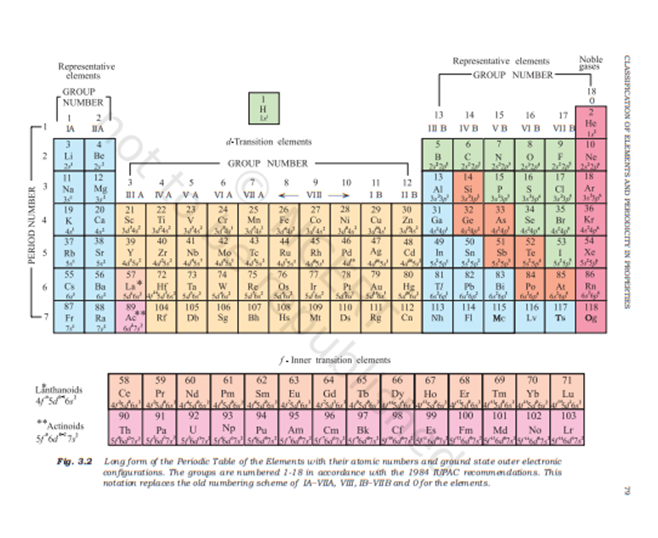
Question 3.1.
What is the basic theme of organization in the periodic table?
Solution :
It is to characterize the elements in periods and groups as per their properties. So, this course of action makes the investigation of elements and compounds of elements in a simple one and methodical way. In this periodic table, elements with comparative properties are set in a similar group.
Question 3.2.
Which important property did Mendeleev use to classify the elements in his periodic table and did he stick to that?
Solution :
Mendeleev organised the components in his periodic table, according to the order of their atomic weight. Mendeleev organized the components in groups and periods according to the increasing atomic weight. Mendeleev set the elements which are having comparative properties in the similar groups.
Nonetheless, he didn’t adhere to arrangement that he gave for long. He discovered that if the elements were organized according to their increasing atomic weights, then a few elements did not match within this plan of characterization.
In this manner, he overlooked the order of atomic weights now and again. For instance, the atomic mass of iodine is lower than atomic mass of tellurium.
Still Mendeleev set tellurium (in Group 6) ahead of iodine (in Group 7) essentially in light of the fact that iodine’s properties are so comparable to fluorine, chlorine, and bromine.
Question 3.3.
What is the basic difference in approach between the Mendeleev’s Periodic Law and the Modern Periodic Law?
Solution :
| Mendeleev’s Approach for periodic law | Modern approach for the periodic law |
|---|---|
| Chemical properties and Physical properties of the elements are the periodic functions of the atomic mass of the corresponding elements. | Chemical properties and Physical properties of the elements are the periodic functions of the atomic numbers of the corresponding elements. |
Question 3.4.
On the basis of quantum numbers, justify that the sixth period of the periodic table should have $32$ elements.
Solution :
In a periodic table containing elements, a period shows the value of principal quantum number ($n$) for the furthest shells. Every period starts with the filling with the principal quantum number ($n$). And $n$’s value for the 6th period is equal to 6. Now, for $n = 6$, the azimuthal quantum number ($l$) can have $0, 1, 2, 3, 4$ values.
As indicated by Aufbau’s rule, electrons will be added to various orbitals according to their increasing energies. Here, the $6d$ subshell is having much higher energy than the energy of $7s$ subshell.
In the sixth period, the electrons can occupy in just $6s, 4f, 5d$, and $6p$ subshells. $6s$ is having 1 orbital, $4f$ is having 7 orbitals, $5d$ is having 5 orbitals, and $6p$ is having 3 orbitals. In this way, there are a sum of 16 ($1 + 7 + 5 + 3 = 16$) orbitals accessible. As indicated by Pauli’s exclusion, one orbital can only accommodate at max 2 electrons.
Hence, sixteen orbitals can have $32$ electrons.
Subsequently, the 6th period of period table ought to have $32$ elements.
Question 3.5.
In terms of period and group where would you locate the element with $Z = 114$?
Solution :
Elements whose atomic number is from $Z = 87$ to $Z = 114$ are available in the seventh period of periodic table. Therefore, the element having $Z = 114$ is available in the seventh period in periodic table.
In the seventh period, initial 2 elements with $Z = 87$ and $Z = 88$ are the elements of $s$-block and the following 14 elements except $Z = 89$ i.e., those from $Z = 90$ to $Z = 103$ are elements of $f$–block, and next 10 elements from $Z = 89$ and $Z = 104$ to $Z = 112$ are elements of $d$-block, next the elements from $Z = 113$ to $Z = 118$ are elements of $p$-block. In this manner, the element $Z = 114$ is the 2nd element of $p$-block in the seventh period of the periodic table.
Therefore, the element $Z = 114$ is available in the seventh period and fourth group in the periodic table.
Question 3.6.
Write the atomic number of the element present in the third period and seventeenth group of the periodic table.
Solution :
First period is having $2$ elements and second period is having $8$ elements.
So, the third period begins with element $Z = 11$. Presently, third period contains $8$ elements. So, 18th element is the last element of the third period and this 18th element is present in 18th group. Thus, the element in the seventeenth group of the 3rd period is having atomic number 17 i.e. $Z = 17$.
Question 3.7.
Which element do you think would have been named by
(i) Lawrence Berkeley Laboratory
(ii) Seaborg’s group?
Solution :
a) Seaborgium (Sg) which has atomic number, $Z = 106$
b) Lawrencium (Lr) which has atomic number, $Z = 103$ and Berkelium (Bk) which has atomic number, $Z = 97$
Question 3.8.
Why do elements in the same group have similar physical and chemical properties?
Solution :
The chemical and physical properties of any elements rely on the quantity of valence electrons. In periodic table elements are in same group are having same quantity of valence electrons. This is why elements present in the same group are having similar chemical and physical properties.
Question 3.9.
What does atomic radius and ionic radius really mean to you?
Solution :
Radius of an atom is known as atomic radius. It quantifies the size of an atom. On chance that the element is a metal, then its radius is termed as metallic radius, and if element is a non-metal, then its radius is termed as covalent radius. The metallic radius can be calculated as inter-nuclear distance between two molecules divided by 2. For instance, the inter-nuclear distance between two adjoining copper atoms is $256\text{ pm}$ in solid copper.
$$\text{Metallic radius of copper} = \frac{256}{2}\text{ pm} = 128\text{ pm}$$
Covalent radius can be measured as the interatomic distance between 2 atoms when they are together by a solitary bond in a covalent atom. For instance, the interatomic distance between 2 chlorine atoms of chlorine molecule $= 198\text{ pm}$.
$$\text{Covalent radius of copper} = \frac{198}{2}\text{ pm} = 99\text{ pm}$$
Radius of an ion (cation or anion) is known as ionic radius. Ionic radius is computed by measuring the inter-ionic distance between the cation and anion in an ionic crystal. Since cations are created by expelling an electron from outermost orbit of an atom, thus cation has less electrons compared to parent atom which results in increased effective nuclear charge.
In this way, a cation is small in size than parent atom. For instance, the ionic radius of $\text{Na}^+$ ion (sodium ion) $= 95\text{ pm}$, while the atomic radius of $\text{Na}$ (sodium) atom $= 186\text{ pm}$. An anion is bigger in size than the parent atom. It is because an anion is having the same nuclear charge, yet more number of electrons compared to the parent atom which results in increased repulsion within atom among the electrons which also results in decreased effective nuclear charge. For instance, ionic radius of $\text{F}^-$ (fluorine ion) $= 136\text{ pm}$, while the atomic radius of $\text{F}$ (fluorine) atom $= 64\text{ pm}$.
Question 3.10.
How do atomic radius vary in a period and in a group? How do you explain the variation?
Solution :
Atomic radius declines as we move from left to right in a period. It happens because in a period, the external electrons are available in a similar valence shell so, the atomic number increments from left to right in a period, which results in increase in the effective nuclear charge. Therefore, the attraction of electrons towards the nucleus is increased.
Also, atomic radius declines as we move from top to bottom in the group. It happens because as we move down in a group then there is increase in principal quantum number ($n$) which brings about increase in the distance between nucleus and the valence electrons.
Question 3.11.
What do you understand by isoelectronic species? Name a species that will be isoelectronic with each of the following atoms or ions.
1. $\text{Ar}$
2. $\text{Rb}^+$
3. $\text{F}^-$
4. $\text{Mg}^+$
Solution :
Ions and atoms which are having equal numbers of the electrons are called the isoelectronic species.
1. $\text{Ar (Argon)}$ is having $18$ electrons. Hence, the species which is isoelectronic with $\text{Ar}$ must also have $18$ electrons. Its some isoelectronic species are:
i) $\text{S}^{2-}$ ion it is also having $18$ electrons ($16 + 2 = 18$).
ii) $\text{Cl}^-$ ion it is also having $18$ electrons ($17 + 1 = 18$).
iii) $\text{K}^+$ ion it is also having $18$ electrons ($19 – 1 = 18$).
2. $\text{Rb}^+$ (Rubidium) is having $36$ electrons ($37 – 1 = 36$). Hence, the species which is isoelectronic with $\text{Rb}^+$ must also have $36$ electrons. Its some isoelectronic species are:
i) $\text{Br}^-$ ion it is also having $36$ electrons ($35 + 1 = 36$).
ii) $\text{Kr}$ ion it is also having $36$ electrons.
iii) $\text{Sr}^{2+}$ ion it is also having $36$ electrons ($38 – 2 = 36$).
3. $\text{F}^-$ (Fluorine) ion is having $10$ electrons ($9 + 1 = 10$). Hence, the species which is isoelectronic with $\text{F}^-$ must also have $10$ electrons. Its some isoelectronic species are:
i) $\text{Na}^+$ ion it is also having $10$ electrons ($11 – 1 = 10$).
ii) $\text{Ne}$ ion it is also having $10$ electrons.
iii) $\text{Al}^{3+}$ ion it is also having $10$ electrons ($13 – 3 = 10$).
4. $\text{Mg}^+$ (Magnesium) ion is having $11$ electrons ($12 – 1 = 11$). Hence, the species which is isoelectronic with $\text{Mg}^+$ must also have $11$ electrons. Its some isoelectronic species are:
i) $\text{Al}^{2+}$ ion it is also having $11$ electrons ($13 – 2 = 11$).
ii) $\text{Na}$ ion it is also having $11$ electrons.
iii) $\text{Si}^{3+}$ ion it is also having $11$ electrons ($14 – 3 = 11$).
Question 3.12.
Consider the accompanying species: $\text{N}^{3-}, \text{O}^{2-}, \text{F}^-, \text{Na}^+, \text{Mg}^{2+}, \text{Al}^{3+}$
a) What is common in them?
b) Arrange them in the order of increasing ionic radii.
Solution :
(a) The species that are given are having equal number of electrons i.e., $10$ electrons. So, they are isoelectronic species.
(b) Arrangement of the given ions according to their increasing order of nuclear charge is:
$$\text{Al}^{3+} > \text{Mg}^{2+} > \text{Na}^+ > \text{F}^- > \text{O}^{2-} > \text{N}^{3-}$$
Arrangement of the given ions according to their increasing order of ionic radii is:
$$\text{Al}^{3+} < \text{Mg}^{2+} < \text{Na}^+ < \text{F}^- < \text{O}^{2-} < \text{N}^{3-}$$
Question 3.13.
Explain why cation are smaller and anions larger in radii than their parent atoms?
Solution :
Cations are formed by expelling an electron from outermost orbit of an atom, thus cation has less electrons compared to parent atom which results in increased effective nuclear charge but the total nuclear charge remains same which results in increased attraction of electrons towards nucleus than that of parent atom. Thus, cations are having smaller radii then that of their parent atom.
Anions are formed by gaining an electron in the outermost orbit of an atom, thus anion has more electrons compared to parent atom which results in decreased effective nuclear charge but the total nuclear charge remains same which results in increased distance the nucleus and the valence electrons as the attraction of electrons towards nucleus decreases than that of parent atom. Thus, anions are having larger radii then that of their parent atom.
Question 3.14.
What is the significance of the terms – isolated gaseous atom and ground state while defining the ionization enthalpy and electron gain enthalpy? [Hint: Requirements for comparison purposes]
Solution :
“Ionization enthalpy is the energy that is required to expel an electron from an isolated gaseous atom in ground state”. Despite the fact that in gaseous state the atoms are generally widely separated, there are a few measures of attractive forces between the atoms. To find the ionization enthalpy of any ion, it is difficult to isolate a solitary atom. This attractive force can be further diminished by bringing down the pressure. Hence, the term “isolated gaseous atom” is utilized as a part of the meaning of ionization enthalpy.
An atom’s ground state is the most stable state. Less energy is required to expel an electron if isolated gaseous atom is present in the ground state. In this way, for the purpose of comparison, electron gain enthalpy and ionization enthalpy must be calculated for an “isolated gaseous atom” and its “ground state”.
Question 3.15.
Energy of an electron in the ground state of the hydrogen atom is $-2.18 \times 10^{-18}\text{ J}$. Calculate the ionization enthalpy of atomic hydrogen in terms of $\text{J mol}^{-1}$. [Hint: Apply the idea of mole concept to derive the answer]
Solution :
Here it is given that, electron of hydrogen is having $-2.18 \times 10^{-18}\text{ J}$ in ground state.
Thus, $-2.18 \times 10^{-18}\text{ J}$ amount of energy will be required to expel an electron from ground state in $\text{H}$ (hydrogen) – atom.
$$\therefore \text{For Hydrogen atom the Ionization of enthalpy} = -2.18 \times 10^{-18}\text{ J}$$
Thus, ionization enthalpy of Hydrogen atom in $\text{J mol}^{-1}$:
$$= -2.18 \times 10^{-18} \times 6.02 \times 10^{23}\text{ J mol}^{-1}$$
Question 3.16.
Among the second period elements, the actual ionization enthalpies are in the order: $\text{Li} < \text{B} < \text{Be} < \text{C} < \text{O} < \text{N} < \text{F} < \text{Ne}$. Explain why:
(i) $\text{Be}$ has higher $\Delta_i H_1$ than $\text{B}$?
(ii) $\text{O}$ has lower $\Delta_i H_1$ than $\text{N}$ and $\text{F}$?
Solution :
(i) In nitrogen, there are three $2p$-electrons and all of these 3 occupy 3 distinct atomic orbital. While in oxygen 2 out of 4, $2p$ – electrons occupy same $2p$-orbital, so the repulsion between the electrons in the oxygen atom increases.
Thus, the energy required to expel $2^{\text{nd}}$ $2p$ –electron in oxygen atom is higher than the energy required to expel $4^{\text{th}}$ $2p$ –electron in nitrogen atom.
Thus, $\Delta_i H$ for $\text{O}$ is lower than $\Delta_i H$ of $\text{N}$.
Fluorine atom is having one proton and one electron more than that in oxygen atom. As electron is added to a similar shell, the increment in attractive force between nucleus and electron (as proton is added) is higher than the increment in the repulsive force between electron-electron (as electron is added). Thus, valence electrons in the fluorine atom experiences higher effective nuclear charge compared to that, which is experienced by electron of oxygen atom. Thus, the energy required to expel an electron from fluorine is higher than the energy required to expel an electron from oxygen.
Thus, $\Delta_i H$ for $\text{O}$ is lower than $\Delta_i H$ of $\text{F}$.
(ii) During ionization process, the electron that can be expelled from $\text{Be}$ (beryllium) – atom is $2s$ – electron, but the electron that can be expelled from boron is $2p$ – electron.
The attractive force between a $2s$ – electron and nucleus is higher than between a $2s$ – electron and nucleus.
Thus, the energy required to expel $2s$ –electron is higher than the energy required to expel $2p$ –electron.
Thus, $\Delta_i H$ for $\text{Be}$ is higher than $\Delta_i H$ than $\text{B}$.
Question 3.17.
How would you explain the fact that the first ionization enthalpy of sodium is lower than that of magnesium but its second ionization enthalpy is higher than that of magnesium?
Solution :
The $1^{\text{st}}$ ionization enthalpy of magnesium is higher than $1^{\text{st}}$ ionization enthalpy of sodium because:
1. Magnesium is having greater atomic size than sodium.
2. Magnesium is having higher effective nuclear charge than sodium.
Thus, energy required to expel an electron from sodium is lower than that in magnesium. Thus, the $1^{\text{st}}$ ionization enthalpy of magnesium is higher than $1^{\text{st}}$ ionization enthalpy of sodium.
The $2^{\text{nd}}$ ionization enthalpy of magnesium is lower than $2^{\text{nd}}$ ionization enthalpy of sodium is because after expelling an electron, there is still $1$ electron remaining in the $3s$-orbital of magnesium, whereas sodium achieves stable inert gas configuration after expelling an electron. So, magnesium still requires to expel $1$ electron to achieve stable inert gas configuration.
Thus, energy required to expel $2^{\text{nd}}$ electron from magnesium is lower than that in sodium. Thus, the $2^{\text{nd}}$ ionization enthalpy of magnesium is lower than $2^{\text{nd}}$ ionization enthalpy of sodium.
Question 3.18.
What are the various factors due to which the ionization enthalpy of the main group elements tends to decrease down the group?
Solution :
The factors because of which in elements of main group the ionization enthalpy decreases when we move down the group are given below:
1. “Increase in the shielding effect”: Inner shells increases as we move down the group. Thus, the shielding effect of valence electrons increases by inner core electrons from nucleus. Thus, the attractive force on electrons towards nucleus is very strong. So, energy required to expel a valence electron decreases as we move down the group.
2. “Increase in atomic size of elements”: Inner shells increases as we move down the group. Thus, the atomic size increases as we move down the group. Also, the distance between the valence electron and nucleus of an atom, as a result the electrons are not strongly bounded. So, valence electrons can be expelled easily. Thus, energy required to expel a valence electron decreases as we move down the group.
Question 3.19.
The first ionization enthalpy values (in $\text{kJ mol}^{-1}$) of group $13$ elements are:
| Elements | B | Al | Ga | In | Tl |
|---|---|---|---|---|---|
| $\Delta_i H_1$ | $801$ | $577$ | $579$ | $558$ | $589$ |
How would you explain this deviation from the general trend?
Solution :
Inner shells increase as we move down the group. Thus, the shielding effect of valence electrons increases by inner core electrons from nucleus. Thus, the attractive force on electrons towards nucleus is very strong. So, ionization enthalpy decreases as we move down the group. Hence for elements of group $13$ the ionization enthalpy decreases as we move down from $\text{B}$ to $\text{Al}$.
Here, $\text{Ga}$ is having high ionization enthalpy than that of $\text{Al}$. This is because $\text{Al}$ comes after the $s$-blocks elements, while $\text{Ga}$ comes after the $d$-blocks elements. The shielding that is provided by electrons of $d$-block elements is not effective. So, the valence electrons are not shielded effectively. Thus, valence electrons in $\text{Ga}$ atom experience higher effective nuclear charge compared to $\text{Al}$.
Further on moving down from $\text{Ga}$ to $\text{In}$, the value of ionization enthalpy is decreased because of the increase in the shielding effect and increase in atomic size.
But, $\text{Tl}$ is having high ionization enthalpy than that of $\text{In}$. This is because $\text{Tl}$ comes after the ‘$4f$ and $5d$ electrons’. The shielding that is provided by these ‘$4f$ and $5d$ electrons’ is not effective. So, the valence electrons are not shielded effectively. Thus, valence electrons in $\text{Tl}$ atom experience higher effective nuclear charge compared to $\text{In}$.
Question 3.20.
Which of the following pairs of elements would have a move negative electron gain enthalpy?
a) $\text{F}$ or $\text{Cl}$
b) $\text{O}$ or $\text{F}$
Solution :
1. $\text{F}$ and $\text{Cl}$ are the elements of the same group in periodic table. On moving down the group the electron affinity becomes less negative. Here, the value of electron affinity of $\text{F}$ is less negative than that of $\text{Cl}$. It is because atomic size of $\text{Cl}$ is larger than that of $\text{F}$. In $\text{Cl}$, the electron will be added to $n = 3$ quantum level, whereas in $\text{F}$, the electron will be added to $n = 2$ quantum level. Thus, as the electron-electron repulsion is reduced in $\text{Cl}$ so an extra electron can easily be accommodated. So, electron affinity of $\text{Cl}$ is more negative compared to that of $\text{F}$.
2. $\text{O}$ and $\text{F}$ are the elements of the same period in periodic table. An $\text{F}$-atom is having $1$ electron and $1$ proton more than that of $\text{O}$-atom as electron is added in the same shell, Thus the atomic size of $\text{O}$-atom is larger than $\text{F}$-atom. As $\text{O}$-atom is having $1$ proton less than $\text{F}$-atom. So, the nucleus of $\text{O}$-atom cannot attract an incoming electron that strongly as that of an $\text{F}$-atom. Also $\text{F}$-atom requires only $1$ electron to achieve stable inert gas configuration. So, the electron affinity of $\text{F(Fluorine)}$ is more negative than that of $\text{O(oxygen)}$.
Question 3.21.
Would you expect the second electron gain enthalpy of O as positive, more negative or less negative than the first? Justify your answer.
Solution :
$\text{O}^-$ ion is formed when $\text{O}$-atom gains one electron and the energy is being released during this process. So the $1^{\text{st}}$ electron affinity for $\text{O}$-atom is negative.
$$\text{O}(g) + e^- \rightarrow \text{O}^-(g)$$
If an electron is added in $\text{O}^-$ ion then it forms $\text{O}^{2-}$ ion, the energy is required to be given to counter the strong electronic repulsions. So, the $2^{\text{nd}}$ electron affinity of $\text{O}$-atom is positive.
$$\text{O}^-(g) + e^- \rightarrow \text{O}^{2-}(g)$$
Question 3.22.
What is basic difference between the terms electron gain enthalpy and electro negativity?
Solution :
| Electron gain enthalpy | Electronegativity |
|---|---|
| Tendency to gain electrons for an isolated gaseous atom is its electron gain enthalpy. | Tendency to attract the shared pairs of electrons for an atom which is in chemical compound is its electronegativity. |
Question 3.23.
How would you react to the statement that the electronegativity of N on Pauling scale is 3.0 in all the nitrogen compounds?
Solution :
Electronegativity of an element is a variable property. It is different in different compounds. Hence, the statement which says that the electronegativity of $\text{N}$ on Pauling scale is $3.0$ in all nitrogen compounds is incorrect. The electronegativity of $\text{N}$ is different in $\text{NH}_3$ and $\text{NO}_2$.
Question 3.24.
Describe the theory associated with the radius of an atom as it
(a) gains an electron
(b) loses an electron
Solution :
(a) When an atom gains an electron, its size increases. When an electron is added, the number of electrons goes up by one. This results in an increase in repulsion among the electrons. However, the number of protons remains the same. As a result, the effective nuclear charge of the atom decreases and the radius of the atom increases.
(b) When an atom loses an electron, the number of electrons decreases by one while the nuclear charge remains the same. Therefore, the interelectronic repulsions in the atom decrease. As a result, the effective nuclear charge increases. Hence, the radius of the atom decreases.
Question 3.25.
Would you expect the first ionization enthalpies for two isotopes of the same element to be the same or different? Justify your answer.
Solution :
The ionization enthalpy of an atom depends on the number of electrons and protons (nuclear charge) of that atom. Now, the isotopes of an element have the same number of protons and electrons. Therefore, the first ionization enthalpy for two isotopes of the same element should be the same.
Question 3.26.
What are the major differences between metals and non-metals?
Solution :
| Property | Metals | Non-metals |
|---|---|---|
| Electron loss | Lose electrons easily | Cannot lose electrons easily |
| Electron gain | Cannot gain electrons easily | Can gain electrons easily |
| Compounds | Form ionic compounds | Form covalent compounds |
| Nature of oxides | Basic in nature | Acidic in nature |
| Ionization enthalpy | Low | High |
| Electron gain enthalpy | Less negative | High negative |
| Electronegativity | Electropositive | Electronegative |
| Reducing power | High | Low |
Question 3.27.
Use the periodic table to answer the following questions:
(a) Identify an element with five electrons in the outer subshell.
(b) Identify an element that would tend to lose two electrons.
(c) Identify an element that would tend to gain two electrons.
Solution :
(a) The electronic configuration of an element having $5$ electrons in its outermost subshell should be $ns^2 np^5$. This is the electronic configuration of the halogen group. Thus, the element can be $\text{F, Cl, Br, I, or At}$.
(b) An element having two valence electrons will lose two electrons easily to attain the stable noble gas configuration. The general electronic configuration of such an element will be $ns^2$. This is the electronic configuration of group $2$ elements. The elements present in group $2$ are $\text{Be, Mg, Ca, Sr, Ba}$.
(c) An element is likely to gain two electrons if it needs only two electrons to attain the stable noble gas configuration. Thus, the general electronic configuration of such an element should be $ns^2 np^4$. This is the electronic configuration of the oxygen family.
Question 3.28.
The increasing order of reactivity among group 1 elements is $\text{Li} < \text{Na} < \text{K} < \text{Rb} < \text{Cs}$ whereas that among group 17 elements is $\text{F} > \text{Cl} > \text{Br} > \text{I}$. Explain.
Solution :
The elements present in group 1 have only $1$ valence electron, which they tend to lose. Group 17 elements, on the other hand, need only one electron to attain the noble gas configuration. On moving down group 1, the ionization enthalpies decrease. This means that the energy required to lose the valence electron decreases. Thus, reactivity increases on moving down a group. Thus, the increasing order of reactivity among group 1 elements is as follows: $\text{Li} < \text{Na} < \text{K} < \text{Rb} < \text{Cs}$.
In group 17, as we move down the group from $\text{Cl}$ to $\text{I}$, the electron gain enthalpy becomes less negative i.e., its tendency to gain electrons decreases down group 17. Thus, reactivity decreases down a group. The electron gain enthalpy of $\text{F}$ is less negative than $\text{Cl}$. Still, it is the most reactive halogen. This is because of its low bond dissociation energy. Thus, the decreasing order of reactivity among group 17 elements is as follows: $\text{F} > \text{Cl} > \text{Br} > \text{I}$.
Question 3.29.
Write the general outer electronic configuration of $s\text{–}, p\text{–}, d\text{–}$ and $f$- block elements.
Solution :
| Element | General outer electronic configuration |
|---|---|
| $s\text{–block}$ | $ns^{1–2}$, where $n = 2 – 7$ |
| $p\text{–block}$ | $ns^2 np^{1–6}$, where $n = 2 – 6$ |
| $d\text{–block}$ | $(n-1)d^{1–10} ns^{0–2}$, where $n = 4 – 7$ |
| $f\text{–block}$ | $(n-2)f^{1–14} (n-1)d^{0–10} ns^2$, where $n = 6 – 7$ |
Question 3.30.
Assign the position of the element having outer electronic configuration (i) $ns^2 np^4$ for $n = 3$ (ii) $(n – 1) d^2 ns^2$ for $n = 4$ and (iii) $(n – 2) f^7 (n – 1) d^1 ns^2$ for $n = 6$ in the periodic table?
Solution :
(i) Since $n = 3$, the element belongs to the 3rd period. It is a $p\text{–block}$ element since the last electron occupies the $p$-orbital. There are four electrons in the $p$-orbital. Thus, the corresponding group of the element $= 2 + 10 + 4 = 16$. Therefore, the element belongs to the 3rd period and 16th group. Hence, the element is Sulphur.
(ii) Since $n = 4$, the element belongs to the 4th period. It is a $d\text{–block}$ element as $d$-orbitals are incompletely filled. There are 2 electrons in the $d$-orbital. Thus, the corresponding group $= 2 + 2 = 4$. Therefore, it is a 4th period and 4th group element. Hence, the element is Titanium.
(iii) Since $n = 6$, the element is present in the 6th period. It is an $f\text{–block}$ element as the last electron occupies the $f$-orbital. It belongs to group 3 of the periodic table since all $f$-block elements belong to group 3. Its electronic configuration is $[\text{Xe}] 4f^7 5d^1 6s^2$. Hence, the element is Gadolinium.
Question 3.31.
The first ($\Delta_i H_1$) and the second ($\Delta_i H_2$) ionization enthalpies (in $\text{kJ mol}^{-1}$) and the ($\Delta_{eg} H$) electron gain enthalpy (in $\text{kJ mol}^{-1}$) of a few elements are given below:
| Elements | $\Delta_i H_1$ | $\Delta_i H_2$ | $\Delta_{eg} H$ |
|---|---|---|---|
| I | $520$ | $7300$ | $-60$ |
| II | $419$ | $3051$ | $-48$ |
| III | $1681$ | $3374$ | $-328$ |
| IV | $1008$ | $1846$ | $-295$ |
| V | $2372$ | $5251$ | $+48$ |
| VI | $738$ | $1451$ | $-40$ |
Which of the above elements is likely to be :
(a) the least reactive element.
(b) the most reactive metal.
(c) the most reactive non-metal.
(d) the least reactive non-metal.
(e) the metal which can form a stable binary halide of the formula $\text{MX}_2$, ($\text{X=halogen}$).
(f) the metal which can form a predominantly stable covalent halide of the formula $\text{MX}$ ($\text{X=halogen}$)?
Solution :
(a) Element V is likely to be the least reactive element. This is because it has the highest first ionization enthalpy ($\Delta_i H_1$) and a positive electron gain enthalpy ($\Delta_{eg} H$).
(b) Element II is likely to be the most reactive metal as it has the lowest first ionization enthalpy ($\Delta_i H_1$) and a low negative electron gain enthalpy ($\Delta_{eg} H$).
(c) Element III is likely to be the most reactive non–metal as it has a high first ionization enthalpy ($\Delta_i H_1$) and the highest negative electron gain enthalpy ($\Delta_{eg} H$).
(d) Element V is likely to be the least reactive non–metal since it has a very high first ionization enthalpy ($\Delta_i H_2$) and a positive electron gain enthalpy ($\Delta_{eg} H$).
(e) Element VI has a low negative electron gain enthalpy ($\Delta_{eg} H$). Thus, it is a metal. Further, it has the lowest second ionization enthalpy ($\Delta_i H_2$). Hence, it can form a stable binary halide of the formula $\text{MX}_2$.
(f) Element V has the highest first ionization energy and high second ionization energy. Therefore, it can form a predominantly stable covalent halide of the formula $\text{MX}$.
Question 3.32.
Predict the formula of the stable binary compounds that would be formed by the combination of the following pairs of elements.
(a) Lithium and oxygen (b) Magnesium and nitrogen
(c) Aluminium and iodine (d) Silicon and oxygen
(e) Phosphorus and fluorine (f) Element $71$ and fluorine
Solution :
(a) $\text{Li}_2\text{O}$
(b) $\text{Mg}_3\text{N}_2$
(c) $\text{AlI}_3$
(d) $\text{SiO}_2$
(e) $\text{PF}_3 \text{ or } \text{PF}_5$
(f) The element with the atomic number $71$ is Lutetium ($\text{Lu}$). It has valency $3$. Hence, the formula of the compound is $\text{LuF}_3$.
Question 3.33.
In the modern periodic table, the period indicates the value of:
(a) Atomic number
(b) Atomic mass
(c) Principal quantum number
(d) Azimuthal quantum number.
Solution :
The value of the principal quantum number ($n$) for the outermost shell or the valence shell indicates a period in the Modern periodic table.
Question 3.34.
Which of the following statements related to the modern periodic table is incorrect?
(a) The $p$-block has $6$ columns, because a maximum of $6$ electrons can occupy all the orbitals in a $p$-shell.
(b) The $d$-block has $8$ columns, because a maximum of $8$ electrons can occupy all the orbitals in a $d$-subshell.
(c) Each block contains a number of columns equal to the number of electrons that can occupy that subshell.
(d) The block indicates value of azimuthal quantum number ($l$) for the last subshell that received electrons in building up the electronic configuration.
Solution :
The $d$-block has $10$ columns because a maximum of $10$ electrons can occupy all the orbitals in a $d$ subshell.
Question 3.35.
Anything that influences the valence electrons will affect the chemistry of the element. Which one of the following factors does not affect the valence shell?
(a) Valence principal quantum number ($n$)
(b) Nuclear charge ($Z$)
(c) Nuclear mass
(d) Number of core electrons.
Solution :
Nuclear mass does not affect the valence electrons.
Question 3.36.
The size of isoelectronic species — $\text{F}^-$, $\text{Ne}$ and $\text{Na}^+$ is affected by
(a) Nuclear charge ($Z$)
(b) Valence principal quantum number ($n$)
(c) Electron-electron interaction in the outer orbitals
(d) None of the factors because their size is the same.
Solution :
The size of an isoelectronic species increases with a decrease in the nuclear charge ($Z$). For example, the order of the increasing nuclear charge of $\text{F}^-$, $\text{Ne}$, and $\text{Na}^+$ is as follows:
$$\text{F}^- < \text{Ne} < \text{Na}^+$$
$$Z = 9, 10, 11$$
Therefore, the order of the increasing size of $\text{F}^-$, $\text{Ne}$ and $\text{Na}^+$ is as follows:
$$\text{Na}^+ < \text{Ne} < \text{F}^-$$
Question 3.37.
Which one of the following statements is incorrect in relation to ionization enthalpy?
(a) Ionization enthalpy increases for each successive electron.
(b) The greatest increase in ionization enthalpy is experienced on removal of electron from core noble gas configuration.
(c) End of valence electrons is marked by a big jump in ionization enthalpy.
(d) Removal of electron from orbitals bearing lower $n$ value is easier than from orbital having higher $n$ value.
Solution :
Electrons in orbitals bearing a lower $n$ value are more attracted to the nucleus than electrons in orbitals bearing a higher $n$ value. Hence, the removal of electrons from orbitals bearing a higher $n$ value is easier than the removal of electrons from orbitals having a lower $n$ value.
Question 3.38.
Considering the elements $\text{B, Al, Mg,}$ and $\text{K}$, the correct order of their metallic character is:
(a) $\text{B} > \text{Al} > \text{Mg} > \text{K}$
(b) $\text{Al} > \text{Mg} > \text{B} > \text{K}$
(c) $\text{Mg} > \text{Al} > \text{K} > \text{B}$
(d) $\text{K} > \text{Mg} > \text{Al} > \text{B}$
Solution :
The metallic character of elements decreases from left to right across a period. Thus, the metallic character of $\text{Mg}$ is more than that of $\text{Al}$. The metallic character of elements increases down a group. Thus, the metallic character of $\text{Al}$ is more than that of $\text{B}$. Considering the above statements, we get $\text{K} > \text{Mg}$. Hence, the correct order of metallic character is $\text{K} > \text{Mg} > \text{Al} > \text{B}$.
Question 3.39.
Considering the elements $\text{B, C, N, F,}$ and $\text{Si}$, the correct order of their non-metallic character is:
(a) $\text{B} > \text{C} > \text{Si} > \text{N} > \text{F}$
(b) $\text{Si} > \text{C} > \text{B} > \text{N} > \text{F}$
(c) $\text{F} > \text{N} > \text{C} > \text{B} > \text{Si}$
(d) $\text{F} > \text{N} > \text{C} > \text{Si} > \text{B}$
Solution :
The non-metallic character of elements increases from left to right across a period. Thus, the decreasing order of non-metallic character is $\text{F} > \text{N} > \text{C} > \text{B}$. Again, the non-metallic character of elements decreases down a group. Thus, the decreasing order of non-metallic characters of $\text{C}$ and $\text{Si}$ are $\text{C} > \text{Si}$. However, $\text{Si}$ is less non-metallic than $\text{B}$ i.e., $\text{B} > \text{Si}$. Hence, the correct order of their non-metallic characters is $\text{F} > \text{N} > \text{C} > \text{B} > \text{Si}$.
Question 3.40.
Considering the elements $\text{F, Cl, O}$ and $\text{N}$, the correct order of their chemical reactivity in terms of oxidizing property is:
(a) $\text{F} > \text{Cl} > \text{O} > \text{N}$
(b) $\text{F} > \text{O} > \text{Cl} > \text{N}$
(c) $\text{Cl} > \text{F} > \text{O} > \text{N}$
(d) $\text{O} > \text{F} > \text{N} > \text{Cl}$
Solution :
The oxidizing character of elements increases from left to right across a period. Thus, we get the decreasing order of oxidizing property as $\text{F} > \text{O} > \text{N}$. Again, the oxidizing character of elements decreases down a group. Thus, we get $\text{F} > \text{Cl}$. However, the oxidizing character of $\text{O}$ is more than that of $\text{Cl}$ i.e., $\text{O} > \text{Cl}$. Hence, the correct order of chemical reactivity of $\text{F, Cl, O,}$ and $\text{N}$ in terms of their oxidizing property is $\text{F} > \text{O} > \text{Cl} > \text{N}$.
Why Class 11 Chemistry Chapter 3 Matters in NEET and JEE
Class 11 Chemistry Chapter 3 is highly important for NEET and JEE because many direct and reasoning-based questions are asked from periodic classification and periodic trends. Students must understand atomic radius, ionic radius, ionisation enthalpy, electron gain enthalpy, electronegativity, metallic character and the reactivity of elements. These concepts are also used in later chapters such as chemical bonding, s-block elements, p-block elements, d-block elements and coordination compounds. JEE often includes comparison-based questions, exceptions to periodic trends and problems based on electronic configuration. NEET commonly tests NCERT statements, periodic orders and the positions of elements in the periodic table. A strong understanding of this chapter helps students solve inorganic chemistry questions more accurately and reduces the need for unnecessary memorisation.
Preparation Tips for Class 11 Chemistry Chapter 3
Begin by understanding the structure of the modern periodic table, including periods, groups and the s, p, d and f blocks. Learn how to locate an element using its atomic number and electronic configuration. Prepare a simple chart showing the trends in atomic radius, ionisation enthalpy, electron gain enthalpy, electronegativity and metallic character. Focus on concepts such as effective nuclear charge, shielding effect and the addition of new electron shells.
Pay attention to important exceptions involving beryllium and boron, nitrogen and oxygen, and fluorine and chlorine. Practise arranging atoms and ions according to size, metallic character, electronegativity and reactivity. Complete all NCERT examples and exercise questions before solving JEE and NEET previous-year questions. Regular revision of trends and exceptions will improve accuracy and examination performance.
FAQs
1. What is the difference between Mendeleev’s and Modern Periodic Law?
Mendeleev arranged elements by atomic mass, while the Modern Periodic Law arranges elements by atomic number. The modern law resolved inconsistencies in Mendeleev’s table and is fundamental to understanding Class 11 Chemistry Chapter 3 NCERT solutions.
2. How is effective nuclear charge calculated in Class 11 Chemistry Chapter 3?
Effective nuclear charge ($Z_{\text{eff}}$) $= Z – \sigma$, where $Z$ is the atomic number and $\sigma$ is the screening constant. This concept helps explain periodic trends and is frequently tested in Class 11 Chemistry Chapter 3 exercise solutions.
3. How do I solve numerical problems related to periodic properties?
First identify the periodic property being discussed, locate elements in the periodic table, apply known trends, consider exceptions, and verify your answer. The Class 11 Chemistry Chapter 3 provides step-by-step approaches for such problems.
4. What are diagonal relationships in the periodic table?
Diagonal relationships occur between elements like $\text{Li-Mg}$, $\text{Be-Al}$, and $\text{B-Si}$, which show similar properties despite being in different groups. This happens due to similar charge-to-size ratios and is explained in detailed Class 11 Chemistry Chapter 3 exercise solutions.