A particle is dropped vertically from rest from a height. The time taken by it to fall through successive distances of 1 m each will then be
A
All equal, being equal to  second
second
B
In the ratio of the square roots of the integers 1, 2, 3.....
C
In the ratio of the difference in the square roots of the integers i.e .  ....
....
....
D
In the ratio of the reciprocal of the square roots of the integers i.e.,. 
Text Solution
Verified by ExpertsThe correct answer is:
C

Velocity after travelling 1 m distance

For second 1 meter distance 
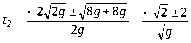
Taking +ve sign 

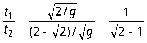 and so on.
Prepare Smarter with CGP Edu
Get practice questions, solutions, and test series in one place.
Write a Review
Share your experience with this question and solution.
Commentary
Send your comment, doubt, correction, or feedback to admin.
Similar Questions
Explore conceptually related problems
A particle moving in a straight line covers half the distance with speed of 3 m/s . The other half …
A particle starts from rest. Its acceleration ( a ) versus time ( t ) is as shown in the figure. Th…
A car accelerates from rest at a constant rate for some time, after which it decelerates at a cons…
A stone dropped from a building of height and it reaches after seconds on earth. From the same bu…
A ball is projected upwards from a height above the surface of the earth with velocity . The time…
A small block slides without friction down an inclined plane starting from rest. Let be the distan…