Published by:
CGP EDU Academic Team
Published on: September 12, 2026
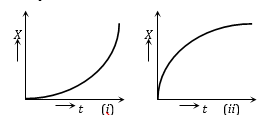
Figures (i) and (ii) below show the displacement-time graphs of two particles moving along the x -axis. We can say that
Text Solution
Verified by ExpertsThe correct answer is:
C
Step 1: Identify the nature of the displacement-time graphs.
In graph (i), the curve is concave upwards, indicating that the velocity of the particle is increasing over time. This is characteristic of uniformly accelerated motion.
Step 2: Analyze graph (ii).
The curve in graph (ii) is also concave but appears to be leveling off. This indicates that the velocity of the particle is decreasing over time, which is characteristic of uniformly retarded motion.
Conclusion:
Therefore, particle (i) exhibits uniformly accelerated motion and particle (ii) exhibits uniformly retarded motion. Therefore, the correct answer is C.
In graph (i), the curve is concave upwards, indicating that the velocity of the particle is increasing over time. This is characteristic of uniformly accelerated motion.
Step 2: Analyze graph (ii).
The curve in graph (ii) is also concave but appears to be leveling off. This indicates that the velocity of the particle is decreasing over time, which is characteristic of uniformly retarded motion.
Conclusion:
Therefore, particle (i) exhibits uniformly accelerated motion and particle (ii) exhibits uniformly retarded motion. Therefore, the correct answer is C.
Prepare Smarter with CGP Edu
Get practice questions, solutions, and test series in one place.
Write a Review
Share your experience with this question and solution.
Commentary
Send your comment, doubt, correction, or feedback to admin.
Similar Questions
Explore conceptually related problems
A particle moving in a straight line covers half the distance with speed of 3 m/s . The other half …
A particle starts from rest. Its acceleration ( a ) versus time ( t ) is as shown in the figure. Th…
A car accelerates from rest at a constant rate \ddot{q} for some time, after which it decelerates a…
A stone dropped from a building of height h and it reaches after t seconds on earth. From the same …
A ball is projected upwards from a height \hat{h} above the surface of the earth with velocity \vec…
A particle is dropped vertically from rest from a height. The time taken by it to fall through succ…