A particle is moving in a straight line and passes through a point () with a velocity of \(6 \, mB^{-1}.\) The particle moves with a constant retardation of \(2 \pi s^{-2}\) for 4 s and there after moves with constant velocity. How long after leaving 0 does the particle return to ()
Text Solution
Verified by ExpertsB
Let the particle moves toward right with velocity 6 m/s. Due to retardation after time t. its velocity becomes zero.
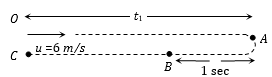
From \(\mathbf{v} = \mathbf{u} - \mathbf{v}t\) ⇒ ⇒ \(0 \quad 6 \cdot 2 \times t_{1}\) ⇒ ⇒ \(\tau_1 \quad 3\ \mathrm{sec}\)
But retardation works on it for 4 sec. It means after reaching point A direction of motion get reversed and acceleration works on the particle for next one second.
\(S_{\alpha} = v_i t_i - \frac{1}{2} a t_i^2\) \(-6 \times 3 - \frac{1}{2} (2)(3)^2 - 18 - 9 - 9m\)
\(s_{ae} = -\frac{1}{2} \times 2 \times (1)^2 - 1m\)
. \(S_x \quad S_{CA} \cdot S_{B2}\) = 9 - 1 \(= 8 \pi\)
Now velocity of the particle at point B in return journey
\(\nu = 0 + 2 \times 1\) \(= 2 \mathrm{m} / \mathrm{s}\)
In return journey from B to C , particle moves with constant velocity 2 m/s to cover the distance 8 m.
Time taken \(= \frac{\text{Distance}}{\text{Velocity}} = \frac{8}{2} = 4 \text{ sec}\)
Total time taken by particle to return at point 0 is ⇒ ⇒ \Gamma = t_{ij} + t_{iB} + t_{Nx} \(= 3 + 1 + 4 = 8 \text{ sec}\) .
Prepare Smarter with CGP Edu
Get practice questions, solutions, and test series in one place.
Write a Review
Share your experience with this question and solution.
Commentary
Send your comment, doubt, correction, or feedback to admin.
Similar Questions
Explore conceptually related problems