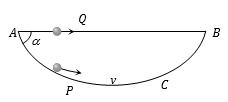
A particle P is sliding down a frictionless hemispherical bowl. It passes the point \Delta A at t = 0 . At this instant of time, the horizontal component of its velocity is v. A bead Q of the same mass as P is ejected from \Delta at t = 0 along the horizontal string AB (see figure) with the speed V . Friction between the bead and the string may be neglected. Let t_p and t_Q be the respective time taken by P and Q to reach the point B . Then
Text Solution
Verified by ExpertsA
For particle P , motion between A and C will be an accelerated one while between C and B a retarded one.
But in any case horizontal component of it’s velocity will be greater than or equal to v on the other hand in case of particle Q , it is always equal to v . horizontal displacement of both the particles are equal, so t_{P} < t_{Q} .
Prepare Smarter with CGP Edu
Get practice questions, solutions, and test series in one place.
Write a Review
Share your experience with this question and solution.
Commentary
Send your comment, doubt, correction, or feedback to admin.
Similar Questions
Explore conceptually related problems