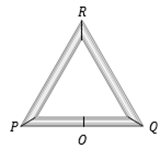
Three rods of equal length l are joined to form an equilateral triangle PQR. O is the midpoint of PQ. Distance OR remains same for small change in temperature. Coefficient of linear expansion for PR and RQ is same i.e.  but that for PQ is
  . Then
A

B

C

D

Text Solution
Verified by ExpertsThe correct answer is:
D



Neglecting  and
and 

Prepare Smarter with CGP Edu
Get practice questions, solutions, and test series in one place.
Write a Review
Share your experience with this question and solution.
Commentary
Send your comment, doubt, correction, or feedback to admin.
Similar Questions
Explore conceptually related problems
A glass flask is filled up to a mark with 50 cc of mercury at 18ºC. If the flask and contents are h…
Solids expand on heating because
An iron tyre is to be fitted on to a wooden wheel 1m in diameter. The diameter of tyre is 6 mm smal…
A glass flask of volume one liter at 0°C is filled, level full of mercury at this temperature. The …
A steel scale measures the length of a copper wire as when both are at (the calibration temperatu…
Two metal strips that constitute a thermostat must necessarily differ in their