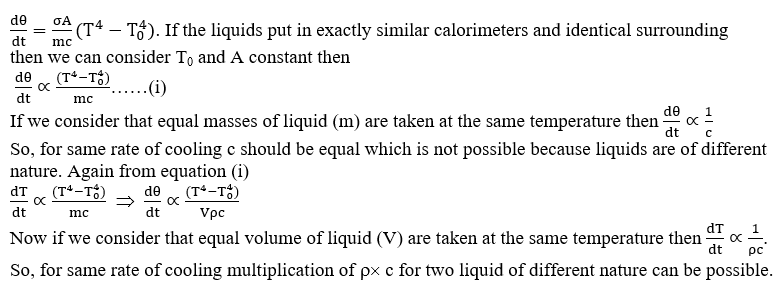
The rates of cooling of two different liquids put in exactly similar calorimeters and kept in identical surroundings are the same if
Text Solution
Verified by ExpertsThe correct answer is:
D
Prepare Smarter with CGP Edu
Get practice questions, solutions, and test series in one place.
Write a Review
Share your experience with this question and solution.
Commentary
Send your comment, doubt, correction, or feedback to admin.
Similar Questions
Explore conceptually related problems
Hot water cools from to in the first 10 minutes and to in the next 10 minutes. The temperature o…
A bucket full of hot water cools from to in time , from to in time and from to in time , t…
Consider two hot bodies and which have temperatures and respectively at . The temperature of t…
Newton's law of cooling is a special case of
Equal masses of two liquids are filled in two similar calorimeters. The rate of cooling will
In Newton's experiment of cooling, the water equivalent of two similar calorimeters is 10 gm each. …