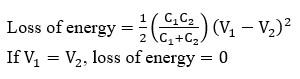
Two capacitors of capacities  and
and  are charged to voltages
  and
and  respectively. There will be no exchange of energy in connecting them in parallel, if
A

B

C

D

Text Solution
Verified by ExpertsThe correct answer is:
C
Prepare Smarter with CGP Edu
Get practice questions, solutions, and test series in one place.
Write a Review
Share your experience with this question and solution.
Commentary
Send your comment, doubt, correction, or feedback to admin.
Similar Questions
Explore conceptually related problems
Two identical capacitors are joined in parallel, charged to a potential V and then separated and th…
The condensers of capacity and are connected in parallel, then the equivalent capacitance is
A parallel plate capacitor is made by stacking n equally spaced plates connected alternately. If th…
Seven capacitors each of capacity are to be so connected to have a total capacity . Which will be…
The capacitor of capacitance and are connected in series. A potential difference of applied to t…
A parallel plate capacitor with air as medium between the plates has a capacitance of . The area o…