Published by:
CGP EDU Academic Team
Published on: September 12, 2026
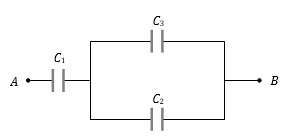
The combination of capacitors with

and
is charged by connecting AB to a battery. Consider the following statements
(I) Energy stored in

= Energy stored in
+ Energy stored in 
(II) Charge on C 1 = Charge on C 2 + Charge on C 3
(III) Potential drop across C 1 = Potential drop across C 2 = Potential drop across C 3
Which of these is/are correct
Text Solution
Verified by ExpertsThe correct answer is:
A
Step 1: Analyze the given combinations of capacitors.
Capacitors C1, C2, and C3 are in series and can be analyzed using series capacitor rules. In a series configuration, the charge is the same for all capacitors.
Step 2: Evaluate Statement I.
Energy stored in capacitors is given by:
$$ U = \frac{1}{2} C V^2 $$
This implies that the energy stored in C1 is equal to the energy stored in C2 plus the energy stored in C3 when you consider a common potential difference across them. Hence, Statement I is correct.
Step 3: Evaluate Statement II.
Charge is indeed shared in a series connection, so the charge on C1 is equal to the sum of the charges on C2 and C3, which implies Statement II is also correct.
Step 4: Evaluate Statement III.
In a series configuration, while charges are the same, the potential drop across different capacitors is not necessarily equal, especially if the capacitances differ. Therefore, Statement III is incorrect.
Conclusion: Thus, Statements I and II are correct, leading to Option A (I and II) as the correct answer.
Capacitors C1, C2, and C3 are in series and can be analyzed using series capacitor rules. In a series configuration, the charge is the same for all capacitors.
Step 2: Evaluate Statement I.
Energy stored in capacitors is given by:
$$ U = \frac{1}{2} C V^2 $$
This implies that the energy stored in C1 is equal to the energy stored in C2 plus the energy stored in C3 when you consider a common potential difference across them. Hence, Statement I is correct.
Step 3: Evaluate Statement II.
Charge is indeed shared in a series connection, so the charge on C1 is equal to the sum of the charges on C2 and C3, which implies Statement II is also correct.
Step 4: Evaluate Statement III.
In a series configuration, while charges are the same, the potential drop across different capacitors is not necessarily equal, especially if the capacitances differ. Therefore, Statement III is incorrect.
Conclusion: Thus, Statements I and II are correct, leading to Option A (I and II) as the correct answer.
Prepare Smarter with CGP Edu
Get practice questions, solutions, and test series in one place.
Write a Review
Share your experience with this question and solution.
Commentary
Send your comment, doubt, correction, or feedback to admin.
Similar Questions
Explore conceptually related problems
Two identical capacitors are joined in parallel, charged to a potential V and then separated and th…
The condensers of capacity $C_{1}$ and $C_2$ are connected in parallel, then the equivalent capacit…
A parallel plate capacitor is made by stacking n equally spaced plates connected alternately. If th…
Seven capacitors each of capacity $2 \mu F$ are to be so connected to have a total capacity $\frac{…
The capacitor of capacitance $4 \mu \mathbf{F}$ and $6 \mu F$ are connected in series. A potential …
A parallel plate capacitor with air as medium between the plates has a capacitance of $10 \mu \math…