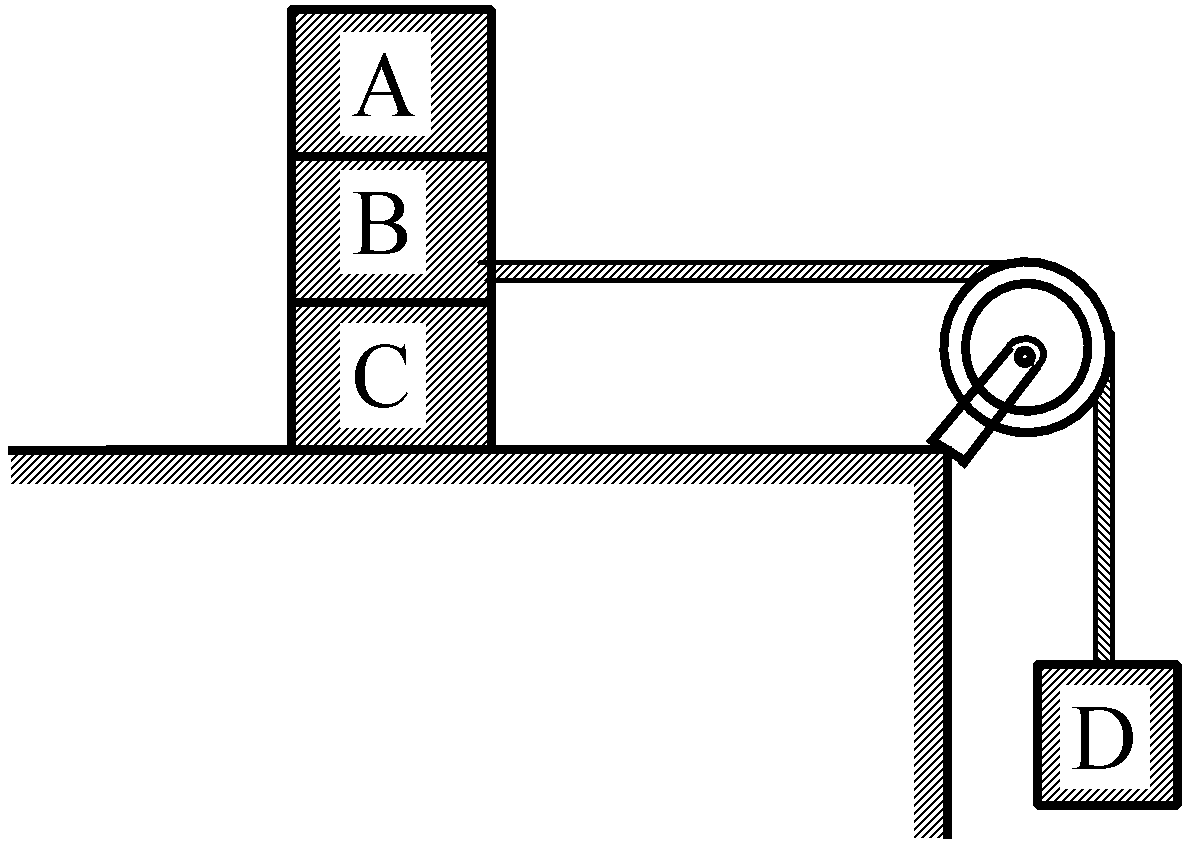
Three blocks A, B and C of equal mass m are placed one over the other on a smooth horizontal ground as shown in figure. Coefficient of friction between any two blocks of A, B and C is ½. The maximum value of mass of block D so that the blocks A, B and C move without slipping over each other is –
Text Solution
Verified by ExpertsC
Blocks A and C both move due to friction. But less friction is available to A as compared to C because normal reaction between A and B is less. Maximum friction between A and B can be:
f max = µ m A g =  mg
mg
 Maximum acceleration of A can be:
a max =  =
= 
further a max = 
or  =
=  or m D = 3m
Prepare Smarter with CGP Edu
Get practice questions, solutions, and test series in one place.
Write a Review
Share your experience with this question and solution.
Commentary
Send your comment, doubt, correction, or feedback to admin.
Similar Questions
Explore conceptually related problems