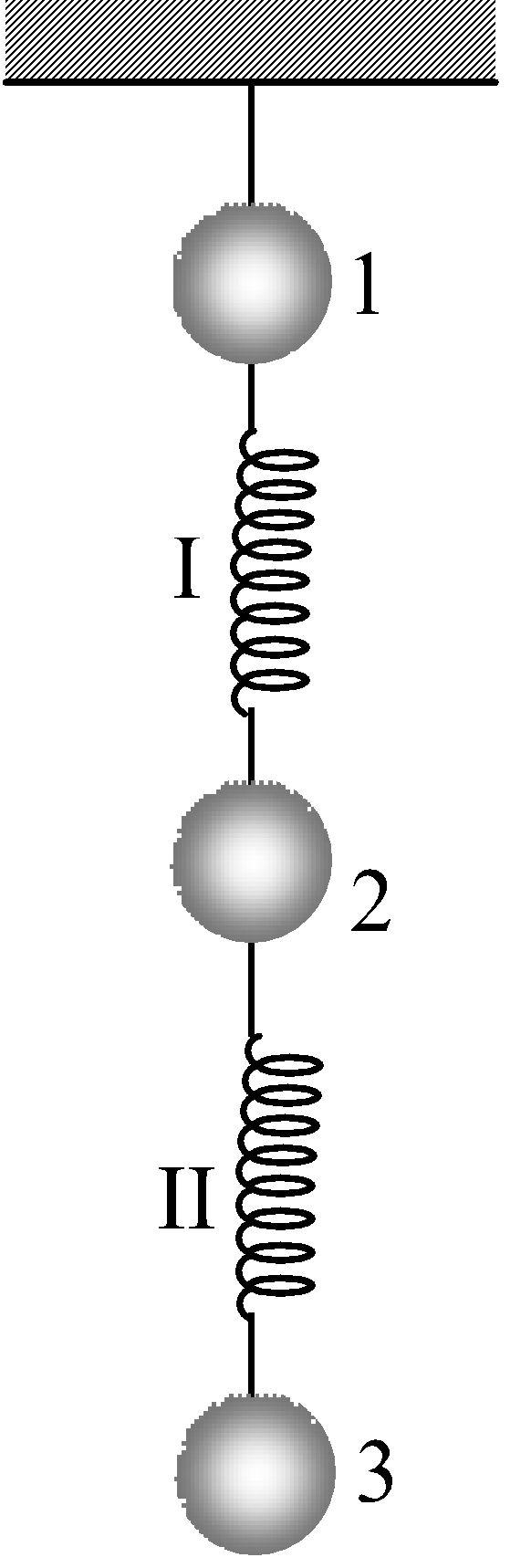
Three balls of equal mass are suspended from a thread and two springs of the same elasticity so that the distances between the first and second ball and the second and third are the same (fig.). Thus, the center of gravity of the whole system coincides with the centre of the second ball. If the thread supporting the top ball be cut, the system will fall and the acceleration of the system's centre of gravity will be  = g
= g
(according to Newton's second law, the acceleration of the centre of gravity of a system equals the sum of the forces acting on the system from outside divided by the system's total mass). But spring I will pull the second ball upwards with greater force than spring II will pull is downwards (the force of spring I at the initial moment f 10 = 2mg, while the force of spring II at the initial moment f 20 = mg) and therefore the centre of the second ball will have, at the initial moment, an acceleration of less than g. And yet the centre of gravity of the whole system must move with an acceleration of g the whole time. Explain the contradiction.
Text Solution
Verified by ExpertsCHECK THE SOLUTION.
Sol. Springs I and II having equal elasticity, act with different forces of 2mg and mg at the initial moment, and yet they have the same length. Thus, when they are not under stress, they must have different lengths. In a free fall, both springs must cease to be deformation will disappear) and since this normal length is not the same for the two springs, the distance between the centre of the first and second ball and the second and third ball will no longer be the same. Thus, the center of the second ball will cease to be the centre of gravity of the system of three balls after the beginning of the fall.
Prepare Smarter with CGP Edu
Get practice questions, solutions, and test series in one place.
Write a Review
Share your experience with this question and solution.
Commentary
Send your comment, doubt, correction, or feedback to admin.
Similar Questions
Explore conceptually related problems