Published by:
CGP EDU Academic Team
Published on: September 12, 2026
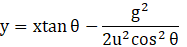
Trajectory of particle in a projectile motion is given as
y = x –
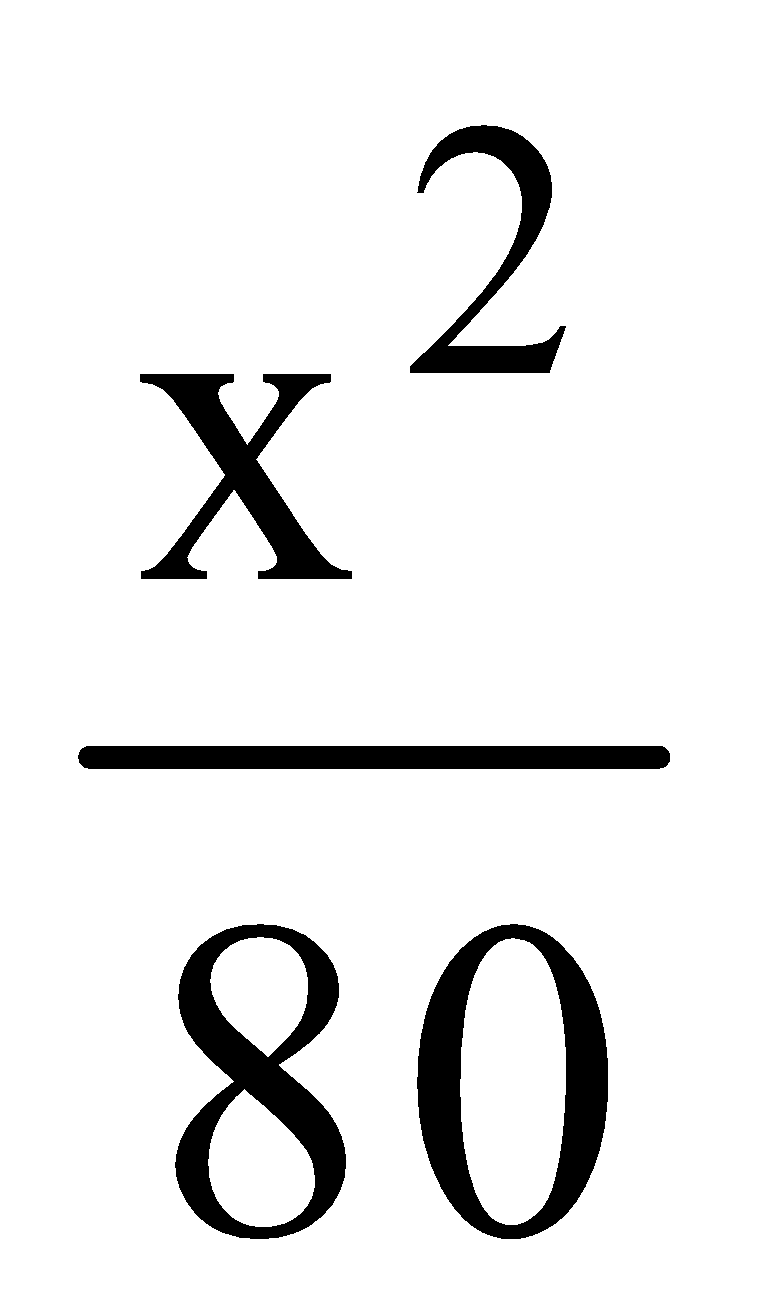
. Here, x and y are in meters. For this projectile motion match the following with g = 10 m/s 2 . x is in horizontal direction and y is in vertical direction.
Column I | Column II |
(i) Angle of projection | [A] 20m |
(ii) Angle of velocity with Horizontal after 4s | [B] 80 m |
(iii) Maximum height | [C] 45º |
(iv) Horizontal range | [D] tan–1(1/2) |
Correct Matrix Matching
Text Solution
Verified by ExpertsThe correct answer is:
C
Step 1: Identify the components of the trajectory equation. The trajectory is given as:
$$y = x - \frac{g}{2v^2} x^2$$
where g = 10 m/s².
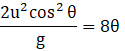
Step 2: The angle of projection ($\theta$) can be determined from the trajectory equation. The equation represents a parabolic motion, where the term for gravity affects how the y-value changes with x. The angle can be derived from the slope at the origin of the parabola – which, if equal to the change in y per change in x, gives you:
$$tan(\theta) = \frac{1}{m}$$ (slope of the initial trajectory). Since m = 2, therefore, the angle is:
$$\theta = tan^{-1}(1/2)$$
which corresponds to option D.
Step 3: Now calculate the angle of velocity after 4 seconds for projectile motion, which involves computing the vertical velocity at that point:
$v_{y} = v_{0y} - gt$ where $g = 10 m/s^2$.
If you visualize this, you would see that at 4 seconds, the angle would need additional calculations based on v0. This needs deeper analysis to find the velocity slope after 4 seconds. Without specific values for v0, we can't numerically compute beyond this point.
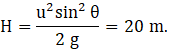
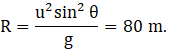
Step 4: Maximum height and trajectory aspects need careful assessments of peak conditions (when vertical velocity becomes zero). Correlate back to horizontal displacement as a function of height for key determinations.
Hence, option C is found to represent the angle of projection. Other aspects require more detailed velocity calculations to confirm their respective alignments.
$$y = x - \frac{g}{2v^2} x^2$$
where g = 10 m/s².
Step 2: The angle of projection ($\theta$) can be determined from the trajectory equation. The equation represents a parabolic motion, where the term for gravity affects how the y-value changes with x. The angle can be derived from the slope at the origin of the parabola – which, if equal to the change in y per change in x, gives you:
$$tan(\theta) = \frac{1}{m}$$ (slope of the initial trajectory). Since m = 2, therefore, the angle is:
$$\theta = tan^{-1}(1/2)$$
which corresponds to option D.
Step 3: Now calculate the angle of velocity after 4 seconds for projectile motion, which involves computing the vertical velocity at that point:
$v_{y} = v_{0y} - gt$ where $g = 10 m/s^2$.
If you visualize this, you would see that at 4 seconds, the angle would need additional calculations based on v0. This needs deeper analysis to find the velocity slope after 4 seconds. Without specific values for v0, we can't numerically compute beyond this point.
Step 4: Maximum height and trajectory aspects need careful assessments of peak conditions (when vertical velocity becomes zero). Correlate back to horizontal displacement as a function of height for key determinations.
Hence, option C is found to represent the angle of projection. Other aspects require more detailed velocity calculations to confirm their respective alignments.
Prepare Smarter with CGP Edu
Get practice questions, solutions, and test series in one place.
Write a Review
Share your experience with this question and solution.
Commentary
Send your comment, doubt, correction, or feedback to admin.
Similar Questions
Explore conceptually related problems
A body of mass \(\pi\pi\) hangs at one end of a string of length l , the other end of which is fixe…
The tension in the string revolving in a vertical circle with a mass m at the end which is at the l…
A stone of mass m is tied to a string and is moved in a vertical circle of radius r making n revolu…
A tube of length l is filled completely with an incompressible liquid of mass \(\mathbf{M}\) and cl…
The kinetic energy k of a particle moving along a circle of radius R depends on the distance covere…
A car is moving in a circular horizontal track of radius 10 m with a constant speed of 10 m/sec . A…