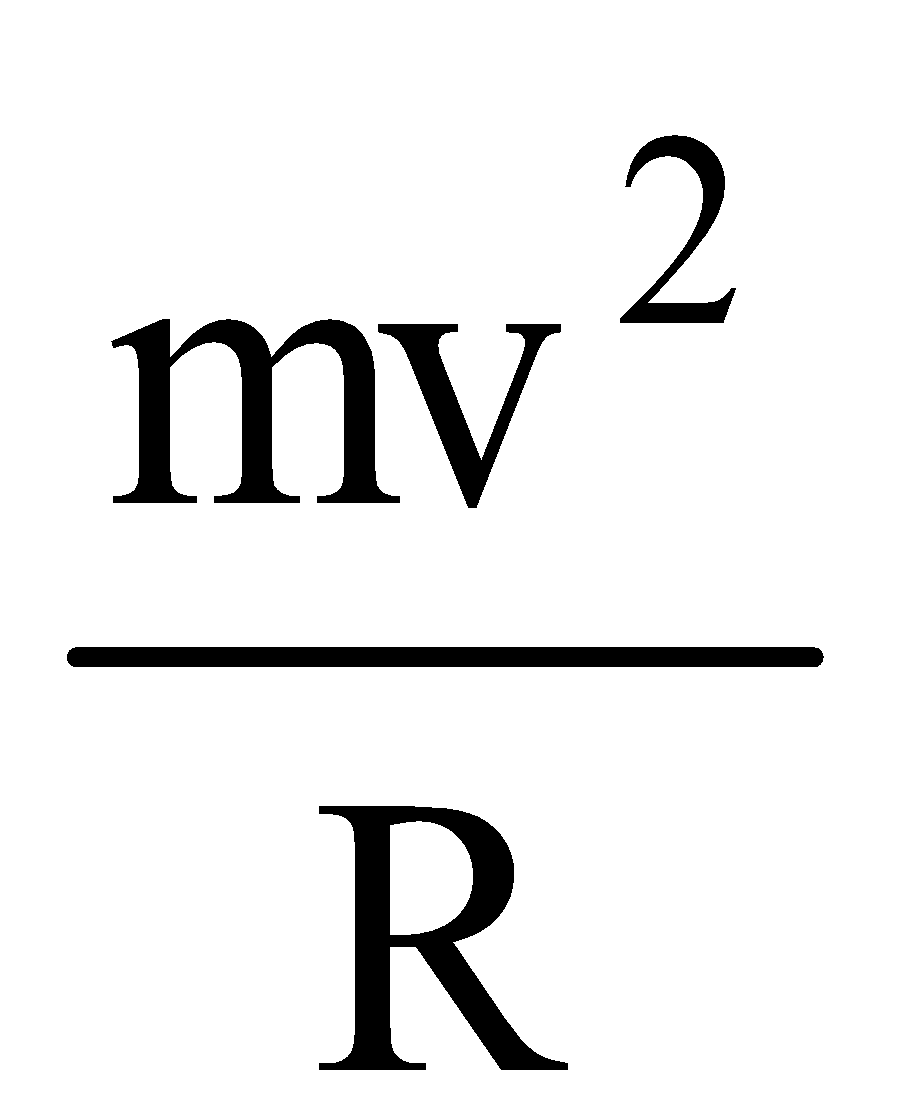
Home Physics Motion in a Plane General A pilot of weight 70kg loops a loop of radiu…
Physics Motion in a Plane General Subjective Type
Published on: September 12, 2026

A pilot of weight 70kg loops a loop of radius 100m in an aero plane flying at 180 km/hr. What is the source of the centripetal force acting on the pilot at the highest and lowest points of the loop? On what is the centrifugal force acting at these points? And with what force is the pilot pressed to his seat at the highest and lowest points of the loop?

Share this question

For Instagram sharing, use “Apps” on mobile or copy the link.

Text Solution

Verified by Experts
The correct answer is:
A
Step 1: Determine the centripetal force requirements.
To keep the pilot in circular motion at the highest and lowest points of the loop, we need to calculate the required centripetal force.

First, we convert the speed from km/hr to m/s:
$$ 180 ext{ km/hr} = rac{180 imes 1000}{3600} = 50 ext{ m/s} $$

Next, we calculate the centripetal acceleration ($a_c$) using the formula:
$$ a_c = \frac{v^2}{r} $$
where $v$ is the speed and $r$ is the radius of the loop.
Plugging in the values:
$$ a_c = \frac{50^2}{100} = \frac{2500}{100} = 25 ext{ m/s}^2 $$

Step 2: Calculate the gravitational force acting on the pilot.
The weight of the pilot (force due to gravity) is given by:
$$ F_g = m imes g $$
where $m = 70 ext{ kg}$ and $g = 9.8 ext{ m/s}^2$ (acceleration due to gravity).
So, we can calculate:
$$ F_g = 70 imes 9.8 = 686 ext{ N} $$

Step 3: Analyze forces at the highest and lowest points of the loop.
  • At the highest point:
    At this point, the gravitational force acts downwards and must provide the necessary centripetal force along with the tension in the seatbelt (if any). The net centripetal force required is:
    $$ F_c = \frac{mv^2}{r} = 70 imes 25 = 1750 ext{ N} $$
    Thus the total vertical forces at the top:
    $$ F_g + T = F_c $$
    This means:
    $$ 686 + T = 1750 $$
    Therefore,
    $$ T = 1750 - 686 = 1064 ext{ N} $$
  • At the lowest point:
    At this point, the gravitational force acts downwards but the centripetal force required must overcome gravity. Thus:
    $$ T - F_g = F_c $$
    So,
    $$ T - 686 = 1750 $$
    Therefore,
    $$ T = 1750 + 686 = 2436 ext{ N} $$

Step 4: Identify the sources of centripetal force and centrifugal force.
At both points, the centripetal force is provided by the pilot's weight and tension in the seatbelt (if applicable). Centrifugal force is a fictitious force perceived in a rotating frame, acting outward away from the center.

Summary:
- At the highest point, the pilot feels a net force of 1064 N pressing him into the seat.
- At the lowest point, he feels a much greater force of 2436 N pressing him into the seat.
Thus, the sources of the centripetal force are a combination of gravitational and potentially additional forces due to the plane's design.

Prepare Smarter with CGP Edu

Get practice questions, solutions, and test series in one place.

Write a Review

Share your experience with this question and solution.

Commentary

Send your comment, doubt, correction, or feedback to admin.

Student Reviews

What students say about this solution

No reviews yet. Be the first to write a review.

Similar Questions

Explore conceptually related problems

CG
CGP Question Assistant Question Bank + AI Help
Hi! Type your question or upload one screenshot. First I will search related questions from CGP Edu Question Bank. If none match, type YES and I will solve it with AI.
Upload only one screenshot at a time. Flow: Question Bank first → If not matched, type YES for AI solution.