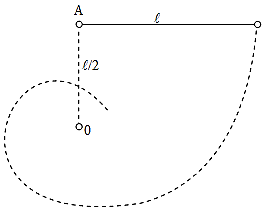
A small ball is suspended from point A by a thread of length  A nail is driven into the wall at a distance of
  /2 below A, at O. The ball is drawn aside so that the thread takes up a horizontal position (fig.) At what point in the ball’s trajectory will the tension in the thread disappear? How much farther will the ball move. What will be the highest point to which it will rise? At what point will the ball pass through the vertical line passing through the point of suspension?
Text Solution
Verified by ExpertsCHECK THE SOLUTION.
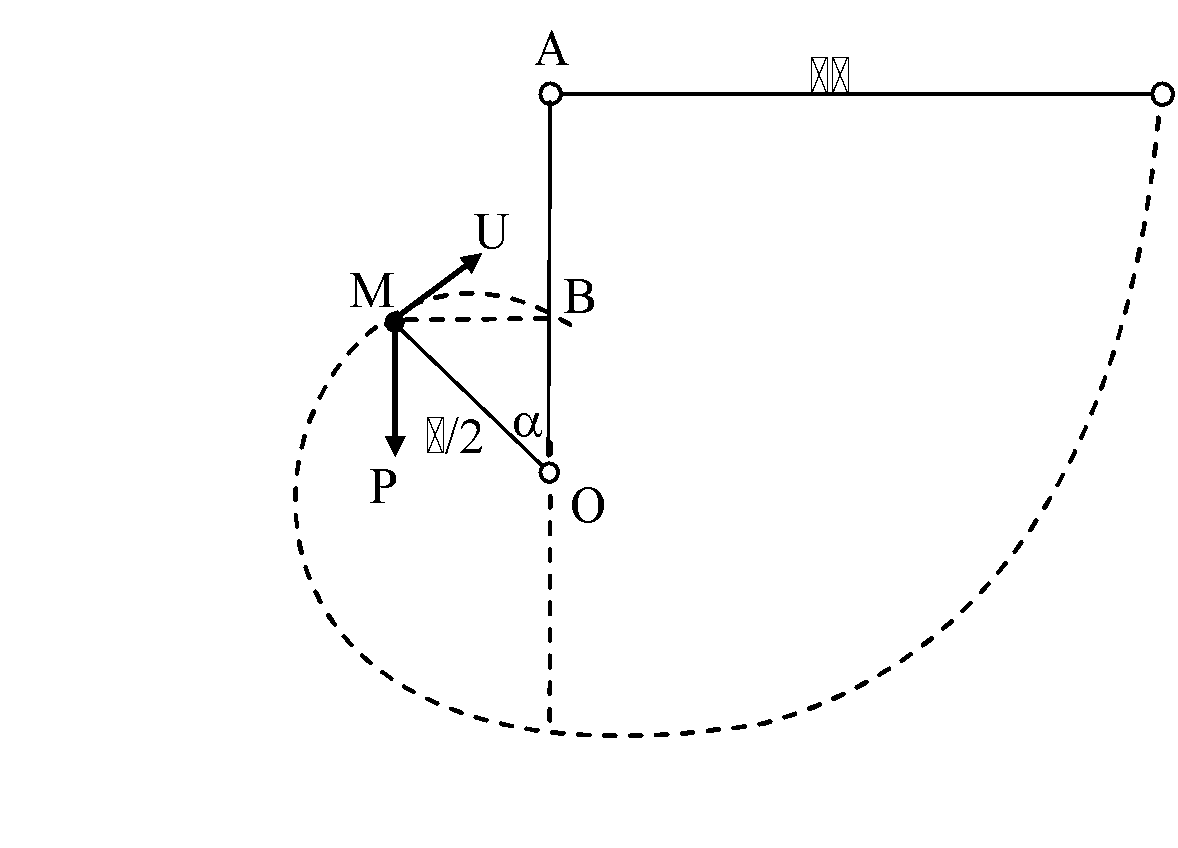
Sol. The ball first of all describes a quadrant of a circle of radius equal to the length λ of the thread. Then the thread touches the nail O, which was driven into the wall, and the ball describes an arc of a circle of radius twice as small as the previous one. Finally, when the weight of the ball gives it the centripetal force necessary to motion in a circle, the tension in the thread will be reduced to zero. Let this happen at point M (fig.) We can find this point’s position in the following manner. The component of the ball’s weight acting along the line of the radius equals P cos α , where α is the angle made by the thread at that moment. Further, at point M, v 2 equals 2gh, where H=AB=AO– BO = λ /2 – λ cos α /2. Therefore the centripetal force at point M equals
 =
=  = 2P (1–cos α ).
Thus at point M we have the equation P cos α = 2P (1 – cos α ), from which cos α = 2/3. The ball continues its path just as a body thrown at an angle of α to the horizontal with an initial velocity v =  . In this case, the highest point of the parabola lies above the point of throwing at a distance of
  =
=  .
.
The vertical line which passes through the point of suspension lies at a distance from M of MB =  =
=  .
.
To travel this distance horizontally the ball will require time t =  =
=  .
.  .
.
During this time the ball will travel, in height, a distance of v sin α t –  =
=  ,
,
i.e. it will cut the vertical line AO at a point lying 5 λ /96 below point B.
Prepare Smarter with CGP Edu
Get practice questions, solutions, and test series in one place.
Write a Review
Share your experience with this question and solution.
Commentary
Send your comment, doubt, correction, or feedback to admin.
Similar Questions
Explore conceptually related problems