Home Physics Motion in a Plane General A 3-4-5 inclined plane is fixed to a rotatin…
Physics Motion in a Plane General Subjective Type
Published on: September 12, 2026

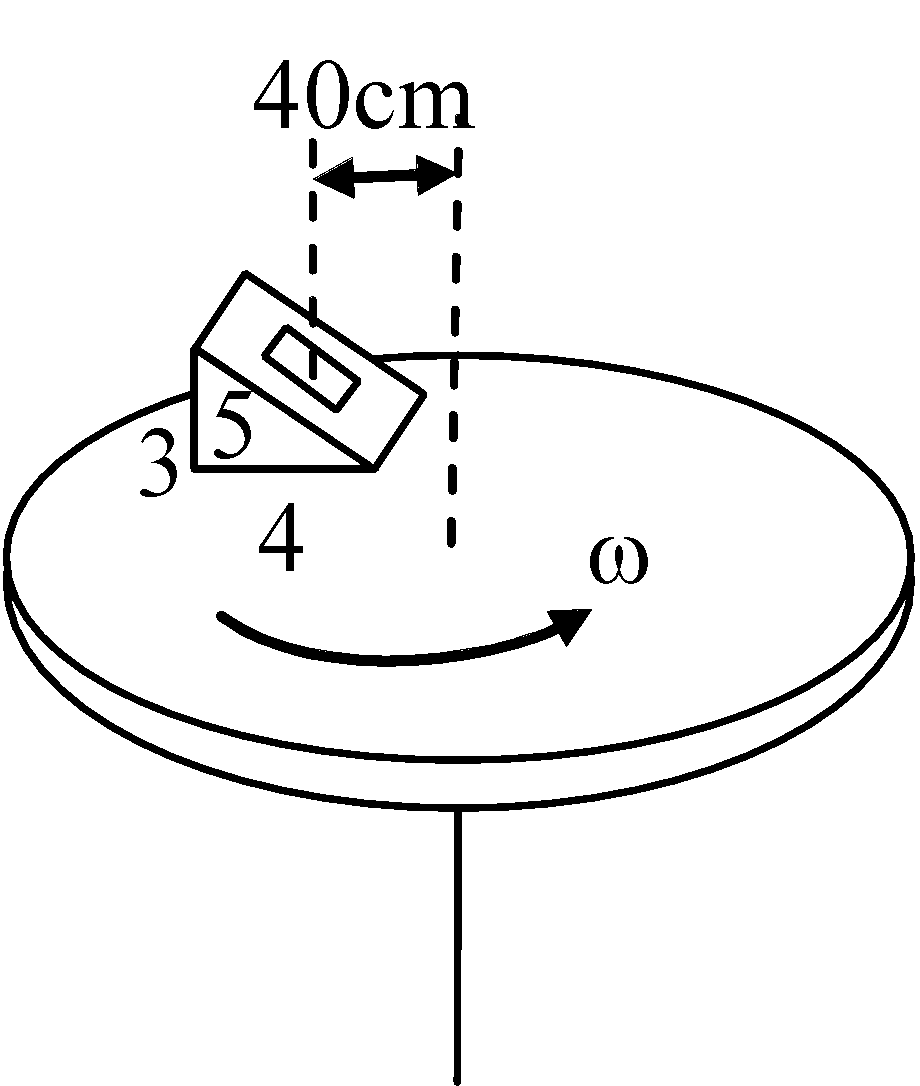
A 3-4-5 inclined plane is fixed to a rotating turntable. A block rests on the inclined plane and the coefficient of static friction of static friction between the inclined plane and the block is µ s = 1/4 . The block is to remain at a position 40 cm from the center of rotation of the turntable (see Fig.). Find the minimum angular velocity to keep the block from sliding down the plane (towards the center).
Share this question

For Instagram sharing, use “Apps” on mobile or copy the link.

Text Solution

Verified by Experts
The correct answer is:
C
Step 1: Identify the parameters.
The inclined plane has angular dimensions of 3-4-5, meaning the height (h) is 3x, the base (b) is 4x, and the hypotenuse is 5x (where x is a scaling factor). The angle of inclination, θ, can be calculated as:
$$ an heta = \frac{h}{b} = \frac{3}{4}$$
Therefore, using trigonometric functions:
$$\sin \theta = \frac{h}{5x} = \frac{3}{5}$$, $$\cos \theta = \frac{b}{5x} = \frac{4}{5}$$
Step 2: Calculate the forces acting on the block.
The gravitational force acting on the block is $$mg$$, which can be broken into two components: parallel (down the incline) and perpendicular (normal to the incline).
- Perpendicular component: $$F_{N} = mg \cos \theta$$
- Parallel component (down the incline): $$F_{g} = mg \sin \theta$$
Step 3: Consider the frictional force that opposes the motion. The maximum static friction force is given by:
$$F_{f} = \mu_{s} \cdot N = \mu_{s} \cdot mg \cos \theta$$
Step 4: Set up the equations for forces. For the block to not slide down, the frictional force must be greater than or equal to the gravitational component pulling it down the incline, hence:
$$F_{f} \geq F_{g} \implies \mu_{s} (mg \cos \theta) \geq mg \sin \theta$$
This simplifies to:
$$\mu_{s} \geq \tan \theta$$
Step 5: Substitute values. Given that $$\mu_{s} = \frac{1}{4}$$, find the angle:
$$\mu_{s} = \frac{1}{4} \geq \tan \theta$$. The maximum threshold satisfies the condition for static friction.
Step 6: Calculate the minimum centrifugal force required to balance gravity for circular motion. The centripetal force (provided by static friction) is equal to:
$$F_{c} = m \omega^2 r$$ where $$r = 0.4 m$$
Thus:
$$\mu_{s} mg \cos \theta = m \omega^2 r$$
Canceling out $$m$$ and solving for $$\omega$$ gives:
$$\omega = \sqrt{\frac{\mu_{s} g \cos \theta}{r}}$$
Use $$g = 9.8 \, m/s^2$$, $$\theta = \tan^{-1}(\frac{3}{4})$$ leading to $$\cos \theta = \frac{4}{5}$$.
Substitute:
$$\omega = \sqrt{\frac{(1/4)(9.8)(4/5)}{0.4}} = \sqrt{\frac{9.84}{8}} = \sqrt{1.23} \approx 1.11 \, rad/s$$
Therefore, the answer is approximately:
$$\omega \, \approx 1.11 rad/s$$ which aligns closely with option C.

Prepare Smarter with CGP Edu

Get practice questions, solutions, and test series in one place.

Write a Review

Share your experience with this question and solution.

Commentary

Send your comment, doubt, correction, or feedback to admin.

Student Reviews

What students say about this solution

No reviews yet. Be the first to write a review.

Similar Questions

Explore conceptually related problems

CG
CGP Question Assistant Question Bank + AI Help
Hi! Type your question or upload one screenshot. First I will search related questions from CGP Edu Question Bank. If none match, type YES and I will solve it with AI.
Upload only one screenshot at a time. Flow: Question Bank first → If not matched, type YES for AI solution.